

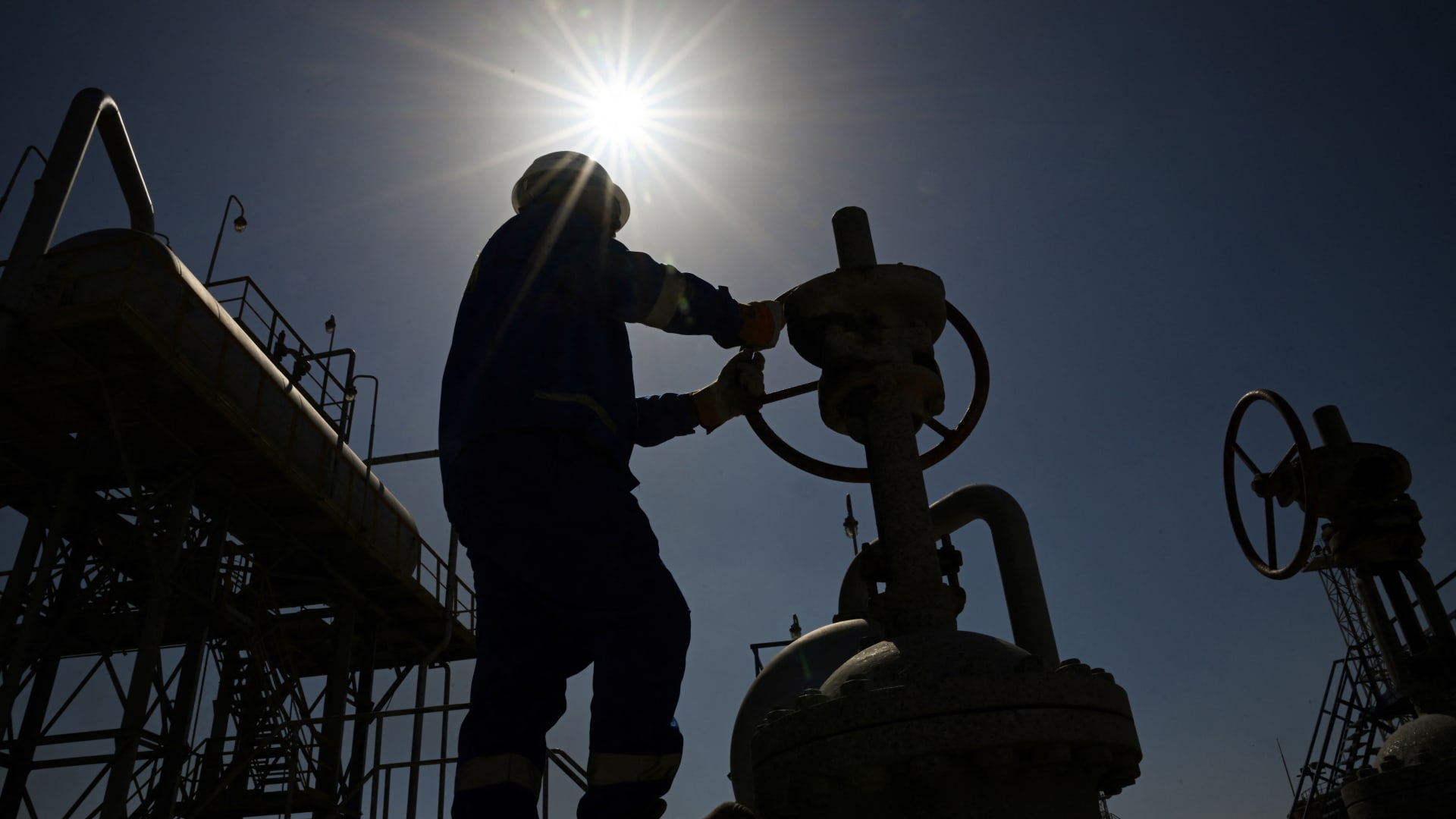
On April 29, 2026, employees of the Basra Oil Company work at the Nahal bin Umar oil and gas field on the outskirts of the southern Iraqi city of Basra.
Hussein Fareh | AFP | Getty Images
Iraq and the United Arab Emirates are fast-tracking plans to expand oil pipelines to make up for capacity lost due to the closure of the Strait of Hormuz, as new data reveals their growing dependence on the Persian Gulf.
Iraq’s cabinet last week approved a plan to accelerate crude oil exports through the Kurdistan-Turkey pipeline network, more than tripling shipments from current 220,000 barrels per day to 770,000 barrels per day.
This route provides an alternative passage through Kurdistan to Türkiye’s Mediterranean port of Ceyhan. When fully operational, it should provide relief to Iraq’s oil-dependent economy, which accounts for 53% of real GDP in 2025, according to the World Bank.
Exclusive data shown to CNBC by economic information provider QuantCube Technology reveals that Iraq’s overall exports have virtually dried up since the start of the war as a result of its geographic dependence on Hormuz.
QuantCube’s metrics measure the deadweight tonnage departing ports in Iraq and the UAE, providing an estimate of the cargo weight carried by a vessel.
“Iraq is in an even more complicated situation because we know that most, if not all, of Iraq’s oil passes through Hormuz,” Alan Rumannen, senior economist at QuantCube, said in an interview with CNBC.
Iraq announced at a press conference on May 16 that it exported 10 million barrels of crude oil through the Strait of Hormuz in April, down from 93 million barrels before the war.
Meanwhile, Abu Dhabi is rushing to build a new east-west pipeline to Fujairah, with a view to expanding its oil export capacity and bypassing the Strait of Hormuz choke point.
The project is expected to be operational in 2027 and will double the export capacity of Abu Dhabi National Oil Company (ADNOC).
Abu Dhabi’s Crown Prince Sheikh Khalid bin Mohammed bin Zayed Al Nahyan on May 15 called for the early construction of the pipeline to meet growing global energy demand.
The impact of the Hormuz closure will be mitigated as the UAE can continue to export oil through other terminals.
“It is clear that Iraq is in a much more complex situation than the UAE or Saudi Arabia due to its location and the impossibility of rerouting,” Lehmannen added.
“The UAE still has a terminal in Fujairah. Even though it was damaged in the war, it still has the infrastructure and ships to theoretically export large amounts of oil.”
But even existing alternatives are at risk. In April, Saudi Arabia’s East-West Pipeline was attacked by Iran, and Fujairah was also attacked by Iranian drones, disrupting oil loading operations at crude oil export terminals.
The East-West Pipeline, which connects processing facilities near the Persian Gulf to export hubs in the Red Sea, and the UAE pipeline to the port of Fujairah are estimated to have a combined available capacity of 3.5 million to 5.5 million barrels per day (mb/d), the IEA said, while Saudi Arabia announced in March that the pipeline was pumping 7 mb/d.
However, the flow rate still falls short of the approximately 20 million barrels of oil and petroleum products that passed through the Strait of Hormuz every day before the war.
Developing alternative export routes requires time as well as huge investments in infrastructure. When pipelines pass through multiple regions, cross-border agreements are often required.
Ship traffic through Hormuz remains well below pre-war levels. Traffic through the sea lanes fell to its lowest level during the Iran war in May, according to Lloyd’s List.
Ships stranded in the Gulf are at risk of attack by Iranian forces unless they receive Iranian government approval to take designated routes through Hormuz. Cooperation with Iran also risks sanctions from the United States.
—CNBC’s Emma Graham, Holly Ellyatt and Spencer Kimball also contributed to this report.
