

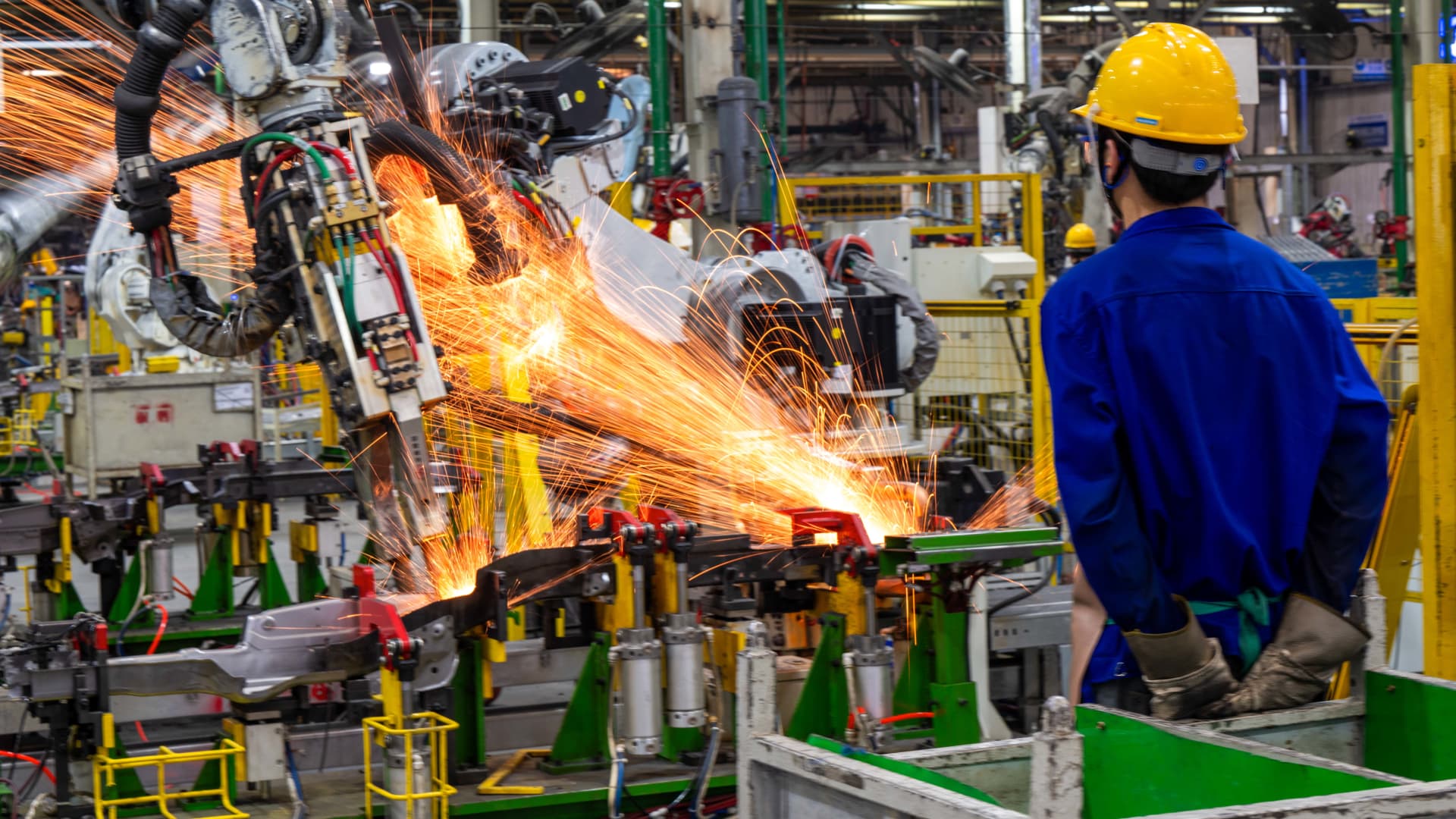
LIUZHOU, CHINA – JULY 25: A robot arm assembles auto parts at the factory of Guangxi Liuzhou Zhuotong Auto Parts Co., Ltd. in Liuzhou, Guangxi Zhuang Autonomous Region, China, on July 25, 2026.
He Huawen | Visual China Group | Getty Images
China’s industrial profits rose 15.1% in June from a year earlier, slowing for the second straight month as easing energy prices capped price increases that had driven this year’s recovery, data released by the National Bureau of Statistics on Monday showed.
After May’s 21.1% rise was the first slowdown since November, June’s numbers extend the slowdown by two months.
Profits rose 18.7% in the first half of this year, slowing from the 18.8% pace recorded in the first half of the year.
Industrial companies’ profits have seen a notable turnaround this year, moving from barely positive growth in 2025 to double-digit growth, as an artificial intelligence-driven chip and equipment manufacturing boom coincided with the end of nearly three years of factory-gate deflation.
Strong year-on-year growth also contributed to the recovery in profits. Profits fell by 3.6% in June last year and by 2.8% in the first half of 2025.
Factory gate prices in the second quarter also rose 3.6% year-on-year, marking the first positive turn since late 2022.
Economists say the reflation boost looks fragile because much of the price recovery has been driven by rising global energy costs while domestic demand has lagged.
Producer prices fell 0.3% month-on-month in June, the first decline since July 2025, as prices for oil, refined fuels and petrochemicals fell due to the normalization of tanker transit through the Strait of Hormuz, according to LSEG data.
Investors will now turn their attention to the Communist Party’s Politburo meeting, which is traditionally held in late July. There, top leaders will review first-half performance and set policy direction for the rest of the year.
Economists expect stronger easing measures after the second quarter’s slowdown, but hopes for a major stimulus remain low as Beijing refrains from stronger action as it focuses on export resilience and reining in excess factory capacity.
“The Politburo is likely to give policy support a little more urgency and prioritize faster fiscal deployment,” said Robin Xin, chief China economist at Morgan Stanley, setting the standard for “gradual policy tightening rather than one-off stimulus.”
“Growth should remain resilient despite lagging domestic demand, thanks to exports,” Singh said, citing an AI-driven investment cycle in which China is a major hardware supplier and a broader industrial capital investment supercycle in Asia currently unfolding.
