

mexico city —
While many countries may claim to be the most passionate about soccer, only Mexico is recognized globally for popularizing one of the sport’s most beloved rituals: The Wave.
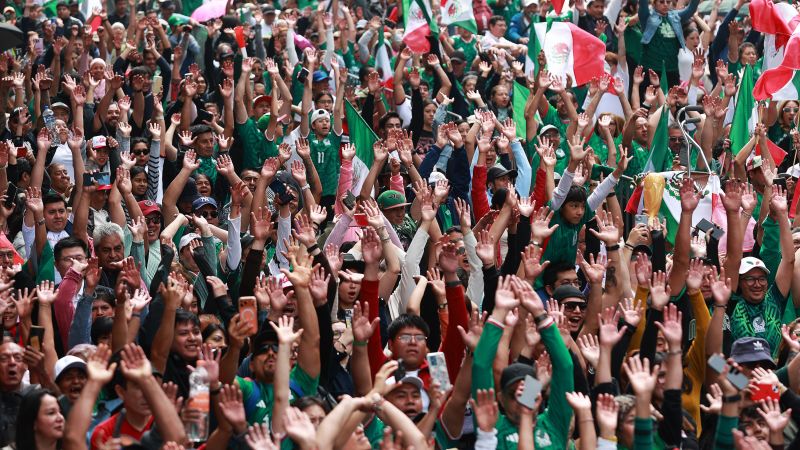
It’s been nearly 40 years since Mexico made the move famous at the 1986 World Cup, and local officials said the country just set a new record for the “world’s biggest wave” just days before the 2026 World Cup. After several practice runs on Saturday, thousands of people swayed in unison for a few minutes along Mexico City’s long Paseo de la Reforma.
CNN has contacted Guinness World Records for confirmation.
The wave is one of many rituals synonymous with Mexican soccer culture, and will be a big part of the experience for the tens of thousands of international visitors who will attend the 13 games in Mexico.
Fans say soccer in Mexico is more of a celebration than a competition.
“It’s like having a party at home and inviting your friends. Now it’s our turn to be the organizers,” said Christian, who watched the Mexico vs. Serbia friendly match in Toluca on Thursday.
One week before the opening World Cup, Toluca Stadium was already buzzing with excitement for Mexico vs. South Africa in Mexico City on June 11th. Drums, horns, and cumbia music (a danceable genre featuring powerful brass instruments and accordions) played nonstop, effectively turning the arena into a giant dance club with cheers of “Ole, Ole, Ole.” Unsurprisingly, a wave of Mexicans hit the stands.
This year’s tournament is also hosted by the United States and Canada, but here’s a closer look at some of the traditions that make Mexico the center of the party.

Today, the wave, a ritual performed at sporting events around the world, owes much of its fame to Mexico, even though it was not invented there.
The exact origins of this wave are debated, but many believe it began in the United States in the late 1970s or early 1980s and spread throughout North America. Years later, Mexican fans performed the song at the 1986 World Cup, helping to popularize it on a global scale. At this time, millions of international audiences were exposed to the wave for the first time, which led many outside of North America to refer to it as the “Mexican Wave.”
Since then, this ritual has become so accepted in Mexico that some Mexicans consider it a symbol of their culture.
Fernando Vizcaino, an expert on Mexican nationalism, says when Mexicans wave, they collectively represent their homeland.
“There’s no ball there, there’s no[fans]on the field, there’s no goal, and strictly speaking there are no players involved, but that movement, that wave, that series of ripples represents Mexico,” said Vizcaino, a researcher at the National Autonomous University of Mexico (UNAM).
The Mexico City Tourism Board says the wave has changed the way the sport is experienced and has become a “universal symbol of joy, brotherhood and euphoria.”

music, chants, noise
That joy comes from the concert-like atmosphere of a Mexican soccer stadium.
Chants, cheers, and songs are synonymous with soccer matches around the world, but the voices heard in Mexico are vibrant, heartfelt, and constant.
“Trust me, with any genre of music, people start partying right away,” said Gabriela, operations coordinator for an auto parts store that was selling merchandise outside Toluca’s main stadium on Thursday.
“So especially bandas, corridos and grupera,” she added, citing other Mexican music genres.
Often mixed in with the beat are noisemakers like the matraca (a flag-shaped wooden object that makes a loud rattling sound when spun) and a plastic horn called a corneta that fans use to liven up the game from beginning to end. These instruments may be heard loudly on the streets, but they have been banned at this year’s World Cup in Mexico to prevent excessive noise. Mexican authorities had previously expressed concern that it could be used as a weapon by unruly fans.

In terms of support, “Tikiti Bum” is one of the most symbolic of this country. Popularized in beer commercials during the 1986 World Cup, it was used to motivate the team with its repeated (albeit gibberish) syllables and upbeat ending.
But not all chants are celebratory. FIFA previously fined the Mexican Football Federation for using slurs and offensive chants, and the federation launched an advertising campaign to stop them.
One of the most criticized uses a four-letter word that is widely considered to be homophobic. UNAM’s Vizcaino said: “This definitely has a chauvinistic connotation, and on the one hand it refers to the repeated entrenchment of traditional masculinity, which is very characteristic of the majority of Mexican culture.”
Away from the stadium, Mexican sports bars and restaurants host lively viewing parties, known in Spanish as partidos en cantinas.
Here, people cheer on their teams while enjoying the food and drinks Mexico is famous for, including locally brewed beer, delicious tacos with lime and salsa, and spicy botanas (snacks) to share with friends and family.

Among the most famous is Salon Corona, a restaurant and brewery in Mexico City’s historic center. For decades, it has hosted fans, celebrities and politicians during major matches, from World Cups to national championships.
“In the Mexican league final between Pumas and Cruz Azul, people were cheering, waving flags and waving,” said coach Miguel Laguna.
Mexicans say that when a match is being held, there is always a festive atmosphere, whether in the bar, at home or at the stadium.
“The truth is, in every World Cup, Mexico always has something to show, right?” Gabriela said after Thursday’s game in Toluca.
“I think in any country, people are always talking about Mexico. Always, always, talking about Mexico. The people, the atmosphere, the music. So I think regardless of the game, people are having fun. I think that’s the important thing.”
