

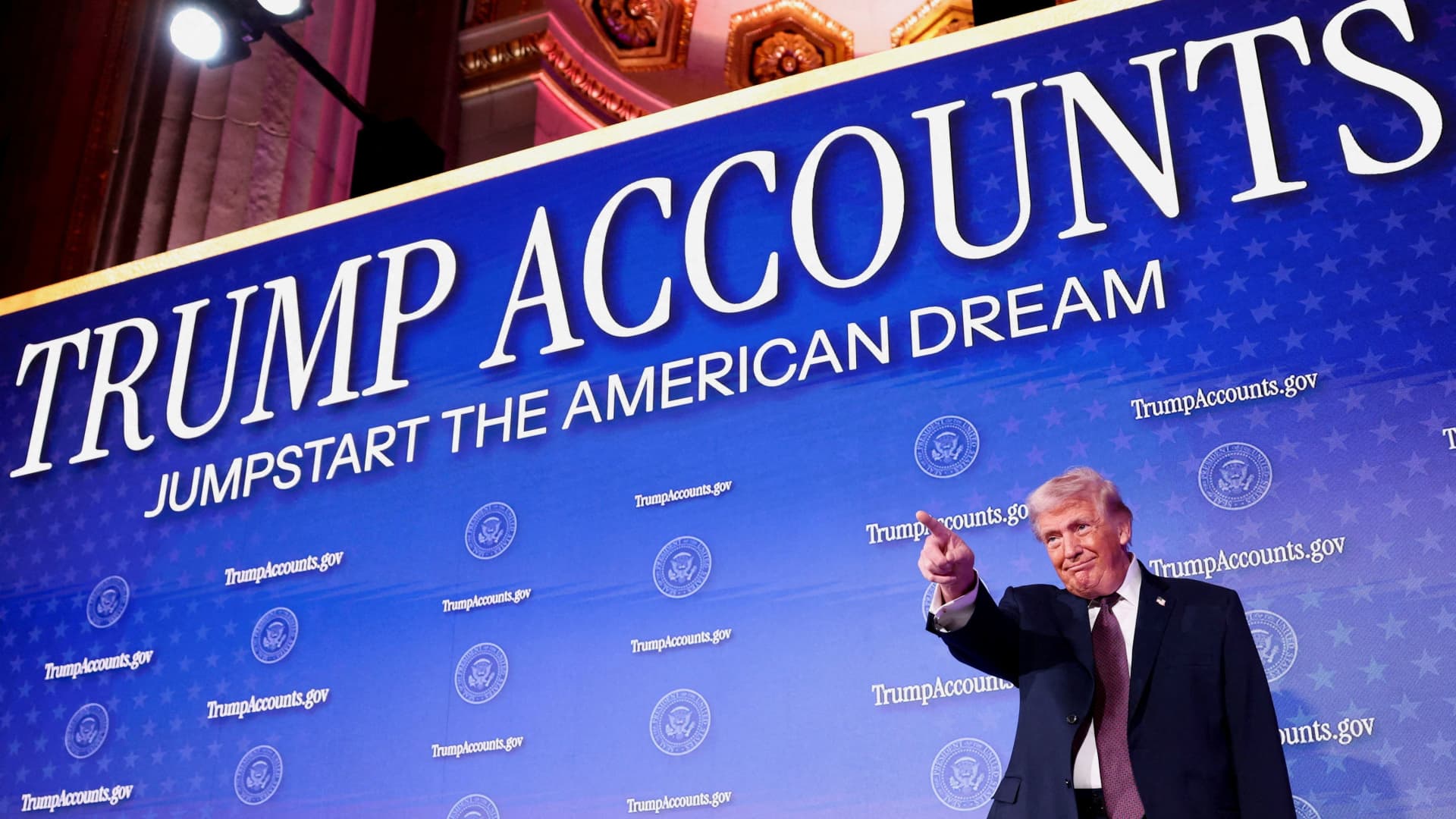

Approximately 6 million children have been registered by families with Trump accounts scheduled to open next month.
For some, claiming an initial grant worth up to $1,000 is appealing. But even children who don’t qualify for “free money” can leverage their accounts with strategies commonly used by older investors to foster future tax-free growth.
The Trump Account, also known as a 530A account, is a new type of tax-advantaged savings and investment account for children that, based on its structure, offers a way for these young investors to build savings into Roth individual retirement accounts, financial planners say.
Experts say Roth IRAs are a powerful savings vehicle, with investment growth and future retirement withdrawals generally tax-free, with some exceptions.
Currently, you can only contribute to a Roth IRA if you have wages, salary, or other income, and children are generally prohibited from having an account.
Experts said Trump’s account would offer another avenue. You can start at a younger age, giving you more time to take advantage of the power of compounding and grow your fund.
“The Trump account creates a legal backdoor into a Roth IRA that doesn’t require the child’s income, something that wasn’t possible before,” said Adam Bergman, a Miami-based tax attorney and founder of IRA Financial.
“Currently, traditional and Roth IRAs are closed to most minors because of their strict requirements for documented earned income,” Bergman said. This is “a meaningful expansion that families haven’t heard about,” he said.
How to tax your Trump account
IRS Form 4547 for the Trump Account, a tax-deferred savings account for growing children, is on display during the Trump Account Tour event in Westlake Village, California on May 29, 2026.
Patrick T. Fallon | AFP | Getty Images
With a few exceptions, most Trump accounts function like personal retirement accounts and can receive contributions from family, friends and employers.
The account, which officially opens on July 4, will likely include a mix of pre-tax and after-tax amounts and be subject to different rules regarding contributions. among them:
Parents, guardians, grandparents, etc. can contribute up to $5,000 per year after taxes until the year before the beneficiary turns 18. These contributions are tax-free upon withdrawal. Employers can also contribute up to $2,500 per year per worker, but this is part of the $5,000 limit and will not be counted as taxable income, the IRS said. Eligible charities and state and local governments may also make donations, but they do not count toward the $5,000 annual limit. The $1,000 in Treasury seed money and charitable donations will be deposited into your account before taxes are paid. According to Treasury guidance, these pre-tax funds are subject to ordinary income taxes upon withdrawal. Similar tax treatment applies to employer matches up to $2,500 per employee and state and local contributions.
The funds in the Trump account grow tax-deferred.
Once your child turns 18, the standard rules for a traditional IRA apply. Withdrawals made before age 59½ are typically subject to income tax and a 10% penalty. There are some exceptions to the penalty, such as down payments for housing and education costs.
Think of them as “retirement accounts first.”
President Donald Trump speaks about the Trump account at the Andrew W. Mellon Auditorium in Washington, Jan. 28, 2026.
Brendan Smialowski AFP | Getty Images
Financial advisors generally recommend that families qualify for an initial $1,000 deposit from the Treasury to open a Trump Account and let the money compound over time.
Jeffrey Levin, a St. Louis-based certified financial planner and certified public accountant, said that beyond getting “free money,” it may not make economic sense to contribute to a Trump account instead of other types of financial accounts that parents might open for their children.
That’s especially true if the Trump account isn’t intended to save for a child’s future retirement, he said.
“Generally speaking, these should be thought of first as retirement accounts and not for any other purpose,” said Levine, chief planning officer at Focus Partners Wealth.
For example, if the majority of your funds are going toward higher education, a 529 college savings plan “has clear advantages in almost all situations,” Levine said. Savings in a 529 plan grow tax-free, and withdrawals for qualified expenses are also tax-free.
How Roth IRA Conversion Works for Trump Accounts
Pro Stock Studio | iStock | Getty Images
There may be another reason to consider a Trump account. That’s for conversion to a Roth Individual Retirement Account.
This strategy involves transferring pre-tax or non-deductible IRA funds held in Trump accounts (seed money, employer matches, charitable contributions, etc.) to a Roth IRA. Instead, your child will have to pay income taxes to turn those funds into Roth savings.
But if done at the right time, the taxes on a Roth conversion are likely to be relatively low, financial planners say.
Financial planners say the timing would likely be early in the account beneficiaries’ careers, between the ages of 18 and their mid-20s, depending on the child’s personal circumstances, when their income and tax rates would almost certainly be lower than they would be later in life.
These should generally be thought of first as retirement accounts rather than for other purposes.
Jeffrey Levin
Certified Financial Planner and Certified Public Accountant based in St. Louis
That way, you can then grow your money tax-free in your Roth account, said Ben Henry Moreland, CFP at advisor platform Kitces.com.
“It can grow into a huge amount of tax-free money by the time you retire,” he said.
Depending on the size of the Roth conversion, the child may not owe federal income taxes as long as the taxable portion is less than the standard deduction, Bergman said. In 2026, the standard deduction for single taxpayers will be $16,100.
Child tax ‘biggest technical risk’
Mini series | E+ | Getty Images
But the Roth conversion strategy could backfire due to a major caveat: the so-called “kid tax” rule.
Cary Sinnett, senior manager of personal financial planning at the International Institute of Certified Public Accountants, said this is the “biggest technical risk” in implementing a Roth conversion strategy.
The so-called “child tax” is an additional tax imposed when a child’s unearned income (such as Roth conversion) exceeds a certain threshold. That threshold currently is $2,700.
Financial planners say such tax measures could be especially economically important for high-income households. If done incorrectly, taxes on a Roth conversion could end up being paid based on the parent’s marginal income tax rate (as high as 37% on the federal side) rather than the child’s.
“It’s going to have a bigger economic impact than they anticipated,” Sinnett said.
Child tax rules can be somewhat complex.
Generally, the child tax always applies to children under the age of 18 with unearned income.
It may apply in certain cases for people between the ages of 18 and 24. For example, if a child is still dependent on a parent’s tax return or is a dependent student of a parent, any unearned income, including Roth conversions, over $2,700 will be taxed at the parent’s tax rate, Henry Moreland said.
“You have to be really careful about when that transformation happens,” Sinnett says. “The safest way to stay out of this problem is to make sure (the child) is over 24, so it won’t be an issue.”
Another factor is how to cover taxes on the converted balance, Henry Moreland said.
“If the owner does not have sufficient funds from outside the account, or if the parent does not agree to pay on their behalf, funds will have to be withdrawn from the account to pay the tax, which will itself be treated as a taxable distribution,” he said. In that case, there will be a 10% early distribution penalty.
That leaves less money in the account that can continue to compound tax-free, making the conversion less attractive as a long-term strategy, Henry Moreland said.
Financial planners say parents may also consider making tax-free gifts to their children to offset their inability to pay their own taxes. The annual gift exclusion for 2026 is $19,000, and this amount is indexed for inflation.
Subscribe to CNBC on YouTube.
