

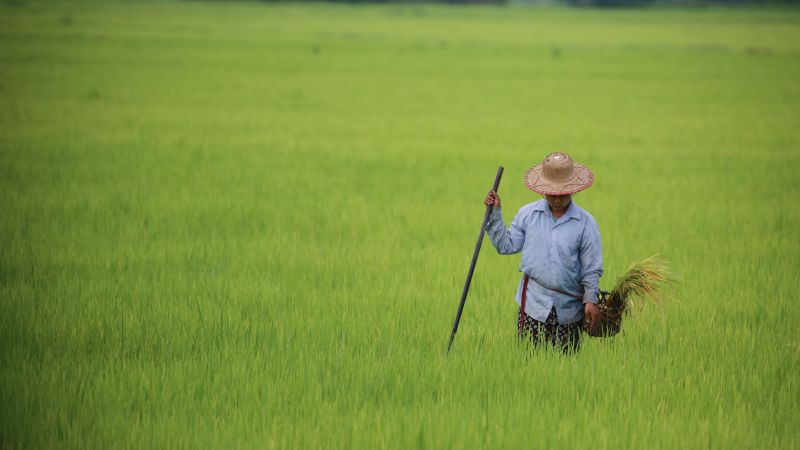
As the rice planting season approaches, Maung Noo Sein needs fuel for tilling and fertilizer to nourish the rice. But the ship carrying his vital cargo is trapped 2,000 miles away as Iran takes control of one of the world’s most important waterways.
Now, farmers are doing the math. Will he be able to survive when fuel and farming costs are higher than the income he earns from selling rice?
“There are many farmers who are abandoning their land because they are struggling with everything,” the 72-year-old told CNN from his home in western Myanmar.
His country had been in a civil war for five years, sparked by a military coup in 2021, before the United States and Israel launched an attack on Iran. The war in Myanmar has displaced millions of people, divided the country into military-controlled and non-military-controlled areas, and destroyed its economy and health system.

Farmers like Maung Noo Sein were already struggling with low rice prices, as well as high fuel and food costs due to the civil war and military blockade of coastal provinces. However, he said the further effects of the Middle East conflict and the closure of the Strait of Hormuz are pushing people in Rakhine state communities into extreme conditions.
“Some people still continue to work some of their land because they need to eat,” he says. “If we completely abandon it, our communities and society as a whole will be ruined because rice is a major food source here in our country.”
Myanmar relies on imports from China, the Middle East and surrounding regions for 90% of its fuel and almost all of its fertilizers to support its agricultural economy.
However, the war with Iran has disrupted the supply of these vital raw materials. Fuel shortages mean it’s more expensive to transport goods, and prices for energy, food, medicine and other basic goods are rising as supplies begin to dwindle.
“The effects of the Middle East wars are having a huge impact here on people who are already affected by civil wars. The situation is even worse,” Maung Noo Sein said.

According to United Nations statistics, a third of marine fertilizers are transported through the Strait of Hormuz, snaking from the hot sandy deserts of the Middle East to the flooded and fertile fields of Asia.
Without it, crops will not grow. Coupled with rising transportation and fuel costs, which are essential for everything from running pumps and irrigation to harvesting and shipping rice to market, farmers may not be able to afford to plant next season’s crops.
Rice is a staple food for much of the population, and most rice cultivation in Myanmar is for domestic use. But its exports, which generated $861 million last year, are also a major source of income and foreign exchange.
World Food Program (WFP) Regional Director for Asia and the Pacific Sameer Wanmali said reduced crop yields are “absolutely important not just for farmers but for the overall food supply in the country”.
“And we are in the agricultural season, approaching the time when the demand for fertilizer is highest, when rice is produced and when water is needed. So for the people of Myanmar, especially the people of Rakhine state, the timing could not be worse.”
Maung Noo Sein said he had to halve the area of land he cultivated since last year due to rising costs.
“It used to cost just $24 to plow a field, but then it went up to $240, then $476. It’s beyond the limit to continue farming,” he says.
“The rice we sell does not even cover the fuel costs, let alone the labor costs.”
As a result, Maung Noo Sein said he is struggling to feed his family of seven and will be forced to borrow money or pledge his assets if the crisis does not improve.
“This war is suffocating us more and more. All we can do is eat half a meal a day and survive this situation,” he said.
Ye Min Aung, chairman of the Myanmar Rice Federation, told CNN that rising prices for fuel, fertilizer and transportation are “putting further pressure on farmers, millers, traders and exporters” of staple crops.
WFP has warned that an additional 45 million people around the world will become severely food insecure if conflicts are not ended by the middle of this year. There are already 12.5 million hungry people in Myanmar, many of them living in remote areas or displaced by the civil war.
Despite the precarious situation, Maung Noo Sein says he is doing better than others. Outside the farm, displaced people can be seen begging for food on the street.
“Many people there are starving,” he says.
Fuel and fertilizer for rice cultivation are just the latest necessities in Rakhine state, which has been devastated by heavy fighting between Myanmar’s military and the Arakan Army (AA), one of the country’s many rebel groups.
The fighting forced Ma Kinh Tan, 46, from her home and is currently taking refuge in a temporary evacuation camp in Myebon.
Tarpaulins have been substituted for roofs and floors in parts of the open field that will be flooded when it starts raining in the coming weeks. Small piles of cooking utensils and clothing are placed in plastic bags or piled on the ground.
Ma Kinh Tan said he was walking along the roads between villages in search of food.
“Sometimes we get rice and cloth, and sometimes we get nothing,” she says.
“We are starving. Our daughters want to go to school, but they can’t. We live like stray dogs or pigs.”
“Yesterday I didn’t have anything to eat. Today I can eat thanks to two cans of rice,” she said. “But we only have rice, so we grind chili peppers and eat them with them.”

Ma Khin Tan’s eldest son’s wife recently gave birth, but she was hospitalized last week because she was not producing enough milk for the baby. “She can’t even afford to feed her milk in a bottle,” Ma Kin Tan said.
Last August, WFP warned of a spike in hunger and “alarming levels of food insecurity” in Rakhine state due to the civil war and military blockade of humanitarian aid and other supplies to the state.
Nine months on, the chaos caused by the Iran war could have devastating consequences for the people of Rakhine state.
“If they do not receive support, poverty levels will rise even further, and the worst-case scenario will be famine-like conditions,” WFP’s Wanmali said.
Ma Kinh Tan said her primary concern was the safety of her two daughters, aged 18 and 13, as the makeshift camp did not have a private place for them to sleep. She says the girls need menstrual products, but the little money they earn from temporary work in the market is spent on feeding their families.

Even people living in Myanmar’s major cities, who have largely escaped the fighting, are feeling the pinch. According to WFP, prices for basic staples such as rice, salt and pulses have increased by about 22% since the start of the Iran war.
“In areas where fuel is nearly inaccessible, we are seeing fuel spikes of up to 30, 40, 50% on average, depending on location,” Wanmari said.
Khin Khin, a mother of two sons who lives in Yangon, Myanmar’s largest city, said her daily cost of living has doubled compared to a year ago.
“With tuition and other prices rising every month, saving is no longer an option,” Kin Kin, who asked to use a pseudonym for security reasons, told CNN by phone. “Most of the time I only cook vegetables because I can’t afford to eat more.”
She says the transportation crisis has thrown her tailoring business into disarray as the cost of yarn and fabric has skyrocketed.
“I can’t buy fabric like I used to. I can’t sew clothes regularly anymore,” she said. “I don’t think the ships are coming as much as they used to. With everything that’s going on, it’s very stifling.”
In Myanmar, where the situation has been exacerbated by the civil war, experts have warned that the blockage of the Strait of Hormuz could reduce rice production across the region, dealing a major blow to food security.

Rice harvests were strong in Asia last year, and “there is plenty of supply on the market,” said Alisher Mirzabayev, senior fellow for policy analysis and climate change at the International Rice Research Institute.
“But that doesn’t mean we should be complacent, because the rice situation is very fragile.”
El Niño is typically expected to bring hot, dry weather to Southeast Asia, which could further impact rice production later this year.
“These multiple and cascading shocks” could “have a significant impact on food security,” Mirzabayev said.
Myanmar’s military-backed government announced last week that efforts are underway to encourage farmers to reduce the use of chemical fertilizers and prioritize natural fertilizers during the monsoon rice season, state media reported.
Maung Nu Sein said farmers like him were “facing insurmountable hardships” but people still depended on them for food.
“No matter how deep the struggle gets, I will continue to work as a farmer. I believe that by doing so, I can help the regions suffering from the war in some small way,” he said.
“If we don’t farm, who will feed us?”
