

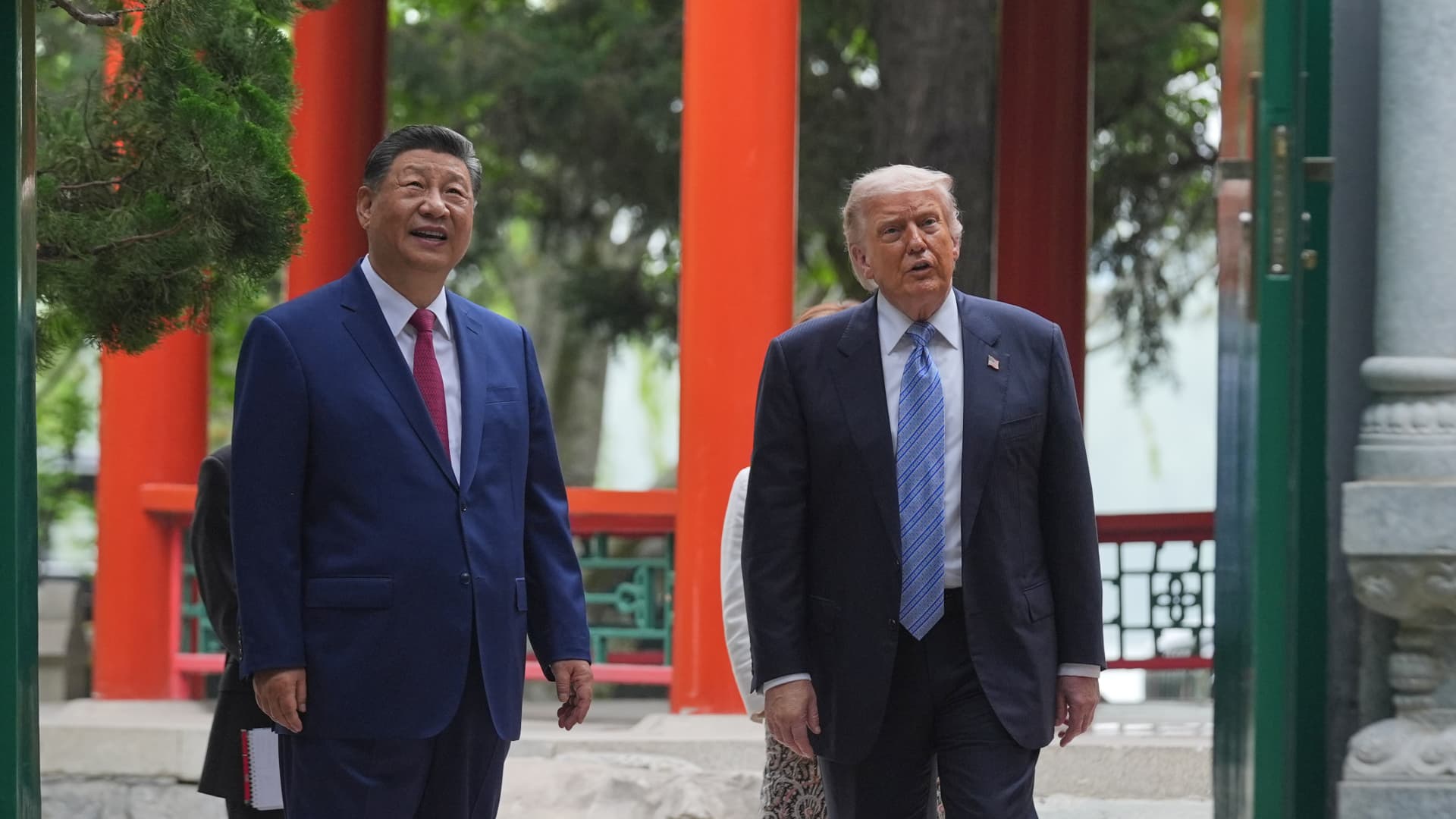
BEIJING, CHINA – MAY 15: U.S. President Donald Trump and Chinese President Xi Jinping visit Zhongnanhai Leadership Center in Beijing, China, May 15, 2026.
Mark Schiefelbein Pool | Getty Images News | Getty Images
U.S. President Donald Trump said China has agreed to buy U.S. crude oil in a prerecorded interview on Fox News that aired Thursday evening, as the two countries aim for concrete trade and business wins at ongoing bilateral summits.
“They’ve agreed to buy oil from the United States, they’re going to Texas, and we’re going to start sending Chinese ships to Texas, Louisiana, Alaska,” Trump said in an interview Thursday after meeting with Chinese President Xi Jinping in Beijing.
President Trump also said China has agreed to support Iran negotiations and not provide military equipment to Tehran, adding that the Chinese leader wants the Strait of Hormuz to be open and toll-free.
President Trump said the United States produces more oil and gas than Saudi Arabia and Russia combined. “They have an insatiable appetite for energy, and we have unlimited energy,” he said. “We produce twice as much oil and gas as they do.”
According to the U.S. Energy Information Administration, in 2025, the United States produced 23.6 million barrels per day of oil and other liquid fuels, Saudi Arabia produced 11.21 million barrels per day, and Russia produced 10.53 million barrels per day.
China is by far the largest buyer of Iranian crude oil, purchasing about 90% of Iran’s crude oil exports. According to data released by the US government, the country imported about 1.4 million barrels of Iranian crude oil per day in 2025.
Meanwhile, US crude oil and oil exports to China have declined for the second consecutive year, dropping 25% from the previous year to 237.8 million barrels last year. In particular, crude oil exports plummeted by 95% from 2023 to approximately 8.4 million barrels in 2025.
China’s Ministry of Energy and Ministry of Foreign Affairs did not immediately respond to CNBC’s request for comment on possible U.S. oil purchases.
China announced on Friday that the two leaders reached a “series of new agreements” during Thursday’s meeting, including an agreement to build “constructive and strategic stability” in bilateral relations for the next three years and beyond.
Regarding the Iran war, the Chinese government called for the early resumption of shipping lanes and called on the belligerent powers to work toward a “comprehensive and durable ceasefire” and bring stability to the Middle East and Gulf region, according to a statement from the Ministry of Foreign Affairs.
Rush Doshi, a senior fellow at the Council on Foreign Relations, said that by focusing on selling oil, soybeans and beef to China without taking steps to restrict the flow of certain high-tech products, the United States “appears to be moving into a role as a supplier of goods to China,” adding that it may not be in the long-term interest of the U.S. government.
Mr. Doshi said that despite signs of progress in building mechanisms to govern future relations, the two countries will inevitably be bound by increased competition and limit the scope of cooperation. Beijing’s “new positioning” of bilateral relations also leaves little room for Washington to push back on economic and technological issues, he added.

President Trump and President Xi met on Friday for a tea session and working lunch to conclude a two-day summit filled with pageantry and business negotiations. The Chinese government also clearly warned that the Taiwan issue would become a decisive factor that could send bilateral relations into a tailspin.
“The first day of the conference went as smoothly as it could…but we didn’t see any real deliverables,” said Wendy Cutler, senior vice president at the Asian Social Policy Institute, who expects leaders to continue finalizing their final deliverables for the second day.
Cutler added that both sides took the opportunity to have more time to de-risk in important areas such as rare earths and advanced technology. “Right now, both sides have an interest in stability, (but) this doesn’t mean we’re going to be best friends.”
After the closed-door meeting, which lasted about 10 minutes, the two leaders strolled through Zhongnanhai Gardens. Zhongnanhai Gardens is a walled government compound where senior Communist Party officials live and work.
President Trump said the two countries had a “great trade deal.”
