

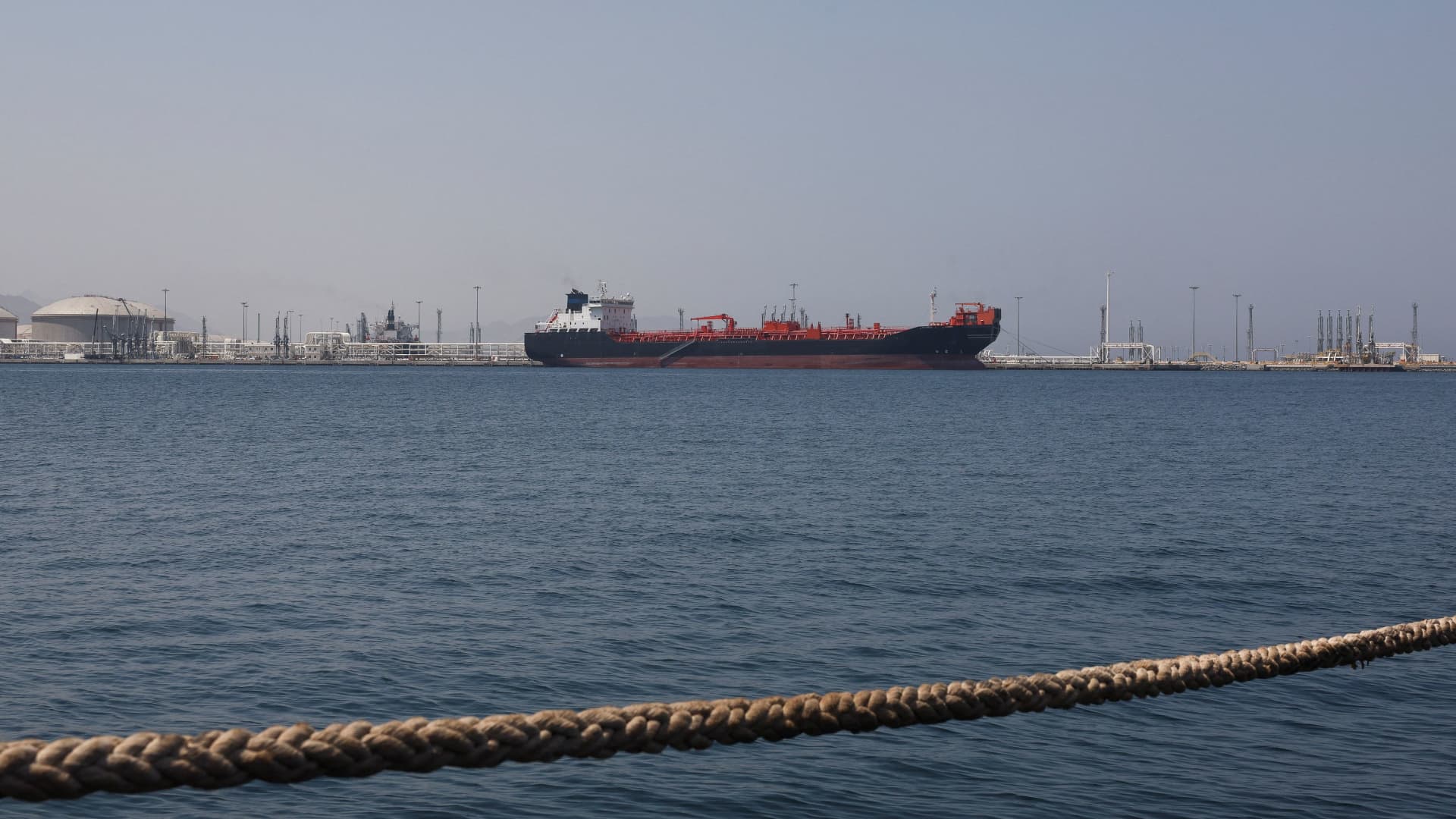
On May 6, 2026, the oil and chemical tanker “Hageman” at the port of Fujairah, as maritime traffic in the Strait of Hormuz is restricted due to the US-Israel Iran conflict in Fujairah, United Arab Emirates.
Amr Alfiqi | Reuters
Oil prices fell slightly on Thursday as the US awaited Iran’s response to its proposal to end the war and reopen the Strait of Hormuz.
international benchmark brent Crude oil futures fell about 1% to close at $100.06 per barrel. us west texas intermediate Futures prices fell 0.28% to settle at $94.81 per barrel.
Oil prices fell by about 5% in the early going on expectations that the US and Iran would reach a deal. Prices began to rise after Iranian officials appeared to reject the U.S. offer.
According to state news agency Press TV, Mohsen Rezaei, a member of Iran’s Expediency Council, said the United States must pay reparations for the damage it has caused to Iran. According to Press TV, Rezaei said that the Iranian government will not allow the US to propose unrealistic plans to reopen Hormuz Island.
Iranian Foreign Ministry Spokesman Esmail Bakaei told media outlets on Wednesday that Iran is still considering the US proposal and plans to present a response to a Pakistani mediator.
In a social media post, Bacaei said negotiations require “a sincere attempt to engage in dialogue aimed at resolving the dispute.” He said the negotiations were not about dictation, deception, blackmail or coercion.
President Donald Trump said Wednesday that the U.S. military offensive known as Operation Epic Fury would “end” if Iran “agreed to give us what we agreed to,” but this is likely a big assumption.
If that happens, a U.S. naval blockade of Iranian ports in the Gulf of Oman would “open the Strait of Hormuz to everyone, including Iran,” Trump wrote in a social media post.
But the president said Iran would be bombed “at a much higher level” if it did not agree to a peace deal, stressing that negotiations between Iran and the United States to end the war remained fragile.
U.S. officials told Axios on Wednesday that the United States and Iran are close to signing a one-page, 14-point memorandum of understanding that would end the war and establish a framework for further negotiations.
According to a report by Axios, the agreement would lift restrictions on the Strait of Hormuz. Iran would commit to a moratorium on nuclear enrichment, and the US would lift sanctions and unfreeze funds.
Scott Kronert, a Citi U.S. equity strategist, said a prolonged conflict would have repercussions across the economy.
“The impact of the duration of the dispute and prolonged oil prices is a big issue because it not only relates to the future growth expectations of many parts of the market, but also how it affects the Fed’s thinking in terms of interest rate trends,” Kronert said on CNBC’s Squawk Box.
— CNBC’s Chloe Taylor and Kevin Breuninger contributed to this report
