

Hong Kong —
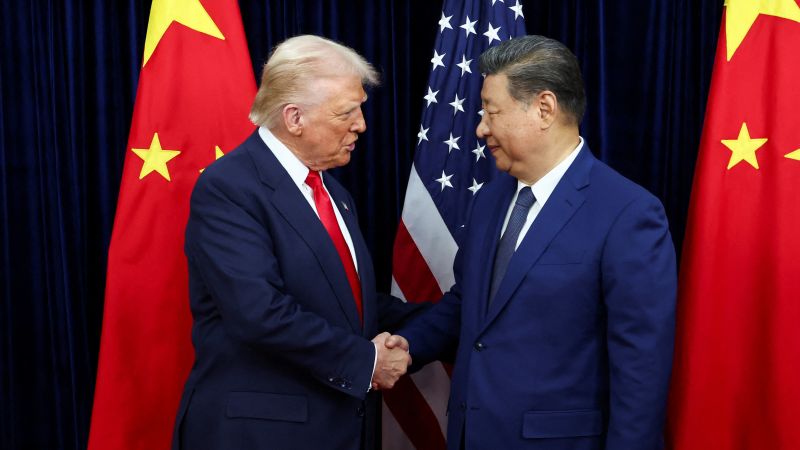
China remains committed to the upcoming meeting between leader Xi Jinping and U.S. President Donald Trump regardless of the situation in the Middle East, and is cautious that the months-long conflict with rival Iran could strengthen its negotiating position, according to Chinese sources familiar with the matter.
The unusual face-to-face meeting was previously postponed due to the war between the United States, Israel, and Iran, but is now scheduled for May 14-15, according to the White House. Sources suggest that Beijing sees the high-stakes summit as a unique opportunity to secure a more stable, long-term relationship with its biggest economic and military rival.
But despite the perceived advantages, officials say Beijing remains extremely cautious, with government insiders divided over how to navigate the myriad complications posed by the conflict, including the prospect that the Strait of Hormuz, through which China imports about a third of its oil and gas, will remain closed even after President Trump arrives in the Chinese capital.
Trump’s visit “is not the same as any visit by any other head of state,” said a Chinese source, who requested anonymity due to the sensitivity of the matter. “Mr. Trump’s tenure is likely to have a lasting impact on the world order, and has already fundamentally changed the way the United States views its own interests.”
“The success of the president’s visit will have a long-term impact on future U.S.-China relations, regardless of whether a Democrat or Republican is in power,” the official said.
Cui Hongjian, a former diplomat and international affairs scholar at Beijing Foreign Studies University, said the visit was initially intended to focus on confirming important agreements between the two countries in various key areas, but the Iran crisis had “severely disrupted” China’s overall plans and expectations.

“China’s foreign policy has a fundamental position. China-US relations are the top priority. If China-US relations become stable, it will in turn lead to stabilizing and improving China’s relations with other countries,” Cui told CNN.
With Iran, a close partner of Beijing, suddenly entering the center of U.S.-China relations, things have become “difficult for the Chinese side,” Cui said.
Beijing has not yet officially confirmed the summit’s date, but with less than two weeks until the scheduled meeting, the prospect of a peace deal between the United States and Iran remains remote, and there is a real possibility of a resumption of fighting. Neither scenario is without risks for China, said another Chinese source, who spoke on condition of anonymity.
“Of course, President Trump will want to visit China to show off his power after ending relations with Iran…But if he attacks Iran after visiting China, it will look as if China has abandoned Iran,” the official said.
“Trump is very smart. He didn’t directly target China, but he first buffeted Venezuela and then went after Iran, essentially clipping China’s wings in these regions,” the official added.
However, the Iran war is not progressing as planned by the United States. Rather than showcasing American power, this conflict has drawn the United States into a highly unpopular and seemingly intractable conflict that is negatively impacting the global economy.
“Trump will now want to turn the page on Iran as soon as possible,” said Wu Xinbo of the Foreign Policy Advisory Committee of China’s Ministry of Foreign Affairs. “If the U.S. had the upper hand, President Trump would have had more influence. But now it’s clear that the U.S. has been unable to deal with Iran, so in a sense its relative bargaining position has weakened when it comes to negotiations with China.”

Chinese officials are believed to have played a role in bringing Iran to the negotiating table. But while a subsequent ceasefire has largely halted fighting in Iran, the United States and Tehran are still unable to agree on a safer peace.
The situation could give China a unique opportunity to capitalize on the conflict ahead of a competitive midterm election for President Trump, who is seen as keen to show concrete victories to American voters, such as large-scale Chinese purchases of American agricultural products and Boeing jets, people familiar with the matter said.
China is poised to get what it wants by leveraging its vast domestic market and advantages in the rare earth supply chain. The United States has expressed “opposition” (rather than non-support) to Taiwan’s independence. Relax restrictions on exports of high-end technology. and remove Chinese companies from the sanctions list.
“Trump probably postponed his visit to China partly because he felt he didn’t have enough influence,” said another official, suggesting that Trump wanted to use his early victory on Iran as political leverage in his talks with China.
“But look at him now. The conflict in Iran has been going on for a long time without any progress,” the official added, speaking on condition of anonymity.
“At the beginning of the war, we were very worried,” said Foreign Ministry adviser Wu, who is also director of the Center for American Studies at Fudan University in Shanghai. “We were worried that not only our oil and business interests in the Middle East, but also that if Iran didn’t hold out, a pro-Western regime could emerge, which would be bad for China’s national interests.”
“However, the current situation has actually turned out to be advantageous for China,” Wu added.

The war is widely seen as lowering the Chinese government’s global standing and positioning China as a cornerstone of stability. During the conflict, President Xi repeatedly called for peace and promised to help developing countries weather energy shortages brought on by the conflict. Meanwhile, Western leaders appear to be strengthening ties with Beijing.
“The United States is fighting without winning, but China is winning without fighting,” said Jorg Wutke, former president of the European Union Chamber of Commerce in China and partner at DGA Albright Stonebridge Group. “Due to energy costs, (China) is certainly negatively affected, but at the same time China benefits a lot from this situation.”
China’s political system, which emphasizes long-term planning and self-reliance, also gave it an advantage in resisting global economic shocks.
“They’re being vindicated with their renewable policies. China is probably the best prepared country. Politically, they’re the winners because they look like the adults in the room,” Utke told CNN.
President Trump received an elaborate red carpet welcome during his last presidential visit to Beijing in 2017. The so-called State Guest Plus included an unprecedented array of lavish honors, including a private reception in the Forbidden City.
But the friendship generated by the visit quickly faded, giving way to a deepening nearly decade-long conflict between the two countries over trade, technology, tensions with Taiwan, accusations related to the COVID-19 pandemic and a bizarre balloon incident.
Given the rift between the two countries, China is unlikely to deviate too much from its strategy in the upcoming talks, a Chinese source suggested.

China and the US are still negotiating on many areas, and “the more agreements are reached, the more mature the timing of the summit will be,” the first official said.
China has refrained from directly criticizing President Trump during the war in an effort to ease tensions ahead of the summit. Mr. Trump also appears to be cautiously handling potential flashpoints.
When U.S. intelligence assessed that China was preparing to deliver a new air defense system to Iran, President Trump suggested that China would face consequences if it forced the delivery, but did not mention Mr. Xi.
While some in China may feel that their country is becoming bolder in its negotiating stance for the summit, William Klein, the former U.S. diplomat who arranged President Trump’s visit to Beijing in 2017, suspects there has been a significant change.
“In trade and investment relations, each side has sufficient influence over the other, and this influence has not changed, strengthened, or weakened so far because of the Iran war,” Klein said.
“Obviously the Iran war is overshadowing and shaping this trip, but I can’t say it favors one side or the other,” said Klein, now a partner at FGS Global.
