

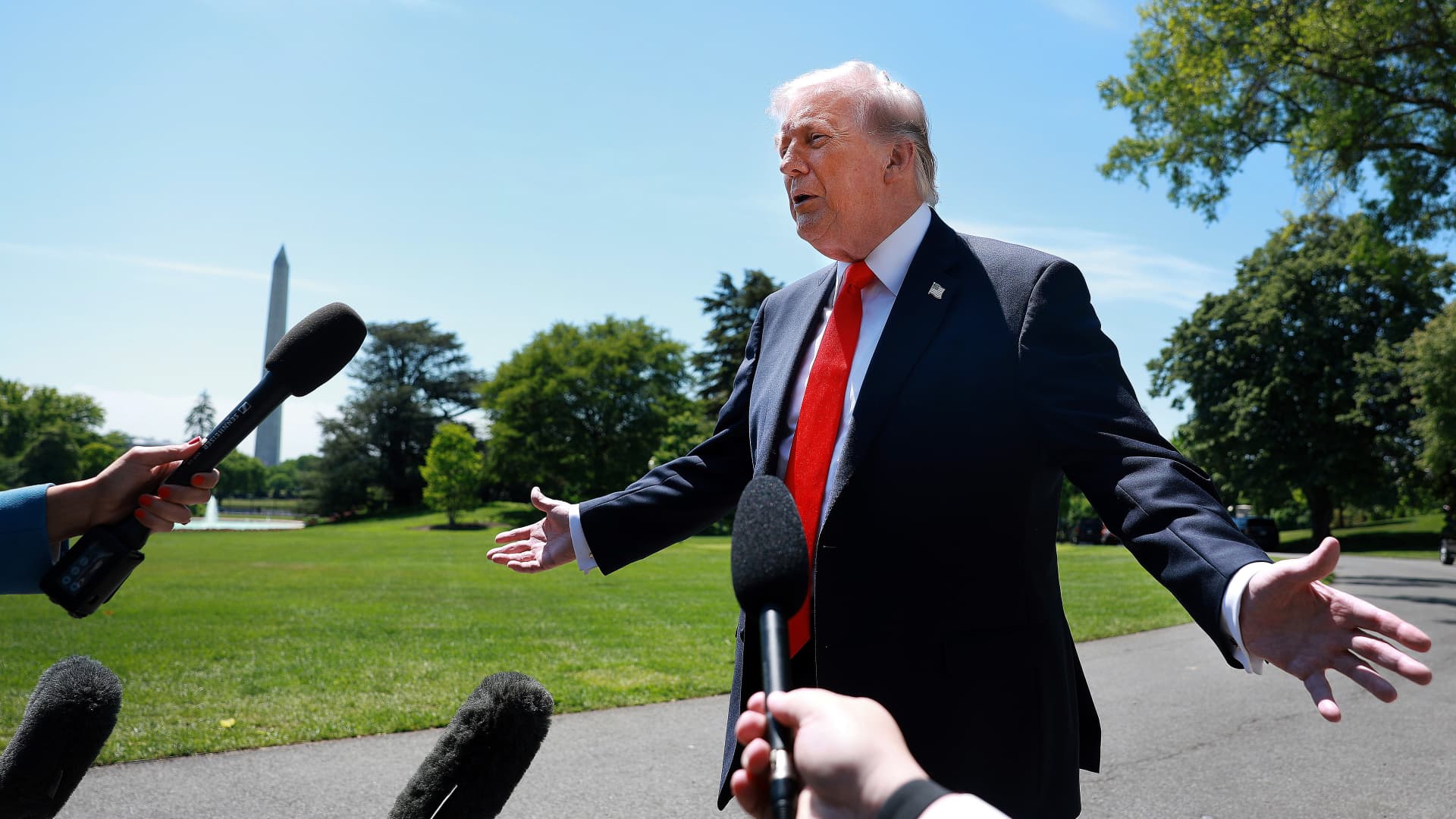
US President Donald Trump speaks to reporters as he departs the White House on May 1, 2026 in Washington, DC.
Anna Moneymaker | Getty Images
President Donald Trump said Sunday that the United States will attempt to “free” stranded ships stranded by the closure of the Strait of Hormuz since the start of the war with Iran.
The effort, which Trump dubbed “Project Freedom” in a Truth social post, is scheduled to begin on Monday. The president said the effort is focused solely on removing civilian vessels registered with countries not involved in the conflict from the disputed waterways and allowing them to “operate freely and competently.”
“I told the members of the House of Representatives to tell them that we will do everything in our power to get the ship and its crew safely out of the Channel,” Trump said. “In both cases, they said they would not return until the area was safe for navigation and everything else.”
President Trump did not provide details on how the United States would seek to carry out such an operation or how the U.S. military would be involved. It is also unclear whether Iran will allow the United States to conduct operations without interference and when the strait will reopen for regular navigation as the conflict continues.
The White House did not immediately respond to a request for further information.
The strait has been largely impassable since the outbreak of war, with ships stranded and major supply chains disrupted. Approximately 20% of the world crude oil will pass through the Strait, leading to a spike in U.S. oil and gasoline prices.
The new effort to free the ship appears to be aimed at allowing the stranded vessel to exit safely, rather than restoring freedom of navigation to the strait. Iran fired on ships attempting to pass and placed mines in the waterway to prevent them from passing.
“The ship movement is only meant to liberate people, businesses, and countries who have done absolutely nothing wrong, and who are victims of circumstance,” Trump said in the post. “This is a humanitarian action on behalf of the United States, the countries of the Middle East, and especially Iran.”
The Pentagon then directed CNBC to a social media post from U.S. Central Command detailing the operation and the broader goal of “restoring freedom of navigation for commercial shipping through the Strait of Hormuz.”
“This mission, led by the President, will support commercial vessels seeking free passage through critical international trade corridors,” the post reads. “A quarter of the world’s oil trade takes place by sea, and significant quantities of fuel and fertilizer products are transported through the strait.”
Centcom said U.S. forces participating in the operation will include guided missile destroyers, more than 100 Army, Navy and Air Force aircraft, multi-domain unmanned platforms and 15,000 military personnel.
The United States and Iran have been in an uneasy ceasefire for more than two weeks as the war enters its second month. The United States and Iran are continuing negotiations to end the war, but no agreement has yet been reached. President Trump said earlier in the week that he was “not satisfied” with recent offers from Iran.
On Friday, President Trump told Congress that hostilities with Iran have “ended.” President Trump’s assertion came at a time when there was a deadline under the 1973 War Powers Resolution to ask members of Congress to formally declare war on Iran or authorize the use of military force against Iran.
In a post on Truth Social announcing the rescue operation, President Trump suggested that allowing Iran to leave the stranded ship would help peace negotiations. But the president warned that any interference would be met with force.
“I am fully aware that my representatives are having very positive discussions with the State of Iran and that these discussions can lead to something very positive for everyone,” he said. “A show of goodwill on behalf of all those who have fought so hard over the last few months will go a long way. If this humanitarian process is disrupted in any way, unfortunately that disruption will have to be strongly responded to.”
