

Reuters —
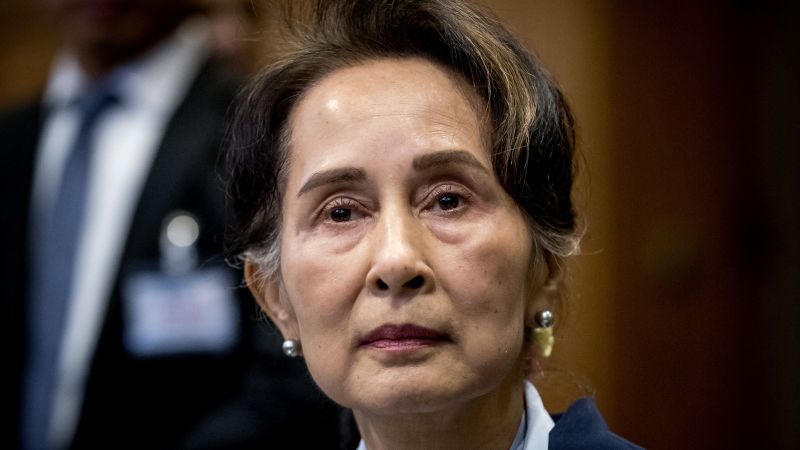
Myanmar’s detained former leader Aung San Suu Kyi will be transferred to house arrest, state media reported on Thursday. It has been more than five years since the military ousted the civilian government she led and imprisoned the Nobel laureate.
Suu Kyi, 80, has been detained by the military since then and remains missing amid a deadly civil war sparked by a coup in February 2021 that has engulfed much of Southeast Asia’s poor country.
“The remainder of Aung San Suu Kyi’s sentence will be commuted and served at her designated residence,” state-run MRTV reported, using the veteran politician’s title.
State media also broadcast a photo of Suu Kyi sitting on a wooden bench, flanked by two uniformed officials. This was Suu Kyi’s first public appearance in several years.
At the United Nations in New York, UN Spokesman Stephane Dujarric welcomed the news.
“We just saw the coverage,” he said. “We can say that we are grateful for the commutation of Aung San Suu Kyi’s sentence to so-called house arrest in her designated residence. This is a meaningful step towards conditions conducive to a reliable political process.”
Dujarric added that the only viable political solution in Myanmar “must be based on an immediate cessation of violence and a genuine commitment to inclusive dialogue.”
However, her son Kim Aris said in a statement that Thursday’s announcement by Myanmar authorities did not allay concerns about her condition or even confirm that she was still alive.
“I still don’t know where my mother is. I don’t know how she’s doing. I’m really worried if she’s still alive,” he said. “If she’s alive, I want proof that she’s alive.”
In December, Alice told Reuters she had not heard from her mother in years and had only sporadically inherited heart, bone and gum problems since her detention.
A member of her legal team told Reuters: “We are happy to hear that house arrest has been confirmed, but we have not received any direct notification.” “I first learned about it from the news announcement.”
After a series of trials, Suu Kyi was found guilty and sentenced to 33 years in prison on charges ranging from corruption and abetting election fraud to violating state secrets rules, although her allies say the charges were politically motivated and aimed at sidelining her.
The sentence was later commuted to 27 years, and then by one-sixth in Myanmar’s New Year amnesty on April 17, when her ally and co-defendant, former President Win Myint, was released.
Earlier on Thursday, her sentence was further reduced by a sixth as part of a broader amnesty for all prisoners in Myanmar’s prisons.
Suu Kyi, the daughter of former Burmese independence hero General Aung San, spent a total of 15 years under house arrest under the previous military regime at her family home on the shores of Inya Lake in Yangon, where she famously gave passionate speeches to crowds of supporters through the compound’s metal gates.
Min Aung Hlaing, Myanmar’s military chief-turned-president who overthrew Suu Kyi in a coup, has been under relentless international pressure to release political detainees, including from the Association of Southeast Asian Nations (ASEAN), which he is seeking to re-engage with after being barred from summits since the recent election.
Min Aung Hlaing told Thailand’s foreign minister last week that Suu Kyi was “well taken care of” and that the government was considering unspecified “good things.”
