

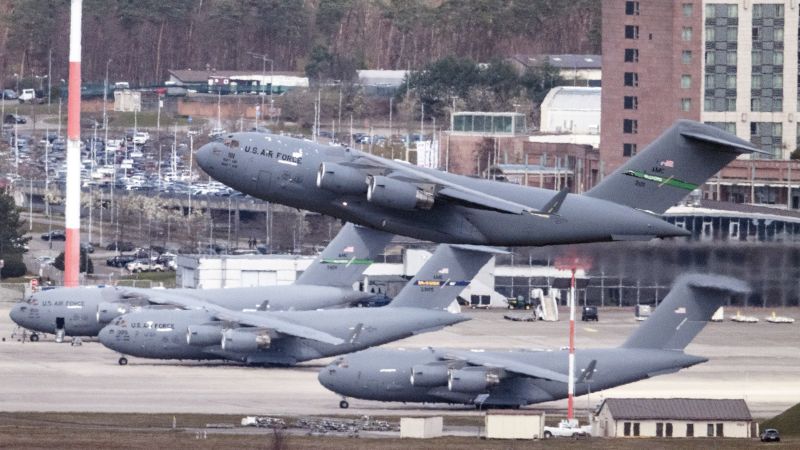
The conflict between the United States and Germany has reached a new level, with US President Donald Trump threatening to withdraw some US troops from the country over disagreements over US-led operations in Iran.
“The United States is studying and considering the possibility of reducing our military presence in Germany, and a decision will be made in the short term,” President Trump said on his Truth social platform Wednesday night.
This comes amid tensions between Berlin and the United States over the US’ approach to war with Iran. German Chancellor Friedrich Merz drew the ire of President Trump this week with remarks on Monday in which he said the United States was “humiliated” by Iran and criticized his administration for not having an effective strategy to end the war.
According to U.S. Defense Manpower Data Center (DMDC) data released in December 2025, there are 36,436 active-duty U.S. military personnel permanently stationed in Germany, a number significantly higher than in any other European country. President Trump previously threatened to reduce the country’s military forces in 2020 during Chancellor Angela Merkel’s first government as German chancellor.
The US-Israel war, which the US launched without notifying most NATO allies, has intensified friction between European leaders and the Trump administration. A government spokesperson told The Associated Press that Germany had been informed of the first attack in advance. European countries have refused to get directly involved in the conflict, instead stressing the importance of finding a diplomatic solution. In response, President Trump threatened to reconsider America’s membership in NATO and called the military alliance a “Paper-Paper Tiger.”
Like other European countries, Germany provides limited military assistance to the United States and, among other things, allows the use of military infrastructure such as air bases for conflict-related operations, but it does not believe this allows its use as bases for direct attacks.
Chancellor Merz also promised further German support, provided the conflict moved into a post-war phase. This could include participation in possible international stabilization missions.
To this effect, Berlin recently announced that it would send naval minesweepers to the Mediterranean in preparation for efforts to reopen the Strait of Hormuz after a permanent end to hostilities. The move follows President Trump’s call for allies to send warships and minesweepers to help secure the strait. Germany is part of a coalition led by Britain and France that seeks to ensure the safe passage of ships in the vital waterway. However, these actions did not satisfy President Trump.
Merz’s attitude towards the war also changed. In the hours after the campaign began, he insisted that “now is not the time to lecture our allies.” His tone changed after a visit to the United States in March, where he said, “I don’t see a clear strategy.”
Differences between Berlin and the United States deepened on Monday when Chancellor Merz harshly criticized attempts to extricate the United States from a war it entered without clear objectives.
“This whole incident is thoughtless, to say the least,” he said, underscoring Berlin’s desire for an early end to the war. “At this point, we don’t know what strategic exit the Americans are choosing.”
On Tuesday, President Trump directly criticized Merz in a post on Truth Social, writing, “German Chancellor Friedrich Merz thinks it’s okay for Iran to have nuclear weapons. He doesn’t know what he’s talking about!”
He continued: “No wonder Germany is in such a bad situation, economically and otherwise!”
Merz, like other European allies, has long acknowledged the threat posed by Tehran and said Iran should not have nuclear weapons.
The German chancellor has since tried to downplay his feud with his US counterpart and adopt a more conciliatory attitude, insisting on Wednesday that relations with President Trump are “good.”
“From my point of view, my personal relationship with the president of the United States remains good,” Merz told reporters, underscoring the negative impact the war has had on Germany’s economy and energy supplies.
On Thursday, Merz reiterated the importance of the transatlantic alliance to Berlin, following President Trump’s announcement that he may withdraw some troops from Germany.
“As you know, this transatlantic partnership is particularly close to our hearts and to me personally,” he told reporters at a military base in Münster.
Since Mr. Trump returned to office, German officials have largely managed to stay out of his line of fire and avoided harsh criticism of many of their other traditional allies. In recent times, this situation appears to have changed dramatically.
