

The biggest impact of AI in science was when Google DeepMind used deep learning models to predict the complex structures of proteins, the molecules that drive nearly every process in living cells.
But as AI models continue to spit out more potential treatment candidates, new bottlenecks are emerging. It’s really about characterizing all of those candidates for testing and mass production.
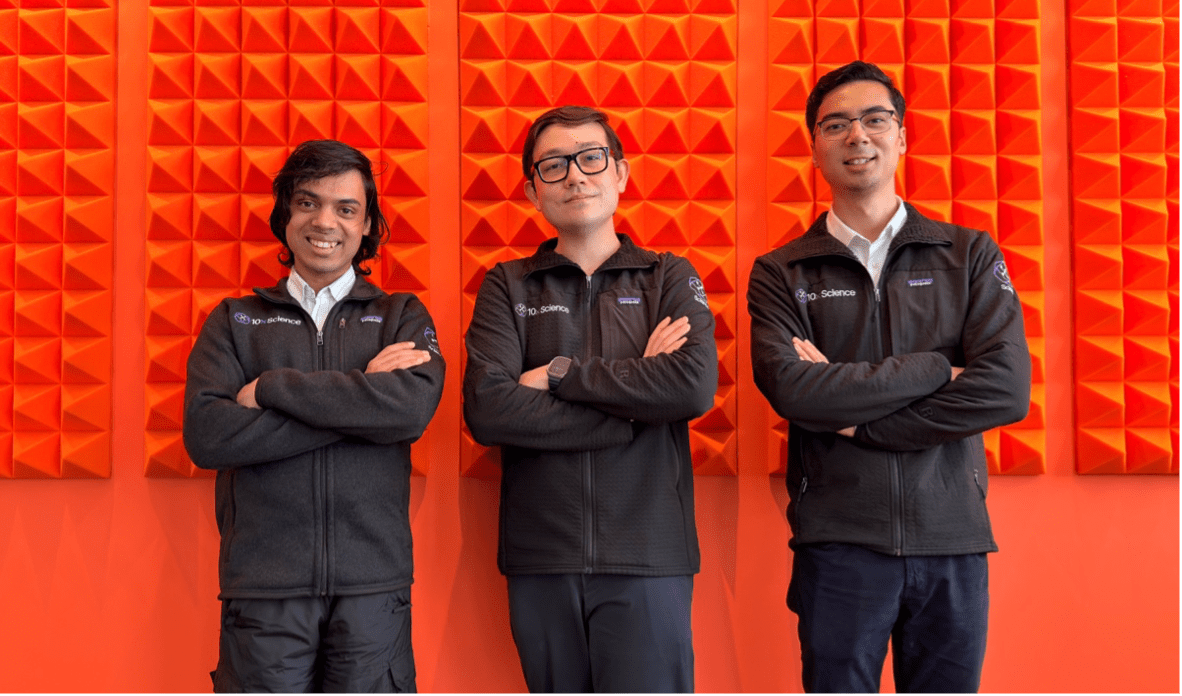
That’s the goal of 10x Science, a startup founded in December 2025. The company today announced a $4.8 million seed round led by Initialized Capital and supported by Y Combinator, Civilization Ventures, and Founder Factor. Its three founders are chemical biologist David Roberts, biologist Andrew Reiter, and serial founder Vishnu Tejus with expertise in computer science and AI models.
“When biopharmaceutical companies try to create new drug candidates, they have all these very good predictive tools,” Roberts told TechCrunch. “You can add as many candidates as you like to the top of the funnel, but every candidate has to go through this characterization process. Everything needs to be measured.”
Understanding protein structure is key for researchers developing biopharmaceuticals. Biological drugs are produced within living cells and are used in sophisticated designs to specifically target diseases and conditions. For example, they can be designed to target specific cells, like Keytruda, a popular drug sold by Merck & Co. that helps the immune system identify and attack cancer.
The three founders of 10x Science worked together in Nobel Prize winner Dr. Carolyn Bertozzi’s Stanford lab, where they studied the interactions between cancer cells and the immune system, but were frustrated by their inability to understand exactly what was happening at the molecular level.
The most accurate way to evaluate molecules is with mass spectrometry, a technique that measures a molecule’s mass and charge to determine its composition and structure. Relatively new approaches generate complex data that requires considerable expertise to interpret, and their analysis is time-consuming.
tech crunch event
San Francisco, California
|
October 13-15, 2026
10x Science’s platform combines deterministic algorithms rooted in chemistry and biology with AI agents that can interpret that data. The team had to do a lot of work to train the model on spectroscopic data and make its analysis traceable. This is a key requirement for the tools used to help businesses achieve regulatory compliance.
Matthew Crawford is a scientist at Rilas Technologies, which runs chemical analysis for other companies. This eliminates the need for clients such as biotech startups to invest millions of dollars in their own spectrometers and the experts to operate them. Crawford has been using the 10x Science platform for several weeks and says it has speeded up his work.
Crawford said he was surprised by the model’s ability to explain its conclusions, uniquely find the right data for analysis, and be adaptable to evaluating different types of molecules. While some AI tools he’s experimented with in the past have had unreasonable expectations or suffered from accuracy issues, this tool makes reasonable assumptions, which he attributes to the deep expertise of its creators.
“When we ran a particular protein, we had some idea of what that protein was probably based on how we named the file,” Crawford said. “Then we searched online databases for the sequence of that protein, so we didn’t have to program the sequence.”
10x executives said they are working with several major pharmaceutical companies as well as academic researchers. The plan is to use this seed funding to hire more engineers and continue to refine the model and bring it to new customers. If the research characterizing proteins can gain traction, Roberts hopes the company will expand to combine protein structure with other data about cells to provide new kinds of understanding of biology.
“The deepest thing behind what we’re building is actually a new way to define molecular intelligence,” Roberts said.
10x offers investors a useful way into the biotech space that is not dependent on the success or regulatory approval of a particular drug. If the company performs as its founders hoped, it will become an important tool in drug development, regardless of whether the final product is a market success.
“This is a SaaS platform where pharmaceutical companies have to pay monthly to consider all of these potential candidates,” said Zoe Perret, partner at Initialized. She relies on the founder’s deep experience to protect the company from competitors. Not many people understand these techniques and the data they generate.
What the platform can do, Crawford said, is help unlock these techniques for researchers who could benefit from them but lack the time or resources to implement them.
“This group here is trying to create new drugs,” he told TechCrunch. “They just want to get quick, easy answers from mass spectrometry, but that opens up a whole can of worms. This software helps keep that can of worms closed and gets only the answers they actually need, so they can do the next thing in their research.”
If you buy through links in our articles, we may earn a small commission. This does not affect editorial independence.
