

budapest, hungary —
In recent decades, the United States and Russia have rarely supported the same candidate in foreign elections. Hungary’s Viktor Orbán was an exception. But in the end, they supported the losers.
For the White House, Orbán, a right-wing populist beacon, was seen as key to pushing for a more nationalist and “like-minded” Europe. For the Kremlin, Mr. Orban was the chief destroyer of the European Union’s efforts to arm Ukraine and divest from Russian fossil fuels.
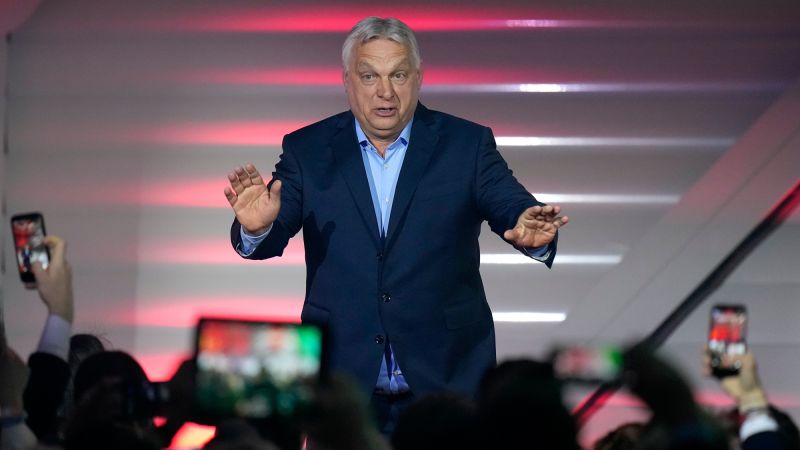
But now US President Donald Trump and Russian President Vladimir Putin will have to make do without their allies in Budapest. Prime Minister Orbán’s Fidesz government suffered a crushing defeat as voters flocked to Prime Minister Péter Magyar’s opposition Tisza party in record turnout. Magyar’s campaign slammed the corruption and cronyism that flourished during President Orbán’s 16 years in office, and called for a break with Russia and improved relations with the European Union.
“We don’t have a second to spare,” Magyar told reporters in Budapest on Monday. “Hungary is in trouble. It is plundered, betrayed and devastated.”
If the Magyar victory was a blow for Trump and Putin, it was a huge relief for Europe. “I’m very happy. I think I’m happier than you,” Polish Prime Minister Donald Tusk said in a phone call with the Magyar president on Sunday night. Ukrainian President Volodymyr Zelenskiy, who has been maligned by Orban’s camp, congratulated Tisza and said Ukraine was “ready to advance cooperation with Hungary.”
When Hungary’s new parliament takes office within the next 30 days, the Magyars will face tough challenges at home, from revitalizing Hungary’s impoverished economy to weakening Fidesz’s control of the media and judiciary. However, the next prime minister will also have to juggle the demands of the United States, Russia, and the European Union, three major powers that have recently become more enthusiastic about Hungarian issues.
The path he plans will have an impact far beyond Hungary’s borders.

Orbán, once described by Steve Bannon as “the Trump before Trump,” is said to have developed a “model” of illiberal governance. He billed himself as a defender of free speech and “traditional values” and slammed what he called the corrupting influence of the European Union.
In addition to supporting President Trump’s election campaign, Mr. Orbán also supports the MAGA movement, positioning Budapest as the European headquarters of the world’s conservative movement. Meanwhile, the Trump administration supported Mr. Orbán’s election campaign, with Vice President J.D. Vance directly fighting for Mr. Orbán.
Responding to questions from CNN at a press conference in Budapest, Magyar said Orbán’s defeat was a “huge defeat” for his US supporters as well. “Orbán was their poster boy,” Magyar said. “He was the intellectual mastermind behind the fight against Brussels.”
In a blow to the Trump administration’s drive for a more Orbanist Europe, Magyar said the government would not help Orban maintain the ideological base he built through generous government subsidies. For example, the Matthias Corvinus Collegium (MCC) that Vance visited last week – an educational institution described by critics as a training ground for national conservatives – is funded by a 10% stake in Hungary’s largest oil and gas company.

Since 2022, Budapest has also hosted the Hungarian version of the annual Conservative Political Action Conference, a prominent right-wing political gathering that originated in the United States. In a statement on Sunday ahead of the election results, CPAC said it was closely monitoring the results and “firmly” supported Orbán, calling him “a leader with strong conservative values who bravely stands up to elitists and globalists.”
Magyar told CNN that neither MCC nor CPAC will receive state funding under his administration.
“I don’t think the state should have funded them in the first place. This was a crime. Mixing political party funding with government spending from the state budget is, in my opinion, a crime,” Magyar said. He added that institutions like the MCC “should be investigated” by the anti-corruption agency he plans to establish.
“CPAC can come to Budapest, they are very welcome, but not from Hungarian taxpayers’ money. Before we get it back from Fidesz money or from Orban’s cronies’ money,” he said.
Magyar did not speak to Vance during his visit to Budapest, but added: “We hope to get to know each other.”
Russia supported Mr. Orbán because he has long obstructed EU efforts to impose sanctions on Russia and provide arms to Ukraine in the wake of President Vladimir Putin’s full-scale invasion.
In December, EU leaders agreed on a crucial 90 billion euro ($105 billion) loan to Ukraine. Prime Minister Orbán always insisted that Hungary would not contribute, and then blocked the loan altogether, citing Ukraine’s slow pace in repairing the oil pipeline that runs from Russia to Hungary through Ukraine. Prime Minister Magyar said on Monday that Hungary was in a “very difficult” fiscal situation and reaffirmed that Budapest would not contribute the 90 billion euros, but hinted at the possibility of lifting its veto. Prime Minister Magyar said the decision “was already taken in December” and his government “wants to remain consistent” with Hungary’s previous commitments.
Mr. Orbán also supported Russia by purchasing oil. When EU member states agreed to phase out Russian oil, the EU gave Hungary and Slovakia more time to reduce their dependence. Instead, they increased it. Last year, 92% of Hungary’s oil imports came from Russia, up from 61% before the invasion.
Days before the election, Mr. Orban’s campaign was damaged by leaked phone calls between the government and the Kremlin. “Whatever I can do to help, I will be happy to do,” Orbán told Putin during a phone conversation in October, Bloomberg reported.

Another report by a group of investigative journalists claimed that Hungarian Foreign Minister Péter Szijjarto colluded with Russian Foreign Minister Sergei Lavrov to weaken EU sanctions against Russia and offered to send EU documents to Lavrov through the Hungarian embassy in Moscow.
In a heated exchange with Orbán, Magyar described Moscow as a “security risk” to Europe and said if he spoke to Putin he would tell him “after four years of war it would be good to end the killings” in Ukraine.
Still, Magyar suggested that Hungary will remain dependent on Russia for the foreseeable future, especially for its energy needs. “You can’t change geography,” he said many times. He said Tisza would “do its best to diversify its energy mix” but said Hungary would continue to seek the cheapest energy sources, leaving open the possibility of continued purchases of Russian crude oil.
The Kremlin said on Monday it respected Hungary’s election results and was ready to hold talks with the new leadership. “If President Vladimir Putin calls me, I will answer it. But I will not make the call myself,” Magyar told reporters.
Unlike Washington and Moscow, Europe is celebrating Orban’s defeat. Although some leaders are wary of Magyar’s status as a former Fidesz insider and his more conservative tendencies, “the mood in Brussels seems to be one of relief,” said Grégoire Rouss, director of the Europe, Russia and Eurasia program at Chatham House think tank.
“He’s definitely more pro-EU than Orban, and he’s less pro-Russian,” Roos told CNN. His hope is that Magyar Hungary will no longer become a “fault line within the EU”.
President Magyar had expressed his intention to break away from President Orbán’s hostile stance toward Ukraine. “All Hungarians know that Ukraine is a victim of this war,” he said on Monday. “No one should tell them on what terms they should sign a peace treaty.”

However, the Magyars also take positions similar to Orbán’s, such as opposing Kiev’s early accession to the EU. But this view is also quietly shared by some of Kiev’s more ardent supporters.
“It (the election result) was a good result for the EU, the UK and Ukraine. It means fewer obstacles and more friendly cooperation going forward,” Roos said. “For the US and Russia, this is clearly a blow. It is clear that a beneficial outlier for both countries will be removed and Hungary will be firmly entrenched in the EU.”
