

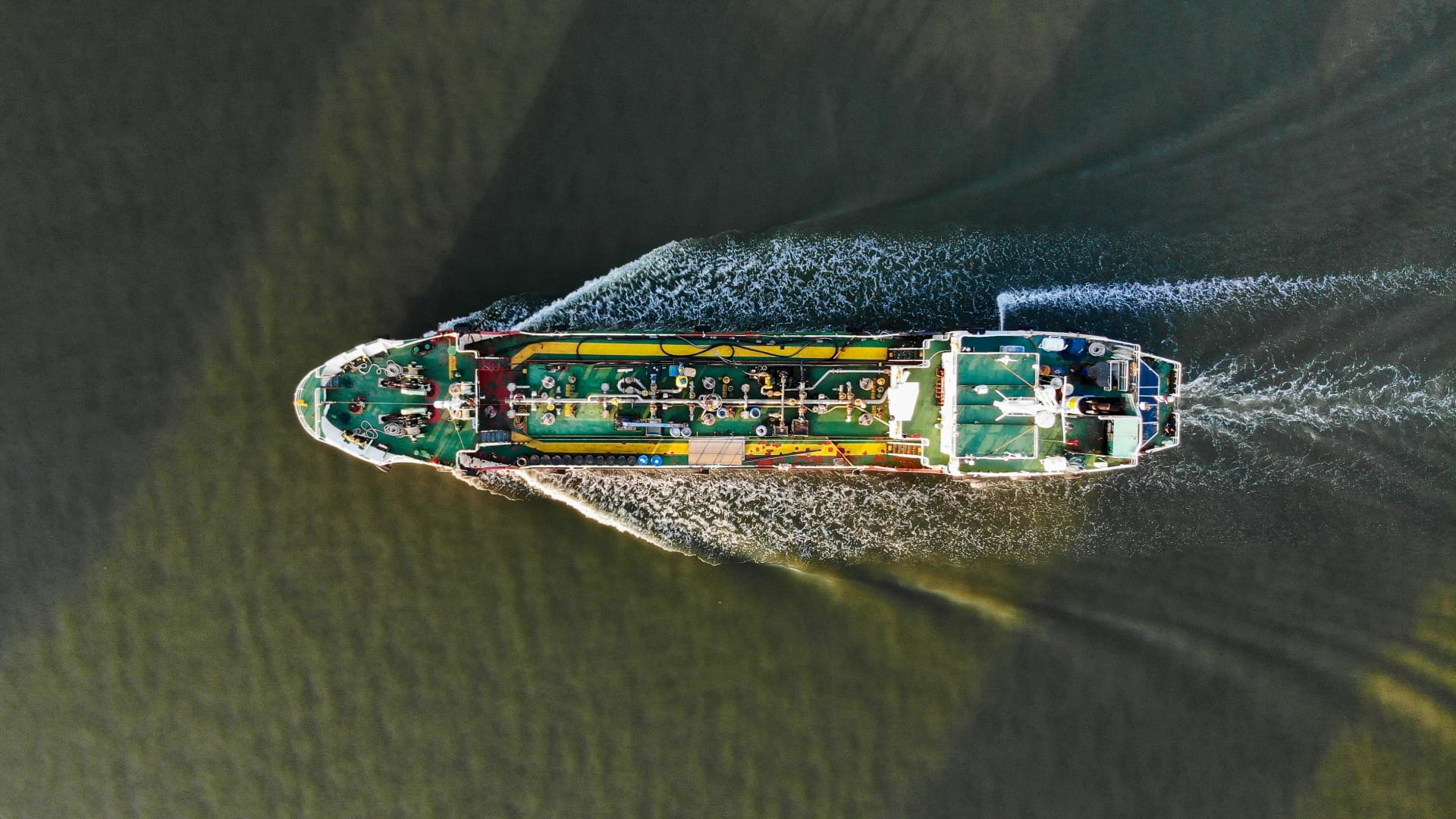
The closure of the Strait of Hormuz affected oil and gas tankers, sparking a global energy crisis triggered by the Middle East war.
Photos for you | Moments | Getty Images
Oil prices soared on Sunday as the US Navy prepares to blockade Iranian ports after peace talks broke down over the weekend.
usa crude oil Futures prices for May delivery rose nearly 8% to $104.20 a barrel by 6:13 p.m. ET. international benchmark brent June delivery rose 7% to $101.86.
U.S. Central Command announced Sunday that the military will block all maritime traffic in and out of Iranian ports at 10 a.m. ET on Monday. It added that the United States would not interfere with ships entering or leaving non-Iranian ports.
“The blockade will be enforced equitably against ships of all countries entering and exiting Iranian ports and coastal areas, including all Iranian ports in the Arabian Gulf and the Gulf of Oman,” Centcom said in a statement.
President Donald Trump had earlier on Sunday threatened to close the Strait of Hormuz after the United States and Iran failed to reach an agreement to end the war during negotiations in Pakistan.
“Effective immediately, the United States Navy, the world’s greatest navy, will begin the process of blockading any vessels attempting to enter or exit the Strait of Hormuz,” Trump said in a social media post.
President Trump is considering a limited strike against Iran to break the impasse in peace talks, officials and people familiar with the matter told The Wall Street Journal.
The president announced Sunday that he has ordered the Navy to detect and interdict vessels in international waters that have paid tolls to Iran to transit the strait. This narrow sea route is a key artery connecting oil-producing countries in the Middle East to global energy markets.
The threat of Iranian attack has sharply reduced tanker traffic through the strait, causing the largest oil supply disruption in history. Until the United States and Israel attacked Iran on February 28, about 20% of the world’s oil supplies passed through the waterway.
It is unclear whether President Trump will resume airstrikes against Iran. The president agreed on Tuesday to a two-week ceasefire in exchange for Iran allowing ships to pass through the strait. He had previously threatened to bomb all bridges and power plants in Iran.
The Iranian government safely passed through the ceasefire period, subject to approval. Ali Akbar Velayati, a senior adviser to Iranian Supreme Leader Mojtaba Khamenei, said on Sunday that the “keys to the Strait of Hormuz” remained in the hands of the Islamic Republic, according to state news agency Press TV.
According to LSEG data, three supertankers sailed on Saturday. Each ship can carry 2 million barrels of oil. However, traffic volume is well below pre-war levels, when more than 100 ships were navigating each day.
Vice President J.D. Vance, who led the U.S. delegation, said Sunday that negotiations had failed because Iran had not shown a “commitment” that it would not seek nuclear weapons.
“The simple question is, do we see a fundamental commitment by the Iranians not to develop nuclear weapons,” Vance told reporters in Islamabad. “We haven’t seen it yet, but we hope so.”
Mohammad Bagher Ghalibaf, speaker of Iran’s parliament, said the United States “failed to gain the trust of the Iranian delegation in these negotiations.”
