

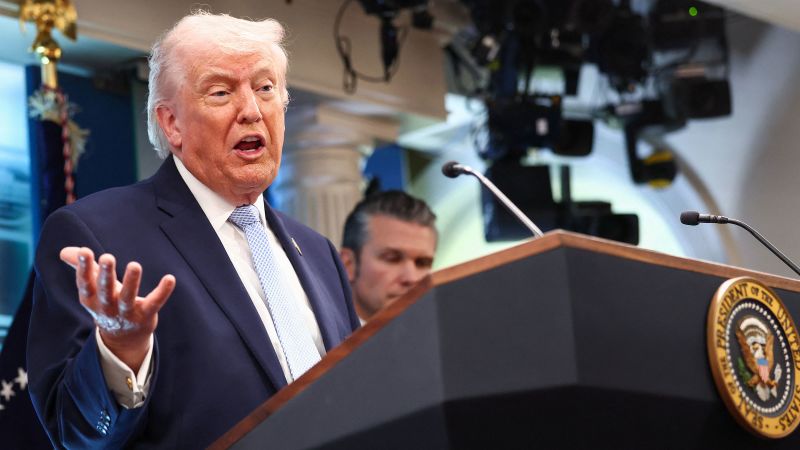
The clock is ticking until the deadline for US President Donald Trump to strike a deal with Iran and open the Strait of Hormuz or face “hell” in the face of massive bombing.
President Trump had set the deadline for the deal to be 8pm ET on Tuesday (3:30am Wednesday Tehran time). But he has issued similar ultimatums several times in recent weeks, each time delaying the deadline. And his threats are highly controversial, with many pointing out that targeting civilian infrastructure amounts to a war crime.
Here’s what you need to know:
The president set the deadline in a post on Truth Social on Sunday after renewing his threat in a profane message to blow up key Iranian infrastructure unless Iran opens the Strait, a gateway to global energy trade.
President Trump spoke again on Monday and said the United States has a plan that could destroy all of Iran’s bridges and power plants by midnight Tuesday. “It will be completely destroyed by 12 o’clock,” President Trump said.
He has previously threatened to attack other Iranian infrastructure, including oil wells and desalination plants.

Iran’s government has so far reacted defiantly in public, with one military commander calling Trump’s threats “baseless” and “delusional” on Tuesday.
“If there are repeated attacks on non-civilian targets, our retaliatory measures will be stronger and more widespread,” warned Ebrahim Zolfakari, a spokesman for the Khatam al-Anbiya central command used by the Iranian military.
And on Monday, Iran’s Foreign Ministry spokesperson called on Americans to hold their government accountable for what he described as an “unfair and aggressive war” against Iran.
Targeting critical civilian infrastructure could be considered a war crime. Objects essential to the survival of the population (including water treatment facilities) are prohibited as military targets under the Geneva Conventions.
If the infrastructure has military uses for Iran, it could be considered a valid target. But President Trump has threatened to not only blow up some of Iran’s power plants; He is threatened to blow them all up.
“A lot of former military lawyers and legal scholars have been very hesitant to say that bombing civilian infrastructure is a war crime, because sometimes it can be done. But the president’s comments this weekend, for me and for many others, changed our opinion on that,” said Margaret Donovan, a former attorney with the U.S. Army’s JAG Corps.
“We’re basically seeing a direct threat to something that we know will have devastating effects on civilians.”
Several countries have privately contacted the Trump administration to warn against such attacks, but many have so far avoided publicly reprimanding the US president. That includes some Gulf states concerned that Iran could target their civilian infrastructure in retaliation, regional sources said.
The Trump administration has largely ignored those concerns, with the White House saying last week that the United States would “always” abide by international law. Asked about the issue on Monday, President Trump said he was not worried and said the real war crime was “allowing Iran to have a nuclear weapon.”
The Iranian government has already accused the United States and Israel of targeting civilian infrastructure, with a major new B1 bridge just outside the Iranian capital being bombed on Friday, and Iran’s Bushehr nuclear power plant coming under multiple projectile attacks in recent weeks.

President Trump insisted on Monday that Iran is an “active and willing participant” in negotiations to potentially end the war and that negotiations with mediators are “progressing well.”
CNN reported early Monday that Pakistan, Egypt and Turkey are acting as mediators between the United States and Iran, but indirect negotiations stalled last week and work toward direct talks appears to have ended.
But diplomatic efforts hit a major hurdle on Monday when neither side agreed to a final plan drafted by countries seeking to end the war: a 45-day cease-fire and reopening of the Strait of Hormuz.
President Trump called the proposal an “important step” but said it was “not enough,” adding that only he could decide whether a ceasefire would work. Iran, on the other hand, rejected the proposal, arguing that a pause in fighting would allow the adversaries to prepare for a continuation of the conflict.
According to Iranian state media, the Iranian government sent back a 10-point response calling for a permanent end to the war “in line with Iran’s considerations.”
