

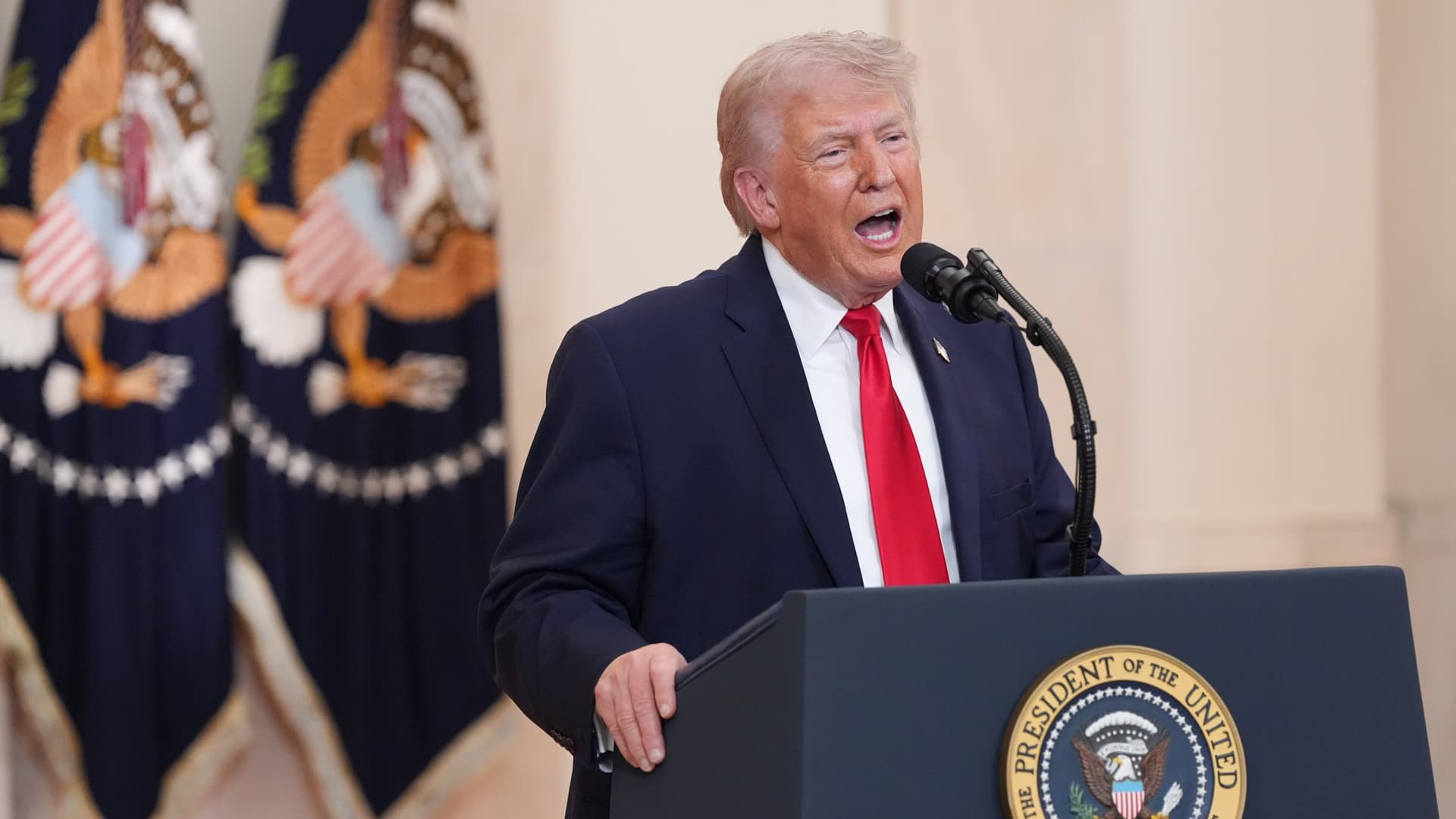
U.S. President Donald Trump delivers a prime-time address to the nation at the Cross Hall of the White House on Wednesday, April 1, 2026 in Washington, DC, USA.
Alex Brandon | Bloomberg | Getty Images
Investors are caught between a quick deal that could end the war and a significant escalation that could send oil prices and bond yields higher as the post-holiday trading week begins.
President Donald Trump issued a profanity-filled ultimatum on Sunday, warning that Iran “will live in hell” if the Strait of Hormuz is not reopened by 8pm ET on Tuesday, declaring the day “Power Plant Day and Bridge Day rolled into one.”
Separately, President Trump said in an interview with Fox News on Sunday that he expects there is a “good chance” of reaching a deal by Monday.
It’s been a week where conflicting signals have forced investors to position for vastly different outcomes.
Meanwhile, Iran continued its attacks across the Gulf, including on Kuwait’s oil headquarters over the weekend, and has said the vital waterway will fully reopen only after Iran compensates for war damage, rejecting President Trump’s latest threats.
“Markets are nervous because time is running out and the outcome is either a ceasefire or escalation,” said Rob Subbaraman, head of global macro research at Nomura. Nonetheless, Subbaraman said Trump’s tone suggests investors remain “hedged against escalation risk” and that the White House has a degree of urgency to end the war.
President Trump has wavered between praising talks with Iran as productive, with a peace deal on the horizon, and warning that he is prepared to step up military action against the Islamic Republic. He has repeatedly extended the deadline for Iran to reopen the Strait of Hormuz.
The mixed messages have led to volatile oil trading and market instability. of S&P500 The stock rose 3.4% last week, its biggest weekly gain since November, as investors bought into hopes of a diplomatic solution. The CBOE Volatility Index jumped from less than 20 before the war to about 24 last week.
“President Trump’s escalating tone[over the weekend]is very much in line with his strategy: headline-driven, unpredictable and designed to apply maximum pressure quickly,” said Mohit Mirpuri, equity fund manager at SGMC Capital.
“Markets will have to get used to this style of policy-making for the foreseeable future during his tenure,” Mirpuri added.
The risk of stagflation is looming
A month of war and the de facto closure of the Strait of Hormuz threatens to plunge the world into one of the most severe energy crises in history. And analysts said even a diplomatic breakthrough might not bring immediate relief to markets.
Brent crude oil prices soared to $109.77 per barrel on Monday, up about 50% since the war broke out on February 28. West Texas Intermediate soared 66% and was trading at $111.2 as of 11pm ET.
Despite a modest increase in recent days, shipping volumes through the Strait of Hormuz, through which before the war about a quarter of the world’s offshore oil and about a fifth of the world’s liquefied natural gas passed through, were still 95% lower than pre-war levels.

“Even in a scenario where the Strait of Hormuz remains open, the damage to trust and supply chains has already been done and things will not return to normal quickly,” Mirpuri said. “The market remains sensitive to headlines and is likely to move sharply in both directions as the narrative changes.”
OPEC+’s decision on Sunday to raise May production quotas by 206,000 barrels per day will do little to shore up oil supplies, as war has limited production and shipments in some of the world’s biggest oil producers.
Subbaraman said the war “has been going on long enough to cause serious inflation spikes around the world,” and warned that “if the war escalates from here, the inflation shock could quickly escalate into a growth shock with demand destruction and complete stagflation.”
Bond yields: an undervalued risk
Bond markets are quietly reassessing the outlook for inflation. The yield on the 10-year Treasury rose to 4.362% on Monday from 3.962% before the dispute began, hovering near its highest level since mid-2025, as investors dial back expectations for the Federal Reserve to cut interest rates this year.
“One of the big underappreciated risks is changes in government bond yields,” Mirpuri said. “If this geopolitical shock sustains inflation expectations, it could push yields back up and tighten financial conditions in an already fragile market.”
Wall Street strategist Ed Yardeni said bond markets are re-pricing government notes to reflect the rapidly deteriorating outlook for inflation, and that “bond vigilantes are taking matters into their own hands and tightening credit conditions.”
“We cannot now rule out the possibility of a bear market or even a recession. It all depends on how long the Straits remain closed,” Yardeni warned, adding that the economic pain from disruptions to global energy flows is becoming even more acute.
Volatility by headline
As investors hold their breath ahead of Tuesday’s deadline, markets are expected to remain highly volatile as they try to gauge any signals from Washington and the Iranian government.
Markets in Japan and South Korea rose on Monday as Axios reported that the United States, Iran and a regional mediation committee were discussing terms for a 45-day cease-fire that could lead to a permanent end to the war, although the report said it was unlikely a partial agreement would be reached by the deadline. India’s benchmark index fell.
“We are (currently) in an event-driven market, where headline risk is dominating intraday movement, and positioning must consider alternative outcomes,” said Hiroki Shimazu, chief strategist at MCP Asset Management.
He expects both sides to gravitate toward détente, in the form of a “quiet reduction in the tempo of attack” brokered by Oman, rather than a definitive solution. “Rather than moving closer to a complete resolution, we are in a prolonged stalemate,” Shimazu said, predicting prolonged instability in the coming weeks.
Investors are also awaiting key economic data coming out of the US this week. The February personal consumption expenditures index, the Federal Reserve’s preferred measure of inflation, is scheduled to be released on Thursday and could provide an early indication of whether the oil crisis is spilling over into prices in the world’s largest economy.
Spot gold, which has fallen about 12% since the war began to $4,672.03 an ounce, also faces a tug of war between safe-haven demand and geopolitical headwinds from a strong dollar and rising U.S. Treasury yields. A strong dollar has made dollar-priced bullion less available to holders of other currencies, and rising yields have made non-yielding metals less attractive.
“Near-term uncertainty is clearly very high and for most investors, it’s a wait-and-see option at this stage,” said Chetan Seth, Asia-Pacific equity strategist at Nomura.
