

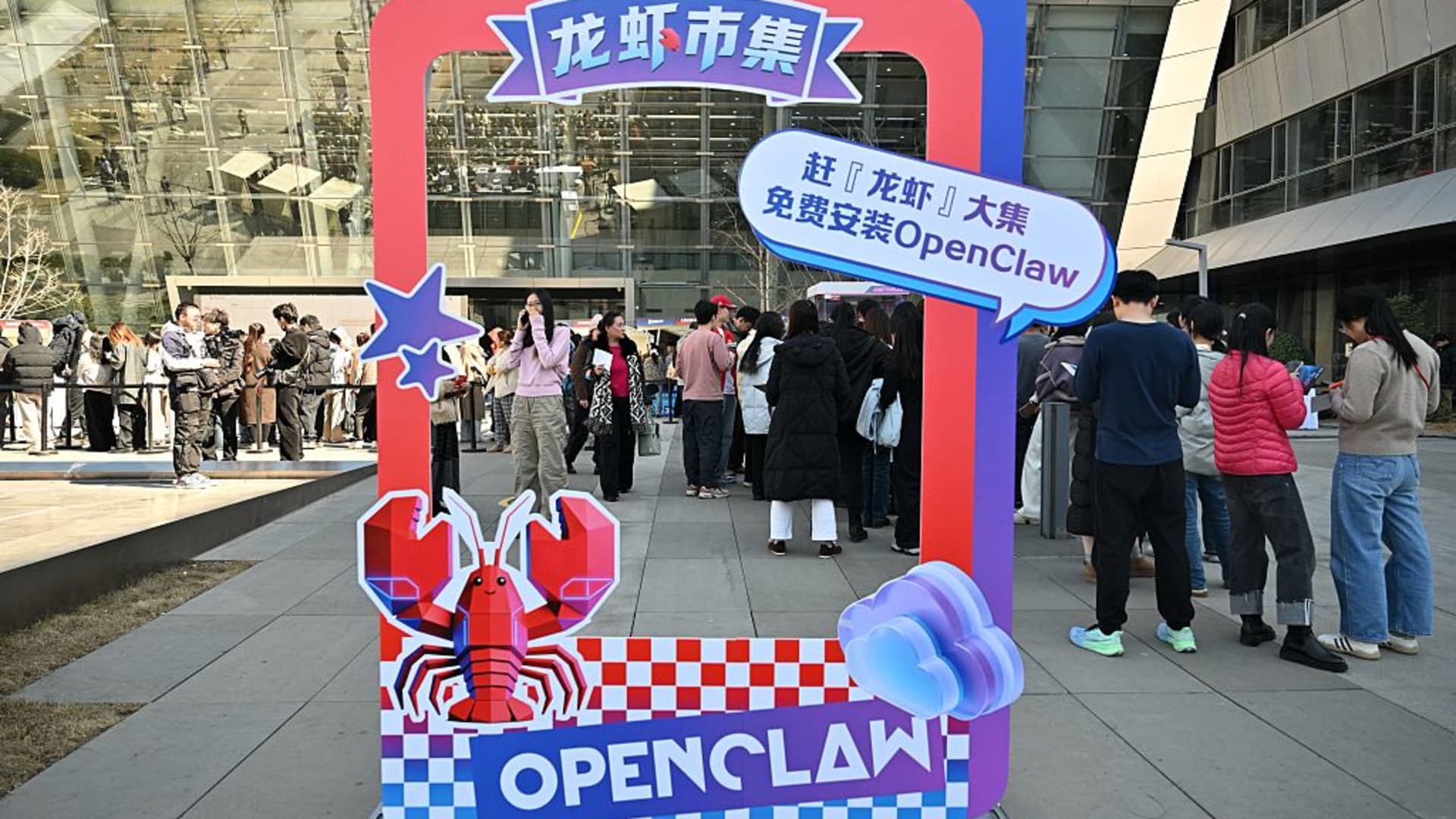
People line up to install OpenClaw, an open source AI assistant, on their laptops at Baidu’s headquarters in Beijing on March 11, 2026.
Adek Berry | AFP | Getty Images
Three months ago, the tech industry didn’t know about a lobster-themed AI coding project built by a little-known Austrian software developer.
OpenClaw, as it is known for its work, has risen rapidly since then, taking center stage at this week’s GTC. Nvidia’s At the annual conference, leaders of the world’s most valuable companies called it “the most popular open source project in human history.”
“This is definitely the next ChatGPT,” Nvidia CEO Jensen Huang told CNBC’s Jim Cramer on the sidelines of a developer event in Santa Clara, California. In his keynote, Huang discussed OpenClaw as a go-to option for building AI agents that can perform tasks such as reconnaissance. eBay He said he made a bid after the deal began, and in just a few weeks, “we’ve done more than Linux has done in 30 years.”
This phenomenon is so important to Nvidia that the chipmaker said at GTC that it is building a free companion security service, packaged as NemoClaw, with the goal of accelerating the adoption of OpenClaw and getting larger enterprises accustomed to its use.
Mr. Huang was validating what other companies in the market were witnessing. Independent developers, rather than large, high-value labs like OpenAI or Anthropic, came up with the next big thing in AI, and in doing so exposed potentially serious flaws in the investment theory behind large-scale language models. That means language models may be commoditized.

While OpenAI and Anthropic remain hugely popular and continue to build services that resonate with users, the power of OpenClaw is that it allows developers and hobbyists of all kinds to quickly create and manage AI agents in online communication channels like WhatsApp and Telegram from their home computers.
Some industry experts say OpenClaw’s rise shows that not all of the value in the AI space comes from just two large startups with a combined private market value of more than $1 trillion and their hyperscalar competitors.
“This strengthens the open source community and proves that you can run fully autonomous AI in your home without relying on the Magnificent 7 or Big AI,” said David Hendrickson, CEO of consulting firm GenerAIte Solutions. “I think this was the black swan moment that most big AI companies were afraid of.”
Hendrickson said developers are attracted to Chinese AI models because of OpenAI, Anthropic, google. And since developers are using OpenClaw on their personal computers, apple We found that using Mac Mini to manage a fleet of always-on AI agents was much more economical than leveraging the cloud to access larger models.
“As underlying models rapidly become commoditized, there is a focus on agent frameworks that emphasize autonomy, ease of use, locality, and control to power agent AI applications and drive business value,” said Forrester analyst Charlie Dai.
OpenAI and Anthropic are well aware of this threat.
Anthropic is debuting similar OpenClaw-like features, including new channel tools.
And last month, OpenAI CEO Sam Altman announced in a Sunday post on X that OpenClaw developer Peter Steinberger would join the AI company and that the services he created would “remain fundamental as open source projects that OpenAI will continue to support.”
Mr. Altman called Mr. Steinberger “a genius with many great ideas” and said he would help “promote the next generation of independent agents.”
“I can’t trust this.”
However, the open source nature of OpenClaw means that OpenAI does not own the technology. This laissez-faire approach can be a challenge for enterprise adoption, as many large companies are wary of the security risks posed by giving hundreds or thousands of digital assistants access to sensitive internal data or allowing them to take actions that could put the business at risk. With NemoClaw, Nvidia is trying to provide that layer of security.
“If it’s for personal use, you might be able to manage the risks, but if you’re building a business, you can’t rely on this and you don’t have peace of mind,” Israeli developer Gabriel Cohen told CNBC. “I have no responsibility to tie my customer data to it.”
Cohen said that when he started brainstorming ways to use OpenClaw within his AI marketing agency, it felt like a “giant light bulb” went on in his head. Because the service can run on messaging apps like WhatsApp, Telegram, Slack, Discord, and Signal, Cohen envisioned AI agents helping facilitate conversations with colleagues in customer management, product development, finance, and other business functions.
But he noticed some major problems from the start, including the software’s inability to distinguish one WhatsApp group message from another. Mr. Cohen said the last thing he wanted was for his colleague to ask the AI agent if he had time for an afternoon meeting and for the agent to respond by saying he had to take his daughter to the ballet at that time, since the agent had deduced his whereabouts from Mr. Cohen’s personal messages.
With the help of Anthropic’s Claude Code, Cohen spent days creating his own OpenClaw variant tailored to meet security expectations, such as blocking personal WhatsApp groups from work chats. Since releasing his work, called NanoClaw, to the open source community at the end of January, the project has snowballed within the AI developer community.
Cohen said his wife started chatting with a new AI agent created by NanoClaw named Andy and realized that the software could help her track stroller prices and message her on WhatsApp when it found a good deal.
“It’s like a SaaS product where you might spend $10 a month on a subscription,” Cohen says.
Mr. Cohen and his brother have since shut down their AI marketing firm, founded a new startup called NanoCo that provides paid services to accompany NanoClaw, and partnered with container technology company Docker last week to solidify its position as a competitor to OpenClaw.

David Bader, director of the New Jersey Institute of Technology’s Data Science Institute, said the tech industry is “seeing a transformation of classic platforms,” with fundamental models and Chinese labs “combining their capabilities.”
“The model becomes the engine, and the agent framework becomes the car,” Bader said.
Representatives for OpenAI and Anthropic have not commented on the matter.
Not everyone in the technology industry is convinced that the basic model is losing momentum.
Jerry Chen, a venture capitalist at Anthropic investor Greylock, said he still believes OpenCrow’s success in showing what a world of “intelligent agents” looks like does not diminish the importance of the underlying foundational model, which is more powerful than so-called openweight alternatives.
“The buzz around OpenClaw stems from the ability to make AI more concrete for a broader audience, beyond researchers and engineers,” Chen said. “The interesting question at this point is whether OpenClaw will become the de facto standard (in Jensen’s words, the Linux of the market) or just the first of many open-source and closed-source agent operating systems.”
For Wall Street analysts covering Nvidia, the OpenClaw moment is historic in its significance.
Jay Goldberg of Seaport Research Partners is the only one of the roughly 70 Nvidia analysts tracked by FactSet with a sell recommendation on the stock. He started reporting on the company in April, when the AI boom was already causing stock prices to soar, and the stock has continued to rise, rising more than 60% from his sell rating.
“Part of my criticism of NVIDIA was, what’s the point with this AI? There’s no consumer use case for AI,” Goldberg says. “I’ve always defended my reputation by saying: If someone comes up with a really great AI application, I could be wrong.”
Goldberg said he finally understood the excitement after trying OpenClaw on his recently purchased Mac Mini.
Goldberg, a parent of three children, said he receives an average of 10 emails a week, which he dreads reading, and wants an agent to scan them and tell him anything important, like if he has to pick up his kids early from school or get them dressed for a photo shoot.
“It’s not just the functionality of the object itself, it’s the part of our lives that gives us access to it,” Goldberg said.
Goldberg said he doesn’t want to give NVIDIA any credit, but he did admit that he was “envious” of Huang, who he said “did a great job” in describing OpenClaw as an operating system. Meanwhile, Goldberg said he watches a lot of TikTok videos on OpenClaw and wants to understand more about TikTok before he feels comfortable incorporating it into his life.
Goldberg said of OpenClaw’s growing pains: “It’s erratic, it’s incredibly unstable, it’s like a half-functioning Mac Mini.” “It’s very easy to see how this can be powerful and really useful.”
Note: Nvidia is one of the fastest growing companies, but one of the lowest valued.

