

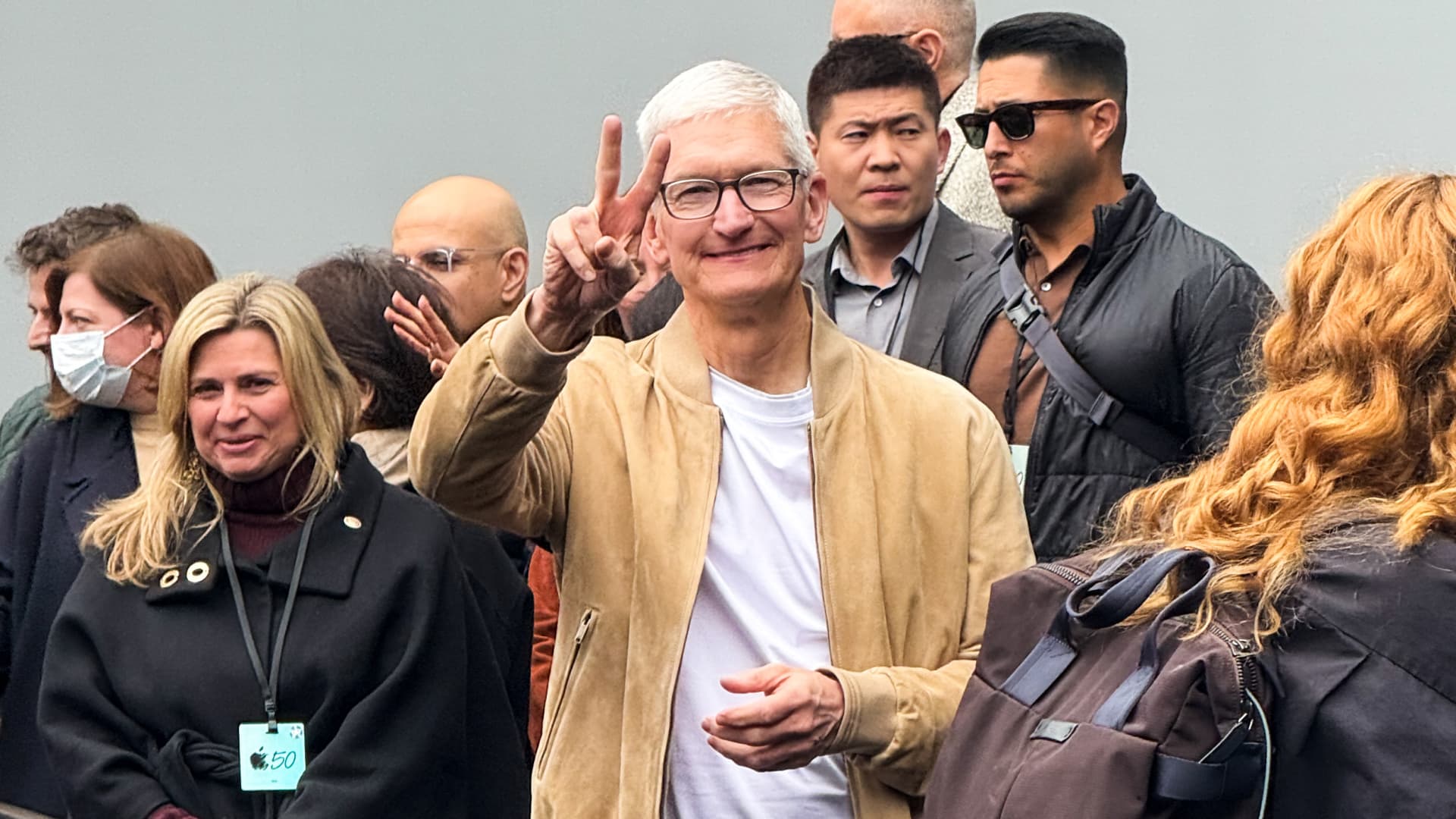
CHENGDU, CHINA – MARCH 18: Apple CEO Tim Cook attends a special event commemorating Apple’s 50th anniversary held at Apple Taikoo Li Chengdu store in Chengdu, Sichuan, China on March 18, 2026.
VCG | Getty Images
Tim Cook arrived in Chengdu, China, this week for an Apple Store event celebrating the company’s 50th anniversary, but the visit was carefully planned and came at a pivotal moment in the iPhone maker’s complex relationship with the world’s largest smartphone market.
Tensions between the United States and China have been ratcheting up, in part due to the Iran war and the announcement of a new investigation into China’s trade practices after the Supreme Court struck down President Donald Trump’s biggest tariffs, including hefty taxes on imports from China.
But China remains a key market for Apple, even as the company faces growing geopolitical challenges and growing antitrust pressure. Days before Cook’s visit, Apple lowered App Store fees in mainland China from 30% to 25% for in-app purchases and paid transactions, effective March 15. Apple also lowered fees for small developers and mini-app partners from 15% to 12%. The company said in a memo last week that the change was due to “consultations with Chinese regulators.”
This isn’t the only concession China is seeking from Apple.
According to an analysis by TMTPost, the Chinese Communist Party’s official newspaper People’s Daily published an editorial arguing that Apple needs to go further. The paper said Chinese users and developers still lack access to third-party payment systems and alternative app distribution, and urged regulators to continue pushing Apple to open up its ecosystem.
Separately, China’s State Administration for Market Regulation is investigating Apple’s app fee policy and ban on external payment services, according to a previous report by CNBC.

Apple celebrates its 50th anniversary next month, but its hardware business in China is thriving despite all the headwinds.
iPhone sales in the world’s second-largest economy surged 23% in the first nine weeks of 2026, according to data from Counterpoint Research released Thursday. This figure is even more remarkable considering that China’s overall smartphone market declined by 4% year-on-year during the same period. Apple’s sales in Greater China jumped 38% to $25.5 billion in the latest quarter, driven by demand for the iPhone 17.
Appease Wall Street
Apple’s iPhone momentum in China is being driven by a combination of online retail promotions and government trade-in subsidies for base iPhone 17 models, according to Counterpoint. At the same time, Android-based competitors such as Oppo and Vivo are pushing up prices to offset the rising cost of memory chips, giving Apple room to keep prices firm and expand market share.
Separately, Apple Chief Operating Officer Sabi Khan spent a week visiting manufacturing partners in China, visiting Sunwoda’s battery factory in Shenzhen and Foxconn’s assembly lines in Shenzhen and Chengdu, state news agency Xinhua reported.
Apple’s continued dominance in smartphones, with heavy help from China, has helped placate Wall Street, which expects the company to gain traction in artificial intelligence.
The company’s shares have fallen more than 8% since the beginning of the year, while the Nasdaq is down about 5%.
According to a Wall Street Journal analysis, Apple is on pace to hit $1 billion in AI revenue this year, with nearly all of that coming from a portion of subscriptions to ChatGPT, Grok, Claude, Gemini, and other generative AI apps sold through the App Store.
AppMagic estimates these fees to be around $900 million in 2025, with ChatGPT alone accounting for three-quarters.
Apple hasn’t built its own frontier model, progress with Siri has been slow, and Apple’s AI chief, John Gianandrea, left last year. His successor, Amar Subramanya, spent 16 years at Google leading engineering on Gemini Assistant, followed by a short stint running AI at Google. microsoftApple has made its most reliable AI hire in years.
As Apple looks to carve out a sustainable AI business, it may continue to rely on the iPhone as a gateway to its most popular chatbots, and whoever wins in the competition can collect royalties.
Attention: Apple’s talent drain concerns

