

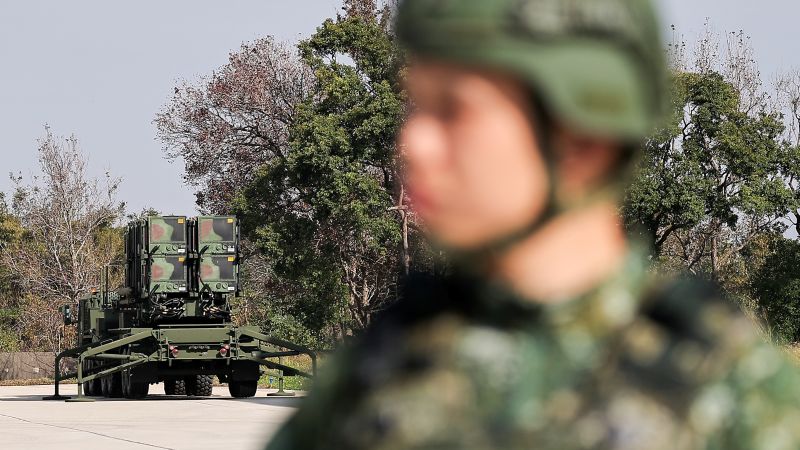
Taipei, Taiwan
—
In recent years, there has been growing concern in Western intelligence circles that China could invade the self-governing island of Taiwan as early as next year. But the US now says an imminent attack is unlikely.
The annual threat assessment by the U.S. intelligence community said Beijing hopes to achieve so-called unification without the use of force and recognizes that an amphibious attack would be extremely difficult and at high risk of failure, especially if the United States intervenes.
“In deciding whether and how to pursue a military approach to unification, Beijing will almost certainly consider a variety of factors, including the readiness of the PLA, Taiwan’s actions and politics, and whether the United States will intervene militarily on Taiwan’s behalf,” the report said, referring to the People’s Liberation Army.
In 2021, Admiral Philip Davidson, then head of Indo-Pacific Command, said China wanted to be ready to invade Taiwan over the next six years. The assumption that Beijing could take action in 2027 has become known as the “Davidson Window,” increasing the urgency for Taiwan’s military reform.
The latest analysis comes as President Donald Trump seeks to postpone a key meeting with Chinese leader Xi Jinping in Beijing, where U.S. policy towards Taiwan is expected to be one of the top priorities.
China’s ruling Communist Party has vowed to “reunify” Taiwan with the autonomous democratic nation as part of its “national revival” plan, even though it has never ruled Taiwan.
The United States does not maintain formal diplomatic relations with Taiwan and has long declined to say whether it would send military aid in the event of a conflict, but Chinese officials have previously accused Washington of interfering in Taiwan’s internal affairs and denounced proposed arms sales that could total $25 billion.
China has also often emphasized its preference for peaceful unification. Still, the increasing frequency of Chinese military incursions around the island and deteriorating relations between Beijing and Taipei have raised concerns that Mr. Xi may eventually resort to military force.
Asked Thursday about the latest U.S. intelligence assessment, Beijing Foreign Ministry spokesperson Lin Jian urged U.S. agencies to “stop exaggerating the ‘China threat’ theory.”
“How to resolve the Taiwan issue is entirely a matter for the Chinese people themselves, and we will not interfere with any interference from any foreign power,” Lin said at a regular press conference.

While the latest U.S. assessment tempers previous assumptions, analysts said it would not have a major impact on efforts by the U.S., China and Taiwan to prepare for a potential conflict.
The 2026 report said the Chinese military is still “making steady but uneven progress in its capabilities to occupy Taiwan and use it in any attempt to deter and, if necessary, defeat U.S. military intervention.”
Taiwan has extended military conscription and increased defense spending, but since President Trump took office, confidence in U.S. military assistance in the event of war with China has waned.
However, a senior Taiwanese security official told CNN that the US revised assessment does not mean the threat is over. “In addition to continued political interference and united front operations, China continues to adjust its expansionist goals and schedule,” the official said, adding that Beijing is “recalibrating its approach based on the changing deterrence posture of the United States and its allies in the global geopolitical landscape.”
According to Reuters, the escalating attack on Iran, for which President Trump is currently considering sending thousands of U.S. troops, could also draw attention and resources away from security in Asia.
“Taiwan continues to view China’s growing military power and the growing fallout from U.S. military adventurism, as demonstrated by the Trump administration’s military operations in Venezuela and Iran, as signs that great powers may increasingly believe that ‘force is right,'” said William Yang, senior analyst at International Crisis Group.
At the same time, China’s appetite for conflict has likely been weakened by its struggle to support its slowing domestic economy and by a wave of layoffs at its top military ranks.
“The purge at the highest levels of the military has effectively put the leadership on hold for at least the next two years on the option of invasion,” said Amanda Shao, China director at political risk consulting firm Eurasia Group. “Beijing continues to view the costs of invasion as too high in the short term because it could derail the country’s development, which is a top priority for the leadership.”
This article has been updated with additional information.
