

The political tug-of-war between the United States and Australia over the fate of seven members of the Iranian women’s soccer team appears to have ended with the exhausted team returning home, with the exception of two players who defected last week.
Critics now claim that as the drama unfolded, politics took precedence over consideration of women’s best interests. The evidence is that of the seven Iranian women who were initially granted asylum in Australia, five changed their minds within days and returned to their home country for undisclosed reasons.
Recommended stories
list of 4 itemsend of list
Critics argue that the outcome could have been different if the women had been provided with independent legal advice sooner and the process had not been so rushed.
“We certainly ended up with an outcome that was far from ideal,” said Graham Thom, advocacy co-ordinator at the Refugee Council of Australia, a not-for-profit umbrella group representing asylum seekers.
“We hope that the two remaining people get the protection they need, and we also hope that those who have returned are safe,” he added.
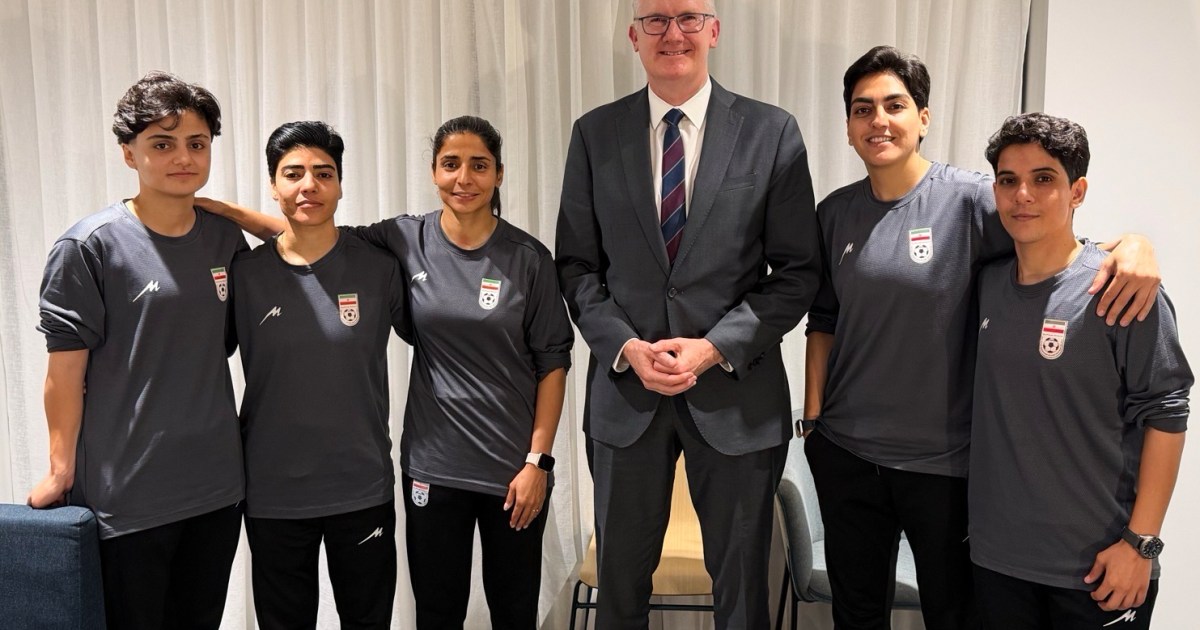
Iran has won an extraordinary public relations battle waged since March 10, when Immigration Minister Tony Burke released to the media a photo of him posing with five women who had been granted protection visas.
He said the women all showed up without head coverings and were happy to have their names and images published in the media.
Refugee advocacy groups were alarmed and questioned whether a woman who grew up under a repressive regime could question the Australian government’s media strategy.
Kylie Moore-Gilbert, a political scientist at Sydney’s Macquarie University who served more than two years in an Iranian prison between 2018 and 2020 on spying charges, said “winning the propaganda war” had cast a shadow over women’s welfare.
Moore-Gilbert told ABC Media this week: “If they had sought asylum quietly and without publicity, the Islamic Republic authorities could have done so, as they have done with other Iranian athletes who have defected in the past…and just tolerated it.”
Australia has traditionally worked on asylum claims behind closed doors, recognizing that increased public attention can increase pressure and pose risks to potential refugees and their families.
Concerns for the team’s welfare were heightened after players decided not to sing the Iranian national anthem before the first match of the Women’s Asian Cup on the Gold Coast on March 2.
Iranian sports commentator Mohammad Reza Shahbazi’s televised remarks calling the women “wartime traitors” were widely quoted by protesters demanding asylum for the team.
Although the gesture attracted worldwide attention, it was not repeated at the women’s next game, where they sang the national anthem.
Shahram Akbarzadeh, a professor of Middle East politics at Deakin University in Geelong, Australia, suspects the team did not give enough thought to the impact of their “expression of political opinion” on the Iranian regime.
“Sometimes the frustration outweighs the fear of the outcome,” Akbarzadeh said.
“Unfortunately for these players, their acts of defiance have become a symbol of resistance against the regime and a cause played by the US and the Iranian diaspora, who are essentially dissidents, with the aim of humiliating and embarrassing the regime and essentially gaining political points from this situation,” he added.
The stakes rose after US President Donald Trump took to social media to call for the team to be granted asylum and called Australian Prime Minister Anthony Albanese on the issue.
Albanese told Trump that the first five players (four players and one team manager) recently accepted offers of humanitarian visas.
Two other team members chose to remain after being eliminated from the competition until the remaining team members flew from Sydney to Malaysia on March 10.
“It quickly became a political conflict and a political arena between Iran and the United States (and) Australia, but of course the Iranians reacted accordingly. They never seemed more embarrassed by their failure,” Akbarzadeh said.
All but two of those who accepted asylum rejoined the team in Kuala Lumpur, after which the team flew to Oman on Monday. Iranian state media reported that they returned to their homeland by bus from Turkiye and that a welcoming ceremony was held.
“I’m very happy to be in Iran, because Iran is our homeland,” midfielder Fatemeh Shaban told the flag-waving crowd.
The reasons why the five women changed their minds about building a new life in Australia were not made public, but there were hopes the regime would threaten their families.
Shiva Amini, a former Iranian national soccer player who now lives in New York City, said he was in contact with the two remaining women in Australia, Fatemeh Pasandide and Atefeh Ramezanisadeh, as well as a number of other women who had decided to return to Iran.
Amini was granted asylum in Switzerland in 2017 after the Iranian government threatened sanctions after she was photographed playing a casual game of soccer with men without wearing the European country’s compulsory hijab (scarf).
“It’s very sad that they couldn’t stay. Even if they go back to Iran, they will threaten your family,” Amini told The Associated Press on Tuesday.
Amini did not elaborate on his conversations with the players, citing concerns for the safety of the players and their families.
She said the government pressured at least one of the players, who she did not name, to return to Iran by threatening to harm her mother.
Iranian Foreign Ministry spokesman Esmail Baghai said none of the five women who changed their minds about remaining in Australia were under pressure from Iran to return.
“They didn’t ask for asylum. They were forced. They were coerced. They didn’t do it voluntarily,” Bagai told the ABC on Thursday.
Asked if the two remaining players in Australia were being held against their will, he said: “I think so.”
Mr Baghai said Australian authorities asked the Iranian woman to go to a room under the pretext of testing her for performance-enhancing drugs, sign visa documents and have her photograph taken with Mr Burke.
“This was a disgraceful and false posturing,” Bagai said.
Australia has denied putting pressure on the women to stay or leave.
On Monday, after the fifth asylum seeker rejoined the team in Kuala Lumpur, Assistant Secretary for Immigration Matt Thistlethwaite described the team’s plight in Australia as a “very complex situation”.
“These are deeply personal decisions and the government respects the decisions of those who choose to return, and we will continue to provide support to the remaining two,” Mr Thistlethwaite said.
