

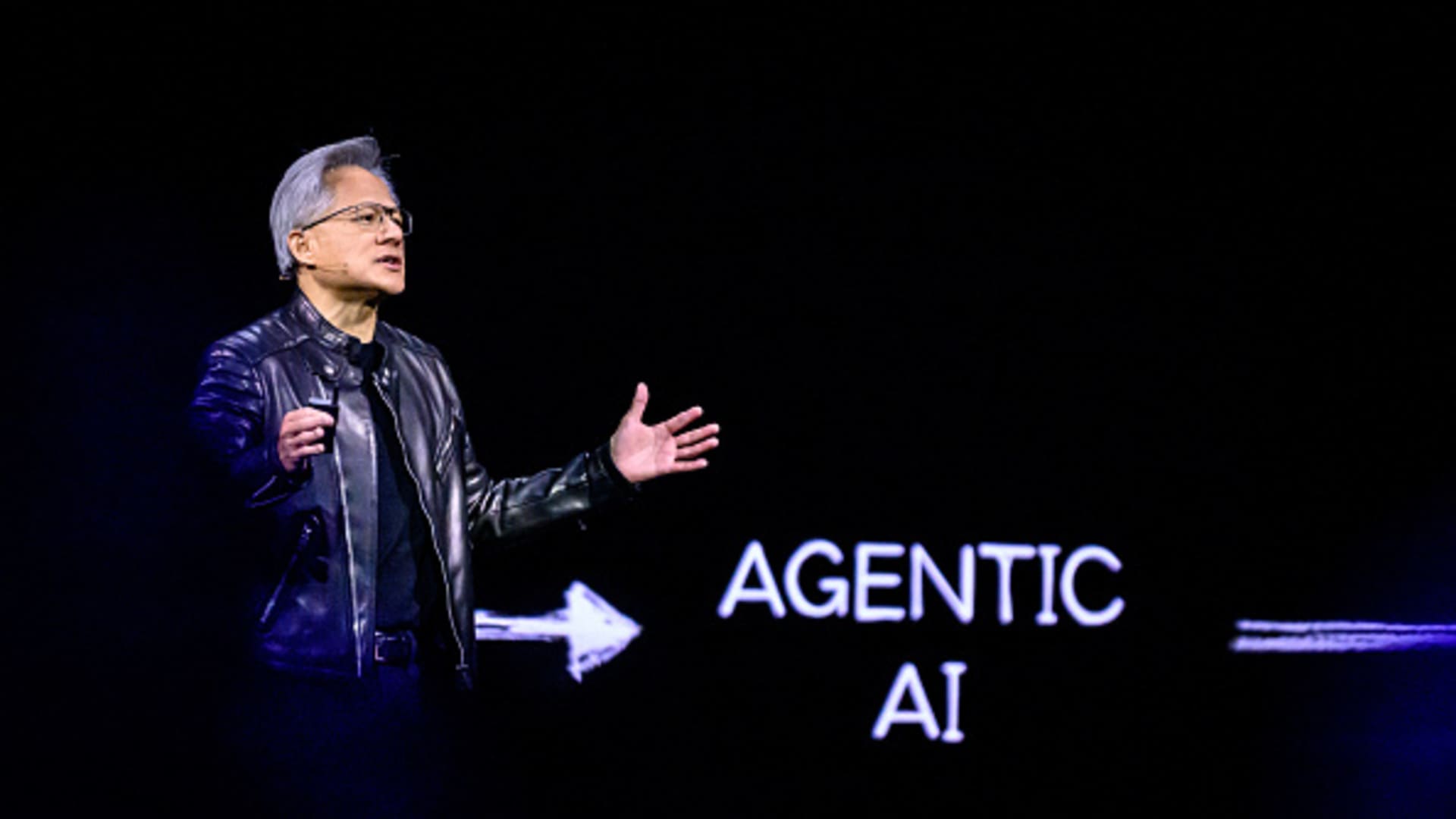
Nvidia CEO Jensen Huang delivers the keynote speech at the GTC AI Conference on March 18, 2025 in San Jose, California.
Josh Edelson | AFP | Getty Images
The perks of working in Silicon Valley have long included high salaries. Now, some engineers may be offered a new incentive in the form of artificial intelligence tokens.
Nvidia CEO Jensen Huang on Monday announced a novel compensation model that gives engineers a token budget on top of their base salary, effectively paying for the cost of deploying AI agents as a way to increase productivity.
Tokens, or units of data, used in AI systems can be used to run tools or automate tasks and are becoming “one of the recruiting tools in Silicon Valley,” Huang said.
“(Engineers) will be making hundreds of thousands of dollars a year, which is a base salary,” Huang said at the chipmaker’s annual GPU technology conference.
“We’re probably going to give half of that (on top of base salary) as a token…because it increases the productivity of every engineer who has access to the token.”
The proposal laid out Huang’s broader vision for the workplace, where engineers oversee a set of AI agents that can autonomously complete complex, multi-step tasks with minimal user input.
That’s the vision Mr. Hwang has been building towards publicly. Last month, he told CNBC that NVIDIA employees will one day work alongside hundreds of thousands of AI agents.
“We have 42,000 biological employees, but we will have hundreds of thousands of digital employees,” he said.
The comments come amid growing concerns that white-collar jobs will be hollowed out by AI agents – software systems that can independently perform complex, multi-step tasks.
In a note to investors, Howard Marks, founder of Oaktree Capital Management, warned that there are “incredible leaps in AI capabilities” that are allowing AI to “act autonomously”, a distinguishing feature that will determine its ability to replace human labor.
“That difference is what separates a $50 billion market from a multi-trillion dollar market,” the veteran investor said.
Goldman Sachs estimates that AI could automate tasks that account for 25% of all U.S. work hours, enough to fuel fears of what some are eerily calling the “jobs apocalypse.”
The bank estimates that AI could increase productivity by 15% and eliminate 6% to 7% of jobs over the implementation period.
“If AI proves to be a greater worker replacement than traditional technologies, the risks will be even more skewed,” said Joseph Briggs, senior global economist at Goldman.
Citing research by economist David Orter, Briggs said that about 60% of today’s workers are in jobs that didn’t exist in 1940, suggesting that while AI will make some roles obsolete, it will create others that don’t yet exist.
AI agents drive software demand
Huang is optimistic about the impact AI agents will have on the software industry, describing it as “counterintuitive.” Rather than reducing the demand for software, AI agents will become the most voracious customers.
His logic is: More AI agents means more demand on the underlying software infrastructure on which they run: the programs, tools, and computing resources that power them.
“The number of C compilers we use, the number of Python programs we have, the number of instances we have are growing very rapidly because the number of agents using these tools is growing,” he said.
Bruno Ghicardi, president and founder of information technology company CI&T, called this change nothing short of a paradigm shift. “A new layer of abstraction is being created through agents,” he said.
“Software engineers can now ‘tell’ computers what to do in plain English rather than programming languages. Tasks that used to take months now take days, and it will only accelerate from here.”
“The Paradox of Talent”
Even as companies struggle to find skilled workers, fears about AI-fueled labor displacement are hard to contain.
The job market currently faces a “talent paradox”, with 98% of executives expecting AI to lead to job cuts over the next two years, while 54% cite talent shortages as their biggest macro challenge, said Luis Garrad, careers practice leader at consultancy Mercer Asia.
Garrad estimates that about 65% of executives expect 11% to 30% of their workforce to be redeployed or reskilled by AI by 2026.
Garrad added that entry-level jobs face the greatest risk as the skills gap widens further as AI eliminates the “stepping stone” tasks traditionally used to train new employees and the demand for AI-savvy workers accelerates.
Andreas Welsch, founder of consultancy Intelligence Briefing and author of Human Agentic AI Edge, said roles such as data analysis, document processing, information comparison and drafting of initial reports were at risk of being made the “front line” for ostracism.
Goldman’s Briggs conceded that even under the most optimistic scenario the transition would not be smooth, predicting that the peak total unemployment rate would rise by about half a percentage point as the job market moves into a new era.

But Briggs said new jobs would be created, stressing that technological change has always been the main driver of job growth in the long term through the creation of new jobs.
Tens of millions of people are currently employed in fields such as computing, the gig economy, e-commerce, content creation, and video games. These industries were the stuff of science fiction a generation ago.
That said, integrating AI capabilities into existing corporate workflows may ultimately prove more difficult than the technology itself. Since 2018, roughly 80% to 85% of AI projects have failed, noted Intelligence Briefing’s Welsch, a sobering statistic for an industry full of ambition.
“We don’t want to have hundreds of thousands of agents creating more problems than they solve,” he said.
