

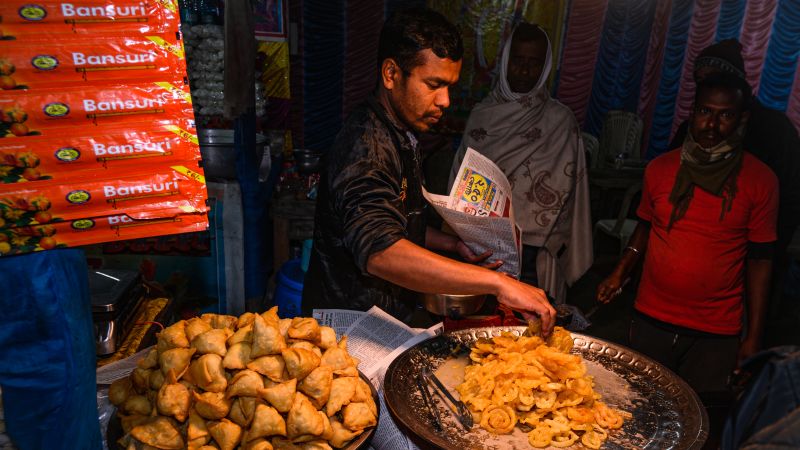
Iran’s strangulation in the Strait of Hormuz has sparked global concerns that fuel pumps will run dry, but it has also caused discomfort in the mouths of some restaurateurs and street vendors in India, with samosas disappearing from menus and the ubiquitous chai in some parts of the country missing its usual aroma.
The world’s fastest-growing major economy imports about 85% of its liquefied petroleum gas (LPG) from the Middle East, much of it used to cook food for its 1.4 billion people.
With supplies affected by the U.S.-Israel war with Iran, the government has begun diverting precious fuel away from industrial users such as cafeterias, hotels and restaurants, and toward keeping fires burning in household stoves.
To keep their kitchens running, some chefs are looking for alternatives or limiting certain menu items. Some people are switching to induction stoves. problem? Traditional Indian cuisine and electromagnetic coils are not completely compatible.
Indian cooking is an alchemy of high heat, heavy cast iron pots, and open flames. Without gas stove fire, curries lack depth, tandoori marinades don’t burn easily, and popular samosas (crispy pastries that rely on the intense, sustained heat of bubbling oil) turn pale and dirty.
Chetan Singh, owner of Gulabji Chai, a popular restaurant in northwest Jaipur, said the LPG shortage has forced him to remove some of his most “iconic dishes like bhang butter and samosas” from the menu.

“(That’s) what people usually line up here for,” he said. “People are disappointed because it is one of the stops for people visiting Jaipur.”
They also had to compromise on how to make their famous chai, a fragrant milky black tea infused with spices.
“We boil chai on an induction top, but it’s not the same and you don’t get the same flavor,” he said. “The menu is limited, but they all taste the same. There’s a heat and flavor that can only be produced on a gas stove.”
Domestic LPG production from refineries has increased by about 38% to address the shortage, the Indian government said in a statement on Tuesday.
Measures have also been taken to “curb LPG hoarding and black marketing across the country”, the report said, adding that more than 15,000 cylinders were seized in the raids.

War in Iran hits kitchens across India
The war in Iran has repercussions far beyond the Gulf. Concerns over a shortage of cooking gas have sparked protests in India, leading to panic buying of substitutes such as induction stoves. Much of India’s LPG imports pass through the Strait of Hormuz, leaving households and restaurants scrambling as the government tries to secure supplies through diplomatic negotiations. CNN’s Hanako Montgomery reports.

But uncertainty has disrupted the fast-paced rhythm of India’s street food and quick-service dining.
Akhil Iyer, founder of Benne Dosa, a chain of restaurants in Delhi and Mumbai, said he had to adapt to keep his kitchen moving.
“We switched our idlis and all our fried foods to induction,” he said. “Anything that can get rid of the gas, we have it.”
But while steamed and fried foods can survive the transition to electric heat, the stars of Ayer’s menu won’t.
“When we conducted the introductory test (of dosas), we found that the quality was not good enough,” he said. “(It) requires flame, it requires gas, it requires fire. We cook on cast iron baking sheets, but we need heat to get crispy and therefore provide the quality that we want to provide.”

One of Ayer’s branches in the financial hub of Mumbai has stopped selling dosas as the last cylinder of it has run out, he said. Iyer said chefs at the Delhi operation continue to use gas cylinders, albeit at a “reduced capacity.”
Last week, residents were seen queuing for hours outside gas distribution centers in several cities, with some arriving as early as 3am to secure cylinders for their homes.
Last weekend, two Indian-flagged ships carrying 92,712 tons of LPG passed through the Strait of Hormuz, which has been effectively closed since the United States and Israel launched a joint attack on Iran.
However, panic buying has begun amid concerns about a major energy crisis. Last week, Reuters reported that sales of induction stoves on Amazon India had surged more than 30 times.
Benne Dosa’s Iyer said teams will have to get creative if the impact lingers.
“We’re trying to find out if there are other ways to heat[cast iron pots]including traditional methods like wood fire,” he said.
That may be possible, but he is wary of the environmental impact. “We don’t want to cause that kind of pollution,” he said.
But when it comes to overcoming obstacles, there’s one thing Iyer says he’ll never do. That means taking my beloved dosa off the menu forever.
“That’s why we started Ben,” he said. “To serve delicious benne dosa.”
