

Editor’s note: Call to Earth is a CNN editorial series dedicated to reporting on the environmental challenges facing our planet and their solutions. Rolex’s Perpetual Planet Initiative has partnered with CNN to promote awareness and education on key sustainability issues and inspire positive action.
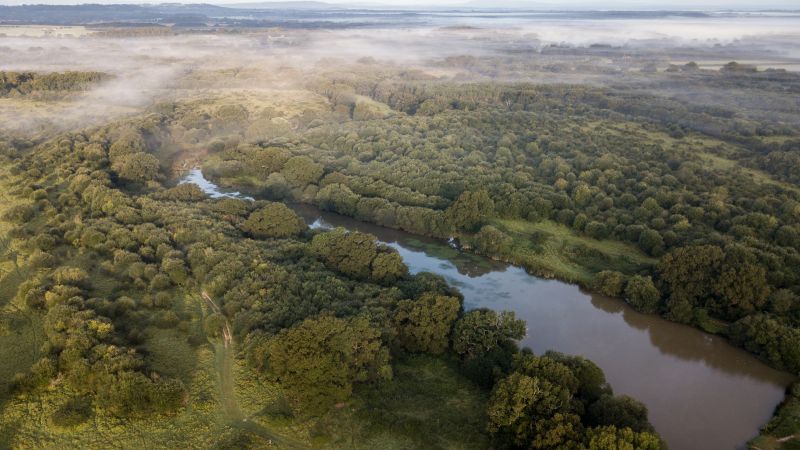
A walk through the Knepp estate in southern England will take you past beaver bogs, breeding herons and free-roaming Exmoor ponies, accompanied by the distinctive call of turtle doves.
“It’s a sound that used to be part of our culture. It defined everyone’s British summer,” says Isabella Tree, who owns 3,500 acres in West Sussex with her husband Charlie Burrell.
Turtle doves were once abundant in Britain, but their numbers have declined by 98% since 1994, and the turtle dove has been on the UK Red List (meaning it is considered an endangered species) for 20 years.
But at Knepp, the birds seem to be bouncing back. A recently published 20-year study of wildlife on the property found that the number of singing males had increased from just two in 2008 to 22 by 2024.
This increase is part of a broader surge in biodiversity at Knepp since Tree and Barrel began a rewilding project on the former farm in 2001.
“We never imagined that in just 20 years we would go from being such depleted, polluted and dysfunctional post-industrial farmland to becoming one of the UK’s most important biodiversity hotspots,” Tree says.

Results include an 870% increase in the number of dragonflies and damselflies on site between 2005 and 2025, and a 110% increase in the number of butterfly species. These include the elusive Purple Emperor butterfly, which currently has the UK’s largest population at Knepp, with 283 individuals counted in one day in 2025.
The number of breeding birds has increased ninefold since 2007, and the threatened nightingale, once common across the UK, is making a comeback. Last year, 62 singing males were sighted, up from just nine in 1999.
The grounds, which include a 19th-century castle, have been in the possession of the Burrell family for over 200 years. Charlie Burrell inherited it in 1985 and, after attending agricultural college, intended to continue farming in the same intensive way his grandparents had done since World War II.
However, by the late 1990s, low yields and rising costs meant the farm was £1.5 million ($2 million) in debt. Tree said, “I finally started to realize that no amount of intensive agriculture would be viable on this land,” which led him to start rewilding the land.
They began by sowing native wildflowers, grasses, and seeds in the 350-acre park area surrounding the mansion. They then introduced Tamworth pigs, Exmoor ponies, longhorn cattle, red deer, roe deer and fallow deer to the large estate.
Internal gates were removed to allow animals to roam freely, and seeds and nutrients were dispersed through their droppings and fur.
Beavers, extinct in the wild in England, were introduced to Knepp in the 16th century, when dams were built in waterways to create ponds and attract breeding birds, Tree said.
But after these reintroductions, Tree says, “The whole idea of rewilding is to let nature go and let it evolve.”
The growth of thorny shrubs on Knepp’s once-tidy farmland has provided “rocket fuel” habitat for turtle doves and nightingales, Tree said.
“It provides wonderful spiny protection for the nest, but it also provides all the food resources that many songbirds need, including seeds and buds, nuts and berries,” she explains.
But despite thriving in Knepp, Mr Tree believes there is a “slim chance” the turtle dove survives in the UK, given widespread habitat loss.
“If we[the UK]were really serious about reversing trends in biodiversity loss, we would be rolling out rewilding in every open space of land possible,” she says.
Almost 70% of Britain’s land is agricultural land, and Rob Stoneman, director of landscape restoration at British wildlife charity Wildlife Trust, says this is one of the main drivers of species decline in the country.
“We’ve been gradually pushing out the wild animals,” he says. “This is bad news for everyone. It’s bad news for the floods. It’s bad news for the drought. It’s bad news for the climate.”

The government has pledged to restore or create more than 500,000 hectares (1.24 million acres) of wildlife-rich habitat in England by 2042, but Stoneman says there are still obstacles to rewilding efforts.
“Education through agricultural universities, the way land subsidies are provided, advice to farmers…all these systems are increasing the focus of farmers,” he says.
Stoneman added that regulatory barriers are an additional challenge. The Dangerous Wild Animals Act of 1976 prohibits keeping the hard-to-obtain bison and wild boar without a permit, but Tree wants the two species released on the Knepp farm.
“Large, free-roaming herbivores are the driving force of the ecosystem,” Tree says.
Stoneman hopes Knepp’s success will pave the way for further rewilding programs across the country. Particularly in high-altitude regions (typically 600-700 meters (1,969-2,297 feet) above sea level), damaged peatlands emit large amounts of carbon and low-fertility soils create unproductive agriculture.
“Knepp is a light that shows the way,” he said, adding that along with biodiversity improvements, the estate was an “economic success story”.
When the land was cultivated, Knepp had only 23 full-time staff, but today it has 168 employees, with 200 working in old farm buildings on the property that are leased to other companies.
Knepp now operates a glamping business offering accommodation in cozy shepherd’s huts, yurts and treehouses, as well as safaris, guided walking tours and rewilding workshops.
Free-roaming large animals managed to prevent overgrazing provide a steady supply of organic meat, which is sold in the on-site shop and seasonal restaurant, which was recently awarded a Michelin Green Star for its sustainable and environmentally friendly gastronomy.
But rewilding has faced criticism from some farmers who fear it could jeopardize their livelihoods and domestic food production.
Britain’s National Farmers’ Union has previously argued that British farms provide important wildflower and hedgerow habitat and that the government should “focus on land sharing to achieve food security and environmental provision, rather than idiosyncratic approaches that risk undermining the social fabric of rural communities”.

Tree and Stoneman argue that rewilding to improve biodiversity is not a threat to farmers, but rather essential support for a food system that is increasingly vulnerable to the effects of climate change.
“Agriculture relies on the presence of nature as a buffer for production of everything from dung beetles, pollinating insects, natural pest control, and extreme weather buffers. Food production relies on all of these,” Tree says.
The farm is currently working with farmers and local communities across Sussex as part of its Weald to Waves project, building a 160-mile ‘wildlife corridor’ from Ashdown Forest in the east of the county to the south coast.
Tree believes Knepp’s biodiversity success can be replicated elsewhere. “If it can happen here, it can happen anywhere,” she says. “This was an extraordinary story of hope.”
