

Civil rights activist Jesse Jackson Sr yells and gestures during a campaign speech, 1988.
Afro Newspaper/Gado | Archive Photos | Getty Images
The Rev. Jesse Jackson, a civil rights icon, Baptist minister and two-time Democratic presidential candidate, died Tuesday at age 84.
The Jackson family confirmed his passing in a statement on Tuesday morning.
“Our father was a servant leader — not only to our family, but to the oppressed, the voiceless, and the overlooked around the world,” his family said.
“We shared him with the world, and in return, the world became part of our extended family. His unwavering belief in justice, equality, and love uplifted millions, and we ask you to honor his memory by continuing the fight for the values he lived by.”
He died peacefully surrounded by his family on Tuesday morning, the family said in their statement. Jackson is survived by his wife, Jacqueline, six children and multiple grandchildren.
The civil rights leader spent decades in the public eye fighting to end racial and class divisions in America.
A protégé of Martin Luther King Jr., Jackson fought on the front lines of the battle against Jim Crow segregation laws as a college student. He stood out for his rousing speeches, radical ideas and passion for racial equality. Jackson would become a key figure in the civil rights movement that pressed for broader economic opportunities for Black people through the Southern Christian Leadership Conference, or SCLC, and more recently, his organization the Rainbow PUSH coalition.
Mahalia Jackson, left, sings “We Shall Overcome” with civil rights leaders the Rev. Martin Luther King, third left, Jesse Jackson, second from right, and Albert Raby, right, on Aug. 4, 1966.
Ray Foster | Tribune News Service | Getty Images
Jackson eventually transitioned into politics. In 1984 and 1988, he ran for the Democratic presidential nomination, winning multiple primaries and surpassing expectations each time. He based his campaigns on expanded equality for various racial minority groups, the working class and women.
Later, Jackson served as U.S. special envoy to Africa in the 1990s. He also acted as “shadow senator” for Washington, D.C., a role in which he lobbied for the district’s statehood.
During the 1980s and 1990s, Jackson also negotiated the release of dozens of international hostages and prisoners, and became a vocal supporter of voting and LGBTQ rights.
Participants carry a banner during the Gay Rights March April 25, 1993 in Washington, DC. Over 500,000 gays, lesbians and bisexual activists and their friends and families participated in the largest gathering of gay men and lesbians in history organized to end discrimination.
Porter Gifford | Hulton Archive | Getty Images
He was no stranger to controversy. During the 1984 presidential primary, he referred to Jews with the slur “Hymies” and called New York “Hymietown” in remarks he at first denied and later apologized for. “Saturday Night Live” lampooned the incident in a sketch featuring Eddie Murphy playing Jackson. And, in a testament to his stature in American political and popular culture, Jackson himself hosted “SNL” later that year.
In 2001, he admitted to having an extramarital affair that led to the birth of a daughter.
Jackson had been fighting Parkinson’s disease since November 2017. In August 2021, he and his wife were hospitalized with Covid-19 at Northwestern Memorial Hospital in Chicago. He was discharged in September after receiving successful treatment for the virus and Parkinson’s disease.
While Jackson had largely been absent from the political and civil rights main stage in recent years, he had taken every opportunity to renew pushes for equality.
Cleveland Mayor Carl Stokes (L) and Reverend Jesse Jackson, national head of Operation Breadbasket, chat together before Mayor Stokes delivered an address in connection with the Black Expo in Chicago. Mayor Stokes called for a “black political strategy for 1972” which “may mean the actual running of a black person for president.”
Bettmann | Getty Images
“If we played the big game, and the rules are not fair, and goals not clear and public, we would protest, but in politics we seem to make it alright, it’s not alright,” said Jackson in a 2018 podcast appearance. “We want a system that’s fair, and fairly applied. Americans want and deserve an even playing field with equal protection under the law, equal access and fairness.”
His family said Tuesday that it was his “unwavering commitment to justice, equality and human rights” that helped shape “a global movement for freedom and dignity.”
“A tireless change agent, he elevated the voices of the voiceless—from his Presidential campaigns in the 1980s to mobilizing millions to register to vote—leaving an indelible mark on history,” the statement said.
Roots of Jackson’s activism
Jesse Louis Jackson was born Oct. 8, 1941, in Greenville, South Carolina, to Helen Burns and Noah Louis Robinson, a married man and former professional boxer.
A year after Jackson was born, his mother married Charles Henry Jackson, a post office worker who later adopted him when he was 15.
Jackson grew up being taunted by other school children for his out-of-wedlock birth, which he said ultimately became his motivation to succeed.
The Reverend Jesse Jackson speaking to crowd in Chicago in Sept. 1969.
Bettmann | Getty Images
”It is where I get the drive to think I could change the South through the civil rights movement and run for President,” Jackson told The New York Times in 1997.
As a child, Jackson would know the harsh reality of the Jim Crow era, growing up at a time when racial segregation was in full force across the U.S. He attended all-Black public schools and was taught to sit at the back of buses and use “colored” restrooms and drinking fountains.
After graduating from Greenville’s Sterling High School in 1959, Jackson spent a year at the University of Illinois at Urbana-Champaign. He then transferred to North Carolina Agricultural and Technical College, or A&T, a historically Black school in Greensboro, North Carolina.
It was during his time at A&T that he first became active in the civil rights movement. Jackson joined the local Congress of Racial Equality chapter in Greensboro and participated in local protests and sit-ins against segregated public facilities.
“I came out of Greensboro,” Jackson told the Greensboro News & Record in 2015. “It was my launching pad. All that I subsequently became in the movement came out of the lessons I learned in Greensboro.”
After being barred from accessing books at the public library and placed in jail for trying to use the same library for class work, Jackson said he felt the “insult of segregation” and the “liberating power of going to jail for dignity,” according to the News & Record.
While home from college, he became a part of the Greenville Eight, a group of Black students who in 1960 protested the South Carolina city’s segregated library system. Jackson and seven Black high school students refused to leave the whites-only Hughes Main Library and were arrested for “disorderly conduct.”
Following their staged sit-in, the library system of the city became racially integrated.
It marked the beginning of what would become a lifetime career of civil rights activism.
Fighting for Civil Rights in the SCLC
After graduating from A&T in 1964, Jackson pursued divinity studies at the Chicago Theological Seminary and began to organize student support for Martin Luther King Jr.
Crowds in Memphis, Tennessee, following the assassination of civil rights leader Martin Luther King Jr in the city, 8th April 1968. In the centre, from left to right are singer Harry Belafonte, Coretta Scott King with Jesse Jackson behind, Reverend Ralph Abernathy and Reverend Andrew Young.
Santi Visalli | Archive Photos | Getty Images
On March 7, 1965, a day that would become known as Bloody Sunday, Jackson watched on television as club-wielding Alabama state troopers fired tear gas and charged at hundreds of nonviolent demonstrators who had just crossed the Edmund Pettus Bridge in Selma, Alabama. The demonstrators were part of the historic marches from Selma to the Alabama capital of Montgomery to fight for Black civil and voting rights.
A day after witnessing the violence on television, Jackson organized a caravan of seminary students to drive down to Alabama and join King in the Selma-to-Montgomery marches.
Jackson appeared at several commemorations of the marches, including an event hosted by former President Bill Clinton on the Edmund Pettus Bridge in 2000.
Reverend Jesse Jackson (2nd L), Coretta Scott King (3rd L), US President Bill Clinton (4th L) and US Rep. John Lewis (5th L) walk arm-and-arm over the Edmund Pettus Bridge 05 March 2000 in Selma, Alabama, to commemorate the 35th anniversary of the 1965 Voting Rights March.
Stephen Jaffe | AFP | Getty Images
“The blood of Selma set all of us free,” Jackson said at the event, surrounded by several prominent civil rights leaders and then-President Clinton. “How can I forget that season? My first-born son Jesse Jr. was born when we were marching here, I almost named him Selma.”
“In Selma, America was reborn, democracy redefined, human rights redefined. The fruits of Selma are bountiful. And so today, we say to all of America, America won. One flag, one nation,” Jackson said, drawing roaring applause. “Not the flag of sedition and slavery and segregation. But one America, one flag.”
Impressed by Jackson’s passion and organizational abilities during the marches, King gave him a staff position at the SCLC, the civil rights organization that King led until his death. Just three courses short of finishing his studies at the seminary, Jackson dropped out to pursue a full-time career in civil rights. Though he still became an ordained Baptist minister in 1968.
In 1966, he was placed in charge of the Chicago branch of Operation Breadbasket, an SCLC initiative that monitored white companies’ treatment of Black people and organized boycotts calling for fair hiring practices.
While Jackson was seen by some in the SCLC as a “loose cannon” that worked too independently of others in the organization, his leadership was integral to the Chicago branch’s success. Under Jackson, the Operation Breadbasket branch won 2,000 new jobs worth $15 million a year in new income to the Black community.
He was promoted to national director of Operation Breadbasket in 1968, the same year King was assassinated in Memphis, Tennessee. Jackson was a floor below King when he was shot dead at the Lorraine Motel on April 4, though he told reporters that the civil rights leader died in his arms, a claim that several King aides have disputed.
Rev. Jesse Jackson visits the balcony outside room 306 at the Lorraine Motel, where he was when Dr. Martin Luther King, Jr. was assassinated, on April 3, 2018 in Memphis, Tennessee.
Joe Raedle | Getty Images
“Every time I go back, it pulls a scab off and the wound is still raw. Every time, the trauma of the incident. His lying there. Blood everywhere. It hurts all the time,” Jackson said in a 2018 interview with CNN.
Jackson was embroiled in controversy after the assassination, with other SCLC leaders accusing him of using the organization and King’s death for self-promotion.
Ralph Abernathy, King’s successor as chairman of the SCLC, told the New York Times in 1977, “I hope God has forgiven (Jackson.)”
In 1971, Jackson formally resigned from the SCLC and founded Operation PUSH, or People United to Serve Humanity — his own Chicago-based civil rights organization that aimed to improve the economic conditions of Black communities across the U.S. Twenty five years later, it would merge with the National Rainbow Coalition, Jackson’s other civil rights organization that sought equal rights for the working class, women and racial minority groups.
The Reverend Jesse Jackson Sr. delivers remarks 15 January 2008 on Dr. Martin Luther King’s approaching birthday and recent comments by US democratic presidential candidates at the National Press Club in Washington, DC.
Paul J. Richards | AFP | Getty Images
Since its establishment, Jackson has served as president of the Rainbow PUSH Coalition, which aims to “protect, defend, and gain civil rights by leveling the economic and educational playing fields,” according to its website.
Entering the political field
Jackson’s fame would escalate in 1984 when he ran for the Democratic presidential nomination, becoming the second Black American to launch a nationwide campaign for president. While pundits dismissed his candidacy, Jackson had a surprisingly strong run.
Politician Jesse Jackson delivers a speech during his 1984 presidential campaign in Chicago, Illinois.
David Hume Kennerly | Hulton Archive | Getty Images
He came in third in the competitive race for the Democratic nomination as Walter Mondale became the nominee, and would exceed expectations again when he ran for president a second time. In 1988, Jackson came in second behind nominee Michael Dukakis.
But his unsuccessful presidential campaigns were not the end of his political career. In 1991, Jackson won election to an unpaid office of “statehood senator,” popularly known as “shadow senator,” to lobby the U.S. Congress for statehood for the District of Columbia.
″Why D.C. statehood? Why not mayor?″ Jackson asked at a gathering of Democratic women in July 1990, The Associated Press reported. ″Because my life commitment is to expand democracy. My quest is not employment. It’s empowerment.″
US President Bill Clinton (R) presents the Rev. Jesse Jackson (L) with the Presidential Medal of Freedom in the East Room of the White House 09 August, 2000 in Washington, DC.
Tim Sloan | AFP | Getty Images
He would serve as a “shadow senator” until getting tapped by then-President Clinton to become the U.S. special envoy to Africa in 1997.
“What joy, what privilege, what responsibility,” Jackson said at his swearing-in ceremony. “I called my mother; we prayed.”
“It is quite a journey from Haynie Street in Greenville, South Carolina. A happy home, but an environment of such low expectations, where our family was denied the right to vote, even though my father was an honorably discharged veteran of the army,” Jackson said. “From that to an assignment by the President and Secretary of State, to in some small measure, to help shape our foreign policy by building bridges between the U.S. and Africa.”
On several occasions, Jackson also worked independently to secure the release of prisoners held by anti-American regimes.
Jesse Jackson (left), Baptist minister and candidate for the Democratic presidential nomination in 1984, attends a press conference with Cuban dictator Fidel Castro during Jackson’s visit to Cuba.
Jacques M. Chenet | Corbis Historical | Getty Images
He frustrated President Ronald Reagan’s administration by traveling to Syria in 1983 to fight for the release of a U.S. fighter pilot who had been held hostage by the Syrian government. That same year, he negotiated the release of 48 American and Cuban prisoners held hostage by the communist Cuban government. And in 1991, Jackson worked to free several hundred citizens hiding in Iraq and Kuwait before the Persian Gulf War.
Jackson also advocated for the LGBTQ community when few prominent Democrats dared to do so, becoming the first speaker at a Democratic National Convention to mention gay and lesbian Americans.
He has been a long champion of voting rights as well. In August, he and others were arrested outside the U.S. Capitol during a demonstration calling for the end to the filibuster.
“Black and Brown people are the base of the party. We’re not the bottom. We’re the foundation,” Jackson told the crowd, according to The Washington Post. “If we lose, they lose. If we lose, democracy loses. If we lose, Democrats lose. If we lose, the nation loses.”
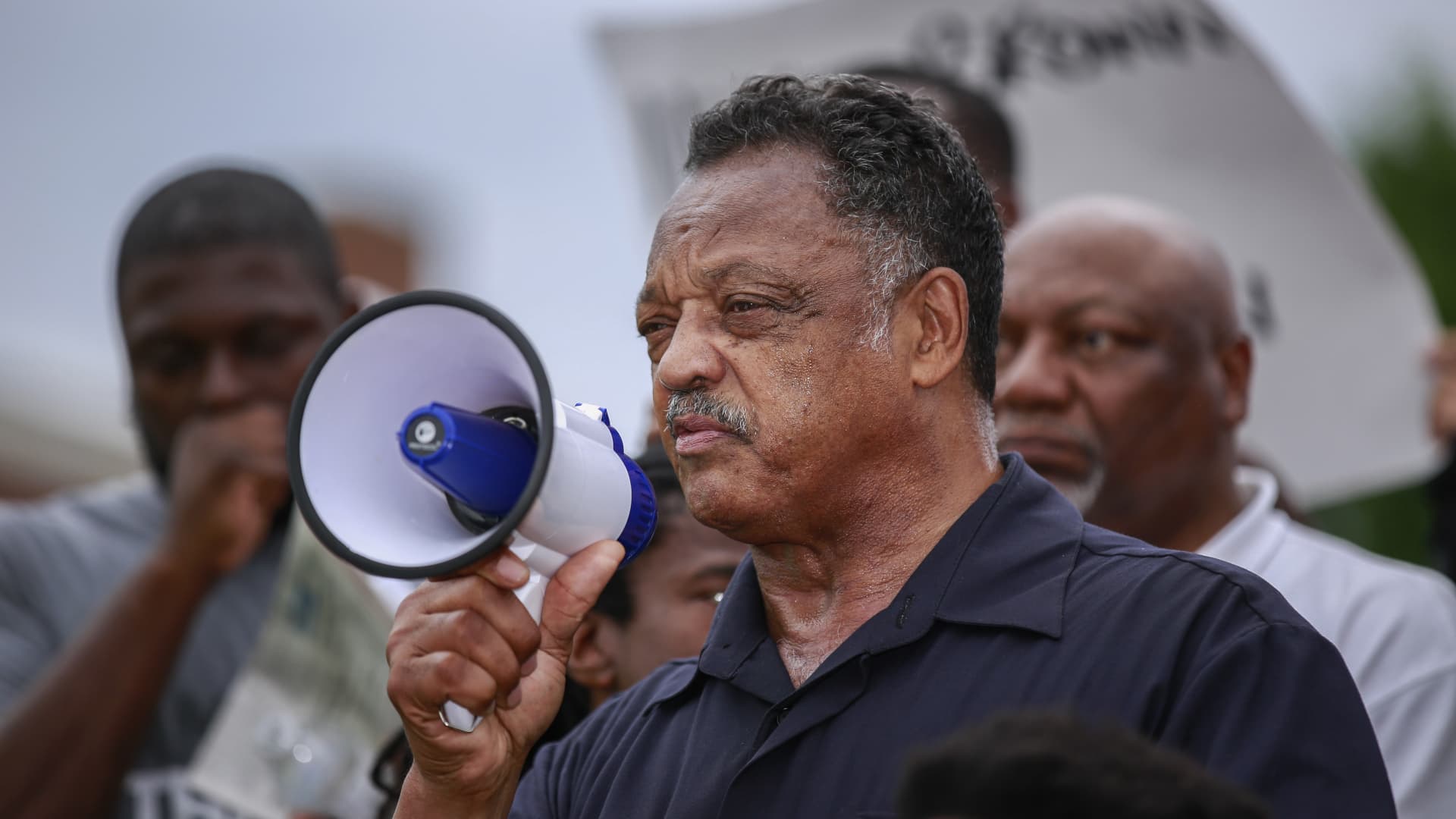
Reverend Jesse Jackson delivers a speech as Americans shout slogans and hold banners during a demonstration against the death of eighteen-year-old unarmed teen Michael Brown in Ferguson, Missouri on August 16, 2014.
Bilgin Sasmaz | Anadolu Agency | Getty Images
