

nairobi
—
Anne Ndalua fights back tears as she talks about her only son. Six months ago, Francis Ndung’u Ndarua went to Russia with the promise of a job as an electrician. She hasn’t been able to contact him since October and doesn’t know if he’s still alive.
In December, someone sent Anne a video of her son warning other Africans not to travel to Russia to seek job offers. “Even if you’ve never served in the military, you end up being taken into the military and taken to front-line combat. And there are real murders happening,” he says in a video sent from an unknown number in Kenya. “Many of my friends died in the name of money.”
About a week later, a disturbing video of Francis went viral on social media. Dressed in military uniform and with a landmine strapped to his chest, he appears frightened as a Russian-speaker uses a racial slur to tell him he will be used as a “can opener” to break through Ukrainian military positions.
“It was very traumatic,” Anne told CNN, adding that she did not watch the video after her daughter explained it to her. Distraught by his plight, she only agreed to the interview as a last resort to get the Kenyan and Russian governments to take action.
“I am appealing to the governments of Kenya and Russia to work together to bring these children home,” she said. “They lied about their real jobs and now they’re at war and putting their lives in danger.”
Francis, 35, unemployed and living with his mother in a small community on the outskirts of Kenya’s capital before leaving, paid an agent about $620 to facilitate the opportunity. Anne was surprised when Francis told his family that he would be forced to undergo military training once he arrived in Russia. She said he was sent to Ukraine after just three weeks of basic training.
Francisco is one of several Africans fighting for Russia in Ukraine, although the exact number is unknown.
A CNN investigation reveals new details about the recruitment tactics of Russian operatives on the continent, exposing the rosy promises made to African job seekers and the reality of forced military service and bloody front-line fighting that many are instead seeing. CNN examined hundreds of chats on messaging apps, military contracts, visas, flights, and hotel reservations, as well as collected first-hand accounts from African fighters in Ukraine, to understand how Russia lures African men to advance their country’s ranks.

Several African governments, including Botswana, Uganda, South Africa and Kenya, have acknowledged the scale of the problem. Local media have detailed how Ukrainian citizens were tricked into becoming Russian mercenaries, and officials are warning others not to follow suit.
Russia’s defense and foreign ministries have not responded to CNN’s requests for comment on allegations that some recruits were misled or coerced. CNN has also reached out to the Russian embassy in Nairobi for comment.
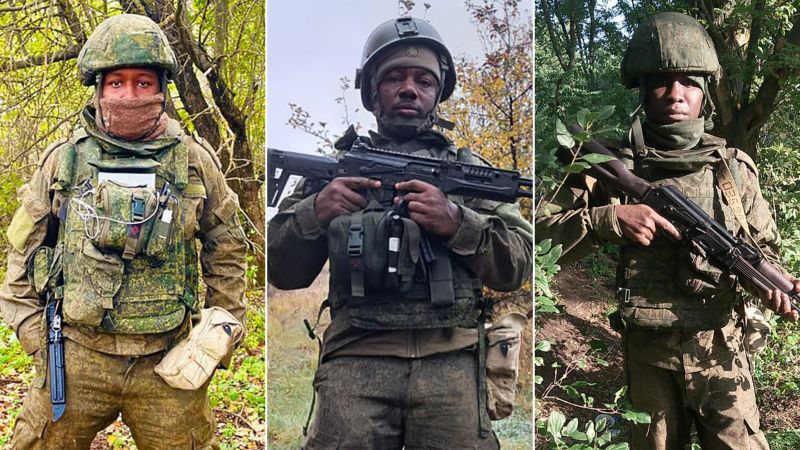
CNN spoke to 12 African fighters from Ghana, Nigeria, Kenya and Uganda who are still in Ukraine and say they have been offered civilian jobs as drivers or security guards. Most said they were promised a contract bonus of $13,000, a monthly salary of up to $3,500, and Russian citizenship upon completion of their work.
But when they landed in Russia, they say they were forced into the army and received little training before being deployed to the front. They were forced to sign military service contracts in Russian without providing lawyers or interpreters. Some had their passports confiscated, making it virtually impossible for them to flee.
Russian law states that only foreigners who understand Russian can serve as soldiers, but none of the Africans interviewed by CNN spoke Russian. Their salaries and bonuses differed from those offered to Russian soldiers and even varied among recruits. Some accused unscrupulous recruitment agents and Russian colleagues of stealing from their bank accounts. CNN has contacted the Russian Ministry of Defense for comment.
“While we were on the front lines, Russian soldiers forced us at gunpoint to hand over our bank cards and PIN numbers,” one African fighter told CNN on condition of anonymity. When he checked, he said, nearly $15,000 had been withdrawn from the bonus, leaving the account nearly empty. “I’ve been here for seven months and I haven’t been paid a penny. They keep promising to check, but nothing happens,” he said, fighting back tears, adding that four others who came with him to Russia have died.
Translated terms of Russian military service contracts obtained by CNN paint a far more binding and long-term picture of military service than what recruitment agents generally advertise. Beyond the headline promise of pay and benefits, the contracts impose broad and open-ended obligations on service members, including participation in combat operations and overseas deployments, strict loyalty obligations, and an obligation to reimburse the state for military training if necessary, with the actual amount left blank at the time of signing. This detail extends to civilian life as well. Access to state secrets could result in bans on international travel, forced surrender of passports, privacy restrictions, and lifelong restrictions on disclosure of classified information.
Although recruitment agencies advertise fast-track paths to civilian employment, contracts stipulate that meaningful support for post-military work, through free professional retraining in civilian specialties, is only available after at least five full years of service (excluding time spent in military education) and only if dismissed for certain reasons, such as age, health, or contract expiration.


The image portrayed on social media is completely different. “For those in Africa or Nigeria who want to join the Russian army, it is very, very easy, very good and stress-free,” an anonymous Nigerian man wearing a Russian military uniform said in a widely shared video. He mentioned his native Nigeria, introduced the Venezuelan man he was sitting next to, and said his experience was good.
“How can I ask an international soldier my salary?” Ghanaian soldier Kwabena Baro, wearing a Russian military uniform, also admonishes on his TikTok page. “With my salary, I can support mom and dad and the whole family for a few years,” he says in Pidgin English. Although some social media videos posted by Africans are in English or French, many are written in languages such as Igbo, Swahili, or Twi to directly appeal to audiences in their target countries.
But of the more than a dozen African recruits currently in Ukraine who spoke to CNN, all but one were eager to leave, including some who had previously served in their country’s military.
Most spoke of forced conscription into a deadly war that resulted in countless casualties, racism from Russian military commanders, non-payment of salaries and no way out. They said they witnessed the bodies of their fellow Africans rotting on the battlefield for months, their compatriots losing limbs without compensation, and suffering constant psychological abuse from Russian soldiers.
“The war here is very intense and many people are dying on both sides,” the only African fighter who told CNN he wanted to fulfill his contract said in a video message. “This was unexpected for them who came to fight. They thought it would be a little easier as mercenaries.”
As the Ukraine war nears its fourth year and facing significant personnel pressures, Russia is actively promoting African recruits to join its armed forces as part of a broader public relations campaign.
State television and local politicians spotlight individual stories of African-born combatants who have acquired Russian citizenship, public congratulations from members of Congress, and televised farewell parties presented as orderly and honorable, portraying foreign recruits as dedicated and grateful contributors to Russia’s war effort.
Patrick Kłova, 39, was persuaded to sign up by his African friends in the Russian military after seeing how great his life was through social media. The carpenter, who also worked on construction sites in Qatar and Somalia, paid a Kenyan agent about $620 in Moscow with the promise of a $23,000 contract bonus.
“I thought I would be a security guard for the army, not a fighter,” he told CNN in Nairobi, where he returned after deserting. He describes the four months he spent in Ukraine as “hell” and considers his return a miracle. He said he received only three weeks of basic military training and firearms handling before being deployed to Ukraine.
Weeks later, Kłova was injured in a Ukrainian drone ambush and subsequent grenade attack, but she said her Russian partners turned hostile instead of helping. “If you’re injured, the code for seeking first aid is ‘three stars.’ I said that to my Russian partner, but he chased me away and started firing,” Kłova recalled. He was eventually able to get help, but knew he had to flee before being brought back into the fight.

“Once you step into the Russian army, it’s time to run or die,” he said. “There’s no way you can go to Russia and come back alive, because if you finish your contract, they’ll force you to stay there. They can’t let you go.”
He fled when he was granted medical leave in St. Petersburg, managed to reach the Kenyan embassy in Moscow, and boarded the next flight home. He said embassy officials issued him with a temporary travel document to avoid detection because he had overstayed the primary tourist visa he used to enter Russia in September 2025.
Kłova still needs surgery to remove debris from her butt and the back of her thigh. But he knows he’s lucky to be alive.

Kenyan photographer Charles Njoki, 32, also learned firsthand the horrors of war. Wanting to earn more money to support his pregnant wife and family, he applied directly to the Russian military’s recruitment portal for a job as a drone pilot, and received a response within two hours, he told CNN. He sold his car to pay for his flight and accommodation, arrived in Russia within a week, and planned to surprise his parents with a large fortune and Russian citizenship upon his retirement. His plans quickly went awry.
His wife suffered a miscarriage during training, but the recruit’s mobile phone was confiscated, so he didn’t find out for several days. He learned to assemble and disassemble the drone from a first-person perspective, but was unable to operate the drone when deployed to the front lines. A few weeks later, a Ukrainian drone attack crippled his left hand and left him with spinal problems that required surgery. “The Russian doctor said he was only interested in the two fingers I use for shooting,” he told CNN in Nairobi.

Njoki claims African fighter jets were intentionally exposed to dangerous conditions as bait for Ukrainian drones. “They tell people, you’re going to protect this place, you’re not going to go to the front as a raider, but before you know it, you’re fighting on the front lines.” He also fled St. Petersburg and ended up at the Kenyan embassy in Moscow, from where he returned home.
“They are lying to people. The money they are telling people they are paying is not true,” he said of Russian recruiters.
Ukraine has called on African countries to stop the influx of men into the Russian military.
“If they are on the front lines, they are our enemies and Ukraine is defending itself,” Yuri Tokar, the ambassador to Kenya, told CNN. “This pipeline must be stopped.”
