

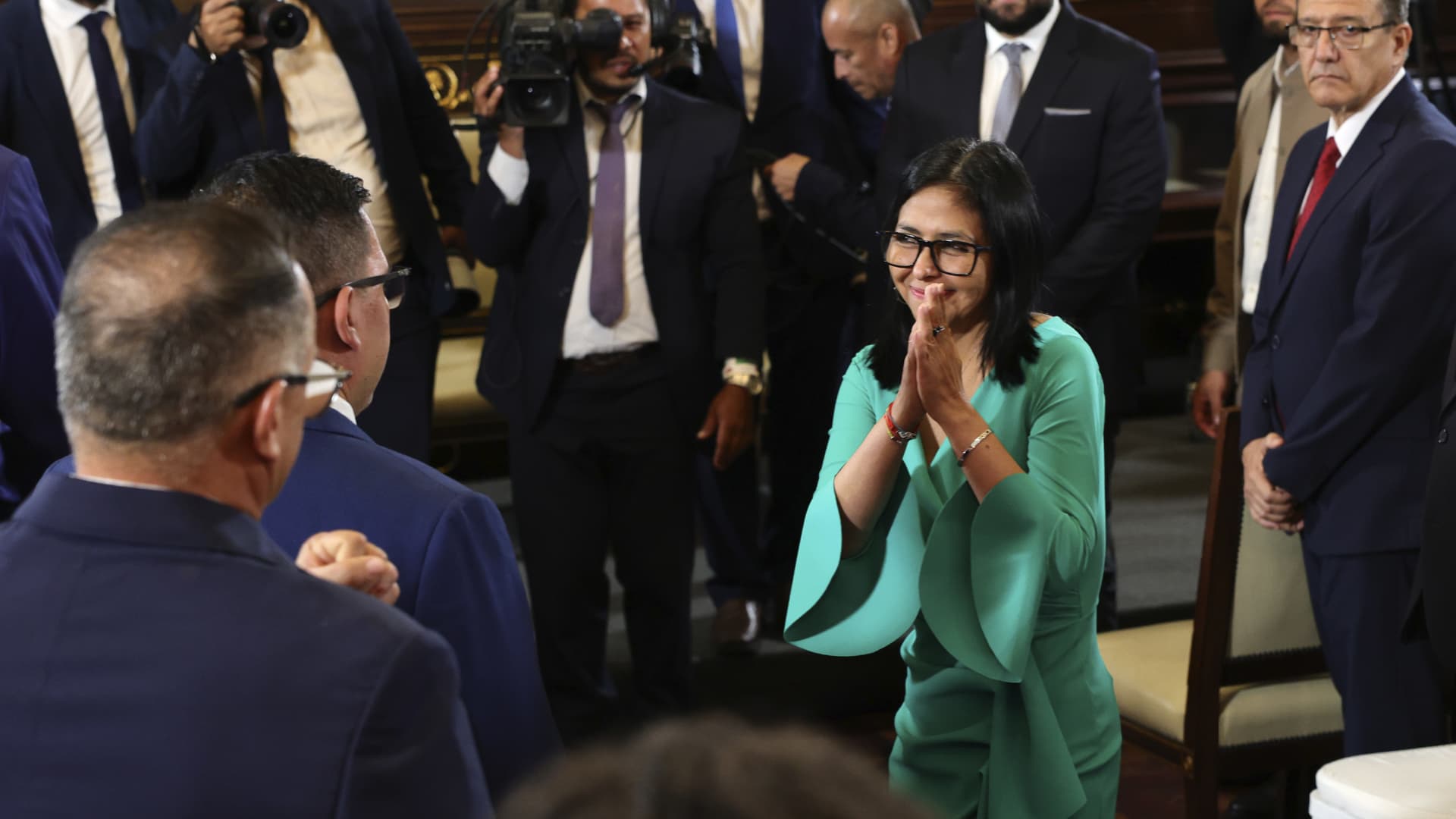
Venezuela’s future remains uncertain after the United States launched a ground offensive last weekend that ousted President Nicolas Maduro. But amid the uncertainty, some investors see potentially lucrative long-term opportunities in the South American country, long closed to international business.
At least that’s what Charles Myers, chairman of consulting firm Sygnum Global Advisors, thinks.
“This is a massive infrastructure project, and I think it could be as much as $500 billion over the next 10 years,” Myers said Monday on CNBC’s “Squawk on the Streets.”
“I think people are too pessimistic. This is a huge opportunity across multiple sectors,” said Myers, who is planning a trip to Venezuela with “investors, multinationals and asset managers” in March.
He did not name the other members accompanying him on the trip, but said the trip was organized independently of the State Department or the U.S. government.
Others see the situation as even more difficult.
President Maduro and his wife, Cilia Flores, were captured on January 3 and taken to the United States. In the aftermath, President Donald Trump said the United States would take control of Venezuela, and in an interview with The Atlantic, he threatened acting President Delcy Rodriguez with “a very high price, perhaps even greater than Maduro’s,” if she opposed the administration’s actions.
Rodriguez initially pushed back against Trump’s comments, but has recently expressed a willingness to cooperate with the United States.
Some see the country as still closed until more details are known about the state of post-Maduro Venezuela.
“Given the regulations and the investment environment that were in place, nothing has changed. In any case, it hasn’t changed yet,” said Robert Koenigsberger, managing partner and chief investment officer at Gramercy Funds Management.
“Investors can’t just fly into Caracas and knock on doors and meet people and say, ‘Hi,’ even if the airport opens,” he said. “Venezuela is littered with sanctioned individuals.”
Myers said the presence of U.S. troops off the coast of Venezuela is reassuring, but noted that foreign investment is primarily driven by security considerations. He acknowledged that sanctions were a limiting factor, but said he would not be surprised if some of them were lifted in the coming months.
He said further opening up of the country, including Venezuela’s return to debt capital markets and the reopening of the Caracas stock exchange, could encourage even greater investment in the future.
“This is not a short-term investor trip. This is a chance to get serious,” Myers said.
Still, in the immediate aftermath of Maduro’s overthrow, oil and gas companies appeared poised to benefit. chevron, exxon mobil and conocophilips They have remained largely silent as stock prices have risen.
Chevron shares rose 5% as some investors said the only U.S. company currently operating in the country could end up being a big winner once the country’s oil infrastructure is rebuilt. The move made Chevron the biggest gainer on the Dow Jones Industrial Average on Monday.
Venezuela has the world’s largest proven oil reserves, but most US oil majors have been locked out of the country since former President Hugo Chávez seized US assets in 2007.
At a press conference Saturday, President Trump called on major U.S. oil companies to invest billions of dollars in the country to rebuild infrastructure.
But opportunities in Venezuela go far beyond oil and gas, Myers said, and those planning to join also come from the construction, automotive, defense and chemical mining sectors.
“And on the asset management side, hedge funds and some long-only investors, and maybe sovereign wealth funds as well,” Myers said.
Myers has led similar trips in recent years to war-torn countries in the midst of political turmoil. In October 2025, he took 27 clients to Damascus, Syria, after President Trump lifted sanctions on the country, which had been embroiled in a civil war for more than a decade. And in early 2025, Meyers led a trip to Ukraine that included TCW Funds, Lazard and Siemens, Bloomberg reported.
“People are trying to compare Venezuela to Iraq,” Myers said. “The better analogy we think is actually either East Germany in the ’90s, or Hungary/Poland around the time the economy transitioned from communism to capitalism.”
CNBC’s Spencer Kimball contributed to this report.
