

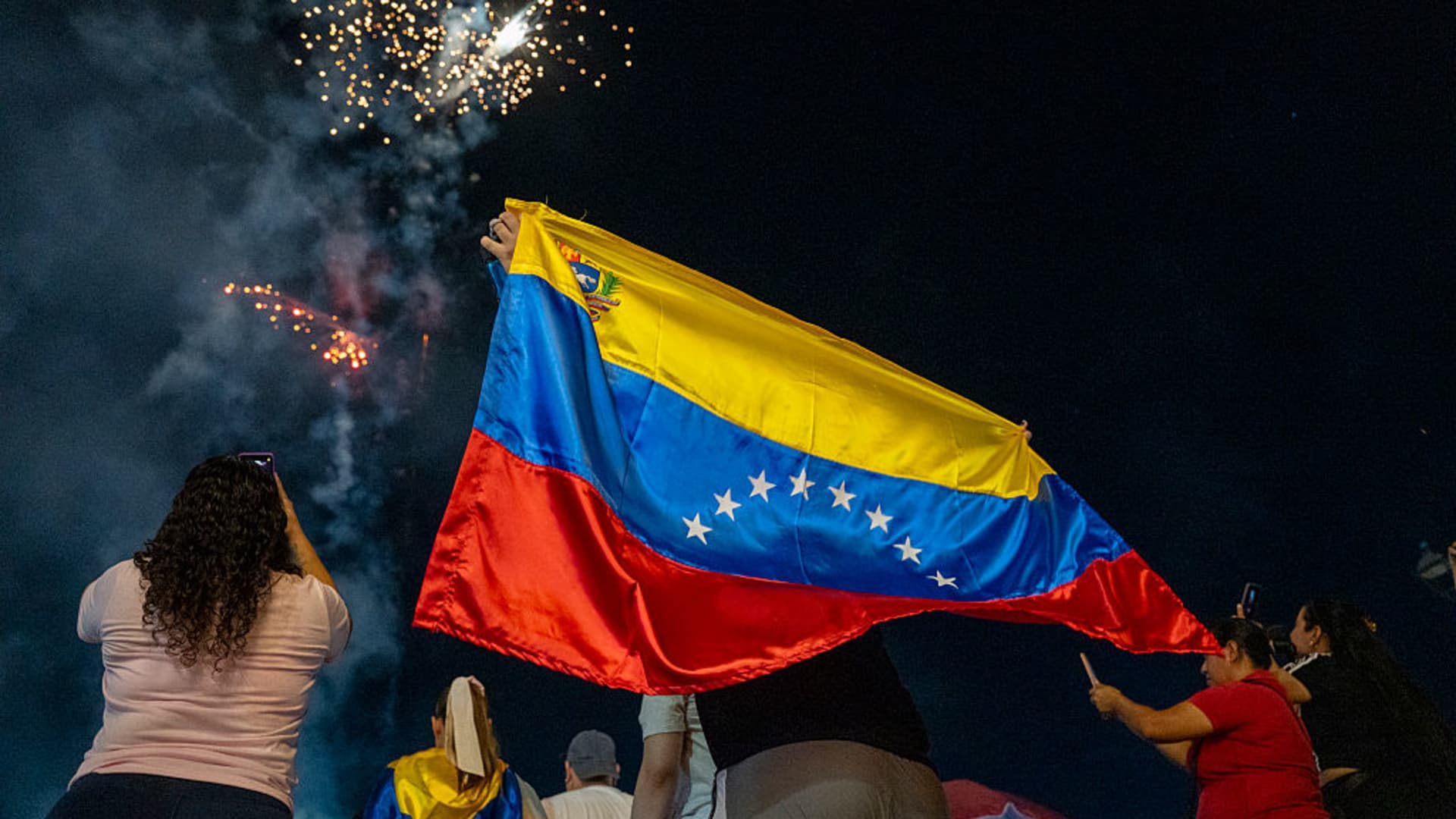
CUCUTA, COLOMBIA – JANUARY 3: Venezuelan nationals watch fireworks during a rally at the Colombia-Venezuelan border following the confirmation of Nicolás Maduro’s arrest on January 3, 2026 in Caracas, Cúcuta, Colombia. President Donald Trump announced that Nicolás Maduro and his wife, Cilia Flores, were captured in Caracas in the early morning hours after a military operation led by the US military’s elite special forces unit, Delta Force. (Photo by Jair F. Coll/Getty Images)
Getty Images | Getty Images News | Getty Images
Markets are considering whether the Venezuela incident marks a turning point in the way political power is priced into assets, or another headline shock that quickly disappears from portfolios.
Gold prices rose more than 2% on Monday to $4,419 an ounce, while the dollar edged higher. The dollar index, which measures the dollar’s value against a basket of six major currencies, rose about 0.2% to 98.662.
The influence of other markets remains relatively modest. U.S. Treasury yields were little changed, with the 10-year yield at 4.187% and the 2-year yield at 3.475%. The MSCI All Country World Index, which tracks the performance of global stock markets, rose 0.48%.
“While the headlines are alarming, the market reaction has been significantly subdued so far,” said Chung In-yoon, founder and CEO of Fibonacci Asset Management, adding that the moves so far reflect “modest hedging rather than safe flight.”
Investors are looking at several signals as they try to differentiate headline shocks from economic spillovers.
1. Oil market structure, not spot prices
The first test of whether Venezuela’s developments are systemically important to markets is not where oil is traded today, but how the market is structured.
“The key here is whether or not supply in the oil market is going to get tight,” said Billy Leung, senior investment strategist at Global XETF. “As long as Brent is trading around $60 and the forward curve is in contango, the market is indicating that supply is plentiful and concerns about disruption from Venezuela are limited.
“The move backwards would indicate that this is becoming a real supply issue rather than a headline news story. That’s not happening at the moment.”

When a crisis truly threatens oil supplies, buyers typically rush to secure barrels quickly, pushing short-term prices higher than future prices. This creates a market structure known as backwardation, a classic sign of scarcity or panic. Until the oil curve tightens, investors do not see Venezuela’s developments as a threat to the global energy system.
That message reverberates throughout the energy complex. Venezuela produces about 1 million barrels per day, about 1% of the world’s supply. Additionally, key infrastructure remains operational. Other energy experts said OPEC+ had paused supply increases, inventories were plentiful and global surplus conditions continued to dominate prices.
Norbert Rücker, Head of Economics and Next Generation Research at Julius Baer, said: “We believe these events pose minimal short-term supply risk and therefore the likelihood of significant oil price increases is minimal…The oil market appears to be in a permanent surplus.”
2. Volatility pricing
Another clear sign of market complacency is volatility, or rather lack thereof. The Volatility Index, which tracks the expected volatility of the U.S. stock market over the next 30 days, currently stands at 14.5.
This number is well below stress levels and a far cry from the 50-plus spike seen during last year’s tariff shock, Leung noted. The VIX acts as a forward-looking indicator of fear and uncertainty in the market, with a high VIX indicating increasing uncertainty and stress and a decreasing VIX indicating otherwise.
“This shows that despite the heightened geopolitical headlines, the market is not paying for protection,” Leung said.
Ed Yardeni, president of Yardeni Research, similarly noted that the market is “waiting to see what happens next, so the initial reaction is relatively muted.”
3. US real yields and credit spreads
If Venezuela were to trigger broader risk repricing, it would manifest itself in lower bond yields and higher inflation expectations, neither of which has happened, market watchers said.
So far, real yields remain high, partly reflecting the US’ heavy debt burden. Leung said inflation expectations were also stable, suggesting no major changes to the growth or inflation outlook.
Investors also keep an eye on the credit markets, which often warn of stress sooner than the stock market.
“Credit markets tend to price in stress faster and in some cases better than equities,” Leon said. “High-yield bonds and emerging market sovereign spreads are important indicators to watch. Venezuelan bonds themselves are already deeply distressed and largely irrelevant to global risk pricing, so they are not informative.”
4. Other safe havens
After hitting a new all-time high in 2025, gold will be the main beneficiary of Venezuela’s development. Similarly, silver prices rose more than 3% to $75.2733 per ounce.
“This suggests that the pricing of geopolitical risk is suddenly increasing,” said Steve Bryce, global chief investment officer at Standard Chartered. The bank expects gold prices to reach $4,800 an ounce this year. “If anything, these developments may facilitate this assessment,” he added.

gold COMEX
While gold tends to perform well even when other assets perform poorly, it performs best “when people lose faith in the way the world works,” said Adrian Ash, director of research at BullionVault. “Mr. Trump’s return to the White House has torn apart the fundamental structures, alliances, and rules that Western business and capital thought they could trust.”
5. Spread to other flashpoints
The long-term risk is not to Venezuela itself, but whether this incident will change political behavior in other parts of the world.
Yardeni noted that Venezuela joins an already crowded list of flashpoints, including the Middle East, the war in Ukraine, and tensions between China and Taiwan.
He said that while these risks are driving the rally in precious metals, “so far, these risks have not stopped the global equity bull market.”
The long-term risk is whether this will set a precedent that will influence behavior in other regions, particularly around Taiwan, Leung said. “Markets will focus less on political rhetoric and more on whether this event changes the behavior of other major countries.”

In the wake of Venezuela’s intervention, there was talk that there could be an agreement between Beijing and Washington to “swap” Taiwan and Venezuela. Marco Papic, chief geomacro strategist at BCA Research, said military unification between China and Taiwan is not imminent at this point.
“The United States recently transferred a significant number of weapons to Taiwan and included Taiwan as a ‘red line’ in its relationship with China in its latest national security strategy,” he said.
For now, most investors see the Venezuela move as a tactical shock rather than a market shift.
“Price trends at this stage point to a temporary geopolitical risk premium rather than a structural change,” added Jung of Fibonacci Asset Management.
