

Beijing
—
Welkin Ray does calculations on paper napkins in his spare time.
A 30-year-old man from Beijing and his wife are considering whether to have a second child and are facing resource issues. Taking care of their 3-year-old son requires hiring a daycare center while working, and the couple, who are both only children, are also anticipating when they may need to balance the costs and time of raising a child and caring for an aging parent.
These considerations are not uncommon around the world, but they are unique because they are also at the heart of the biggest long-term domestic challenge facing China’s leaders. The idea is that the country’s young people are being encouraged to have more children after decades of strict state-enforced birth control that distorted demographics.

Why China is raising the prices of condoms and contraceptives

And Ray believes the government can do more, especially when it comes to providing more financial support to families. “If we want to encourage people to have more children now, we need to put the same or even more effort and commitment into making that happen,” he says.
January 1 marks 10 years since the Chinese government abolished its infamous one-child policy, recognizing that falling birth rates threatened to undermine the world’s second-largest economic growth.
But this revolutionary change, and many other measures to encourage couples to have more children, failed to increase the population.

China’s population decreased in the three years to 2024. Although the number of births rose slightly in the same year, it was still not enough to outstrip deaths, and this trend is not expected to continue.
The United Nations predicts that people over the age of 60 currently make up more than 20% of the 1.4 billion population and could account for an astonishing half of the population by 2100. This is a reality with potentially far-reaching implications not only for China’s economy but also for its ambitions to rival the United States as a military power.
Chinese leader Xi Jinping has emphasized the need for “population security” and has made “cultivating a high-quality population” a national priority. Analysts expect more policies and incentives to support childbirth and marriage over the next year.
However, many argue that raising the birth rate in China means addressing core issues such as high youth unemployment, high childcare costs, and unequal childcare burdens on women.
And as a direct legacy of China’s “one child” policy, a generation of children without siblings are left solely responsible for caring for their aging parents, in a country where gender imbalances and social safety nets remain weak in many regions.
That’s why Ray said he’s so worried about the future, even though he has a stable job at a financial company.
“No matter how much we save for the future, we know that in order to support (our parents) in retirement, we will have to buy the labor of other people’s children,” he said. “If we think about the development of society, we won’t have that luxury in the future.”
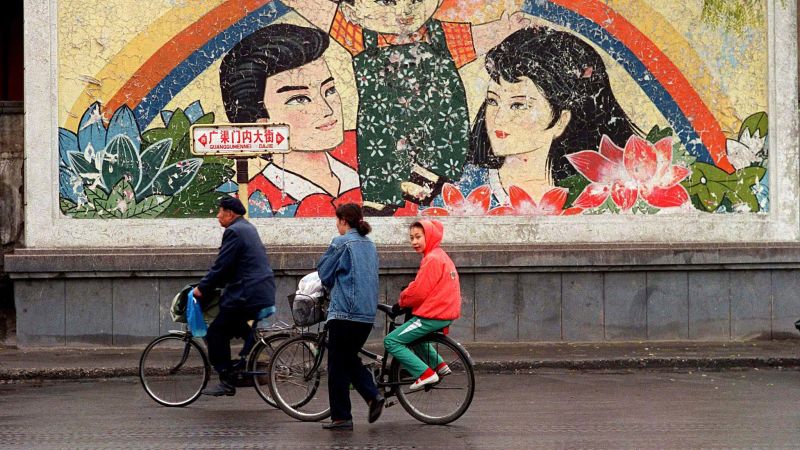
For decades, the Chinese government has prevented “excess” births through a vast and ruthless government apparatus that monitors its people and pressures them to have fewer children, using mass propaganda, harassment, hefty fines, forced abortions and sterilizations.
Officially enacted in 1980, the goal of the one-child policy was to curb China’s runaway population growth, which officials at the time feared could jeopardize any hope of lifting the country out of poverty.
Officials now worry that China will get older before it gets richer. This is a set of circumstances that distinguishes China from other countries with aging populations, such as Japan and South Korea, which have more developed economies and face serious demographic challenges.
In a stunning shift, Chinese authorities have steered the country in a pro-natalist direction, promoting marriage and childbearing by heterosexual couples as key to the country’s future. Underscoring this change in trend, the country began imposing value-added tax on condoms and other contraceptives from January 1.
Local governments have experimented with a number of incentives in recent years, ranging from tax breaks, financial support for home purchases and rentals, and cash transfers to extended maternity leave. On social media, women reported receiving calls from community officials asking about their plans to have children, raising concerns that the policy could take a coercive course.
Recently, China’s central government has taken the lead. Over the past year, it has given families with children under 3 an annual cash bonus of 3,600 yuan (about $500), amended rules to streamline marriage registration, and launched a plan to make public kindergartens free of charge.

The Chinese government has already announced that it aims to eliminate out-of-pocket costs for hospital births by 2026, and last month announced a bill to tighten regulations on childcare services.
However, many feel that the existing benefits have little impact on the actual cost of raising children in China. A 2024 study by the Beijing-based Yuhe Population Research Institute found that China is one of the most expensive places in the world to raise children, in relative terms.
Mi Ya, 34, who is raising a 9-year-old son in the financial capital of Shanghai, told CNN: “Childcare costs in big cities are too high, and subsidies feel like a drop in the bucket.”
“They don’t stimulate the desire to have a baby.”
Meanwhile, Mee, who spoke anonymously to CNN to discuss the sensitive issue, said the “one child” policy changed the outlook of a generation.
“People are now realizing that having one child can be an acceptable lifestyle and family structure,” she says.
And for many Chinese young people entering adulthood during and after the COVID-19 pandemic, policy measures to encourage more births are misplaced as they struggle to earn a living for themselves.
Many government crackdowns on private industry have also taken a toll, and youth unemployment has remained high in recent years as record numbers of university graduates struggle to find work amid the economic slowdown.

Zhou, a 27-year-old engineer, told CNN he wants to find a partner and start a family, but despite being employed, he still relies on his parents for a living in Hefei, the capital of eastern China.
“The economy is very gloomy now. People have to earn money first. How can they have the courage to have a child if they can’t earn money?” said Zhou, who asked to only give her last name to express her concerns. “The government needs to find a way to address these economic hardships.”
China’s low marriage rate is also an obstacle to increasing births. And many young women think that’s a good thing. This is because they are choosing to focus on their careers and reject entrenched gender norms that can lead to women not only working full-time but also controlling their children’s education in China’s competitive system.
“I don’t want to live my life just to have children. I want to live for myself,” Liu, a 24-year-old master’s student, told CNN.
Disillusionment with the future, and the accompanying feeling of not wanting to have children, has become the rallying cry of people in China at some point, especially during the pandemic when the government has taken strict measures to stop the spread of the virus.
“We are the last generation” then went viral after a Shanghai resident used the phrase in a videotaped altercation with police enforcing the city’s quarantine measures.
China’s deepening demographic challenges are the result of a combination of factors. The demographic scars of the one-child policy are exacerbating trends seen in other countries grappling with declining birth rates linked to rising educational levels, changing attitudes to marriage, rapid urbanization and rising costs of raising children.
Rapid demographic changes in China are putting at risk the Chinese government’s long-term goals of increasing domestic consumption, reducing high debt and maintaining its role as the world’s manufacturing powerhouse.

Yanzhong Huang, a senior fellow for global health at the Council on Foreign Relations, said the economic impact of the country’s shrinking workforce and consumer base and the rising costs of caring for the elderly will be “severe.”
So far, he added, pro-natalist policies have been “effective at best” and fail to address the underlying problems of high child support costs and weak social security networks.
The Chinese government is working on pension system reform, including raising the retirement age in stages. Under Xi, the country is also rushing toward another solution to its shrinking workforce: automating factories and outsourcing human labor to robots.
Such measures could help the country’s economy weather the demographic impact. But experts remain skeptical that raising the birth rate significantly or returning to the era of double-digit million births a year would be possible, even if policy measures ultimately have some effect on mitigating the decline in birth rates.

“If the one-child policy had been changed 20 years ago, things would have been much better. It’s already too late,” said Yao Yang, director of the Dishuihu Institute of Advanced Finance at Shanghai University of Finance and Economics. And while further policy support may lead to fluctuations and stabilization over the next few years, in the long term “the decline in fertility is irreversible” for a variety of reasons, he said.
For many who lived under this policy, such considerations provide insight into what was really going on.
“Few people in my generation thought about having a second child,” said Song Ming, 57, from Beijing.
Decades later, Song, a mother of one, looks back and says she would have made a different choice had she been free.
“I feel that the ‘one child’ policy was very limiting in my thinking at the time. But looking back, I realized that I actually wanted multiple children, not just two.”
