

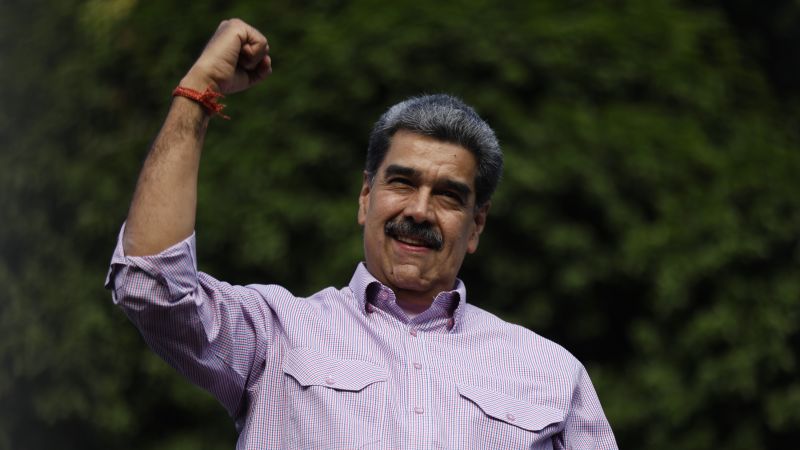
What will happen to Nicolas Maduro? There is a $50 million bounty on his head, the CIA is openly operating in Caracas, US troops are massing in the Caribbean, and experts and politicians from across the Americas are weighing in on the fate of the Venezuelan president.
Some hope the United States will remove him, Saddam Hussein style (or Salvador Allende style, or Manuel Noriega style). Over the past two weeks, prominent neoconservatives Bret Stevens and Elliott Abrams have argued in columns for the New York Times and Foreign Affairs that they support the complete overthrow of President Maduro.
Some wonder if President Maduro will leave of his own accord. On Wednesday, Colombian Foreign Minister Rosa Yolanda Villavicencio Mapi suggested that President Maduro’s negotiated exit from office was the most “healthy” option available.
“I believe he has actually considered that, that there is a way that you can leave the country without going to jail and someone who can make that transition come in and have a legal election and a transition,” Villavicencio Mapee told Bloomberg News. “That would be the healthiest thing to do.”
Immediately afterwards, Colombia’s leftist government clarified that the minister’s comments should not be interpreted as support for President Maduro to relinquish power, stressing that Colombia has no interest in interfering in “the internal affairs of other countries.”
It has been a difficult year for Maduro, who took over as president of Venezuela in 2013 following the death of charismatic leftist president Hugo Chávez.
His claimed victory in Venezuela’s 2024 elections was contested by the country’s opposition parties and unrecognized by most Western countries. The United States has long considered him a criminal and accused him of being the head of a criminal organization known as El Cartel de los Soles (Sun Cartel), which most experts say technically does not exist.
Recently, the Trump administration designated El Cartel de los Soles as a terrorist organization, creating the possibility of a U.S. military attack on Venezuela.
To make matters worse for the embattled president, his political rival, opposition leader Maria Colina Machado, won the Nobel Peace Prize in October. Machado secretly warned that Maduro’s time as president was coming to an end and promised a “new era” for Venezuela.
CNN spoke to experts about what lies in store for the Chavismo leader, and all agreed that it is highly unlikely that Maduro and his government will voluntarily relinquish power.
Elias Ferrer, a risk consultant at Caracas-based Orinoco Research, said Mr. Maduro and his colleagues are keenly aware that leaving power without guarantees of immunity could lead to prison terms or extradition to the United States.
“The United States is one of the few countries in the world that can come after you to the end of the world if you mess with them,” Ferrer said. “They face very real danger.”
Venezuelan Vice President Delcy Rodríguez promised in a speech at a cultural event in Caracas on Thursday that the country would “not surrender.”
“What Venezuela is going through today, I would call it a period of danger, or rather, a period of historical definition, a period of historical rebellion, to let them know that this people will not surrender, that this people will not be intimidated,” Rodriguez said.
David Smilde, a Venezuela expert and professor at Tulane University, told CNN that many observers underestimated how committed Mr. Maduro and his allies are to Chavismo, the socialist movement and state’s guiding ideology named after Hugo Chávez.
“They’re worried about their safety, they’re worried about their wealth,” Smilde said. “But they also see themselves as revolutionaries, anti-imperialist, and a historically significant project that has been doing its own thing for 25 years, defying the United States and defying Venezuela’s ruling political class.”
“For President Maduro to accept any transition, there will have to be some path for the Chavistas to become a viable political force, so that there is no subsequent witch-hunt against them,” Smilde continued.
Brian Fonseca, a professor at Florida International University, said defection to Russia might be a satisfactory “exit” for Maduro, but not without pressure from within.
“I think there will have to be enough pressure within the political and military elite to finally oust him. I don’t think he will step down deliberately,” Fonseca said.
Ferrer, however, told CNN that he did not think Maduro or anyone around him would accept asylum.
“They don’t want to seek asylum in Russia or Cuba or anything like that,” Ferrer said. “They basically want something very real, that Mr. Maduro and his friends will still be the country’s economic elite and that they can trust whoever is in charge of the military.”
Smilde warned against expectations that the final end of Maduro’s term would mean the end of his regime.
“He doesn’t have charisma, so what he had to do was build a pyramid of people who were benefiting in some way,” Smilde said. “Even if you take President Maduro out of the pyramid, the pyramid is still there. And there are a lot of people who have a lot of interest in seeing things continue the way they are.”
The professor recalled that when Hugo Chavez died in 2013, many mistakenly thought his political project was over.
“I was on a plane to Caracas,” Smilde said. “I was walking in first class, and there were all these Venezuelans drinking champagne, hugging each other and saying, ‘It’s over, Chavez is dead.'” And here we are. Nothing actually changed. That leader left, and then a worse leader came along. ”
