

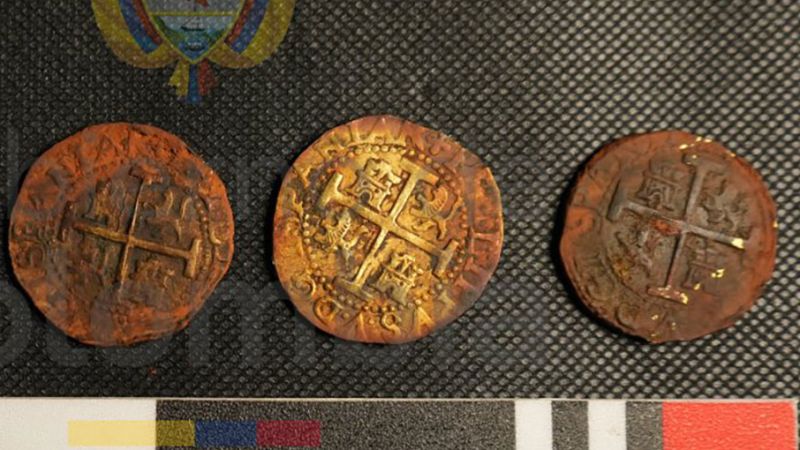
Colombia has recovered gold and bronze coins, porcelain cups and cannons from a sunken Spanish warship dubbed the “Holy Grail of Shipwrecks.”
These artifacts are the first treasures recovered from the wreckage of the Spanish galleon San José, sunk by the Royal Navy in the Caribbean more than 300 years ago.
When the ship sank during the War of the Spanish Succession, the San José was carrying large quantities of gold, silver, and emeralds back to the King of Spain from the Spanish colonies in Latin America.
These treasures, collectively thought to be worth billions of dollars in today’s money, are at the center of a bitter legal dispute between the Colombian government and the US-based salvage company Sea Search Armada (SSA).
Colombia claims it discovered the San José in 2015 with the help of international scientists, but the SSA, formerly known as Glocca Mora, claims it discovered the wreck in the early 1980s and has launched a legal battle at the Permanent Court of Arbitration, claiming it is entitled to about $10 billion, roughly half the estimated value of the shipwreck’s treasure.
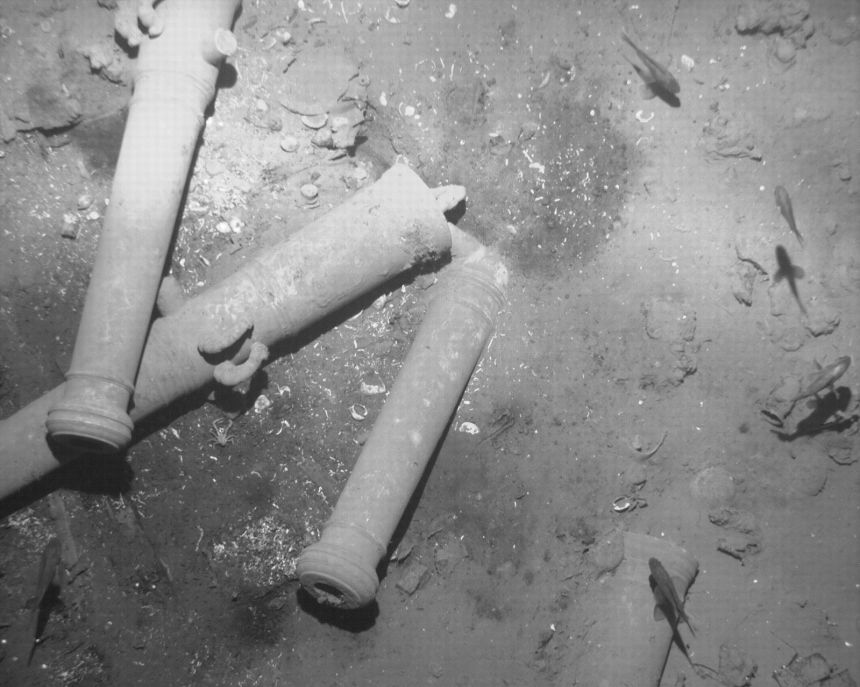
The Colombian government says the recovery of the treasure is part of a research project that could provide clues about the economic, social and political situation in Europe in the early 18th century. It also states that galleons are important to Colombian culture and identity.
Colombia’s Culture Minister Yannai Cadamani Fonrodna said in a statement Thursday that the reconstruction is a “historic event” that proves the country’s ability to protect its underwater cultural heritage.
Algena Caicedo Fernández, director of the Colombian Institute of Anthropology and History, said this “opens up the possibility for the public to approach the history of the San José galleon through physical evidence.”
According to the government, the artifacts were recovered using underwater robots and will undergo a long-term preservation process in a laboratory before being used for archaeological research.
According to historical records, the San José was part of a convoy known as the Frota de Tierra Firme.
The ship was one of several ships that left Peru in 1707 with a large cargo of royal cargo, but records indicate that it never reached Spain and sank off the coast of Colombia the following year after a battle with the British.
