

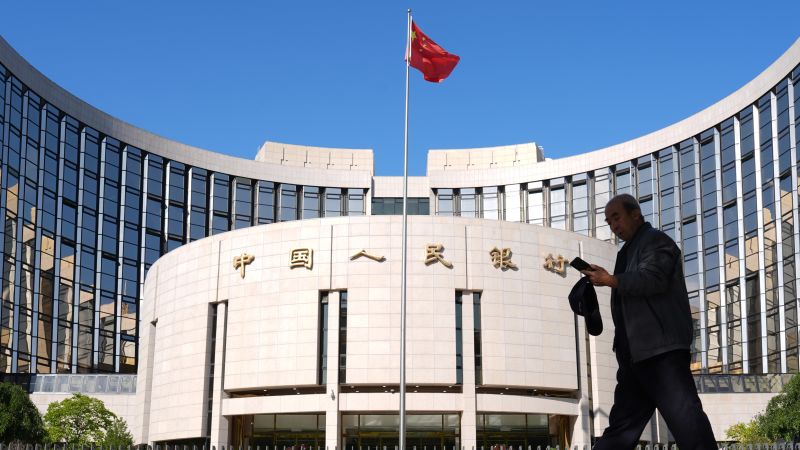
Beijing
—
The U.S. government has spent years warning countries about the risks of accepting loans from China. But for the past 20 years, the United States has been the world’s largest recipient.
That’s the finding of a new report by AidData, a lab at the College of William and Mary in Virginia that has compiled the most extensive public database ever on China’s overseas lending activities.
The findings released on Tuesday revealed that between 2000 and 2023, the Chinese government or mostly state-owned enterprises loaned or provided $2.2 trillion in aid, extending credit to more than 200 countries.
At the top of the list of destinations is the United States. The findings run counter to the common belief that Chinese money is mainly funneled to developing countries, for example under the auspices of Chinese leader Xi Jinping’s flagship infrastructure initiative to promote the Belt and Road Initiative, the researchers said.
Instead, more than three-quarters of China’s overseas lending operations now support projects and activities in upper-middle-income and high-income countries, and are used to acquire critical infrastructure, critical minerals, and high-tech assets essential to China’s national security objectives, AidData found.
“The United States and its wealthy industrialized allies have allowed Chinese state-owned creditors to finance critical infrastructure assets within their jurisdictions. They have allowed Chinese state-owned creditors to finance the acquisition of critical minerals within their jurisdictions. They have allowed Chinese companies to use loans to purchase technological treasures,” AidData executive director Bradley Parks told CNN.
For much of the past decade, Parks added, the U.S. government has been warning countries that Beijing is a predatory financier who will take control of other countries’ assets if their loans fail.
The world’s second-largest economy has emerged as the world’s largest official creditor, seeking to position itself as a reliable financial ally for developing countries. In the process, Beijing has also faced serious criticism that its practices burden countries with unsustainable debt, an accusation Beijing denies. Some analysts also argue against a debt trap.
Currently, the United States is the top Chinese government sector lender, receiving more than $200 billion for approximately 2,500 projects and activities found in nearly every state in the country, according to the latest AidData.
More than half of that credit was in the form of corporate liquidity support, a type of loan in which Chinese creditors, as part of a syndicate of many international financial institutions, functioned as lines of credit to large companies in need of cash.
Such deals are a common corporate practice, a way for banks to make profits, and do not give Chinese companies control of the company’s stock or borrowers, including Fortune 500 companies.
However, since 2000, researchers have found that Chinese state-owned enterprises have also financed the acquisition of American high-tech companies and the construction of infrastructure such as LNG projects, energy pipelines, power lines and airport terminals.
Transactions in sensitive areas have become increasingly difficult in the U.S. in recent years as concerns grow in Washington about the national security implications of Chinese financial stakes in the United States and increased regulatory scrutiny. AidData found that Chinese companies are turning to other high-income countries where checks are less strong.
According to AidData, the UK received $60 billion and EU member states $161 billion over the 24-year period covered.
Like the United States, the United Kingdom and Europe have come under increasing scrutiny and alarm in recent years about the level of Chinese investment, particularly in critical infrastructure.
“We do not claim or believe that all of these loans to the United States serve some grand geopolitical or geoeconomic strategy. Some of it is really just about profiteering… China’s financial sector is simply controlled by the state,” Parks said.
But determining which transactions are “benign and which are not” is a key challenge for regulators and national security officials, he added.
AidData researchers said in the report that they found “increasing alignment of China’s cross-border lending activities with party-state policy priorities, including policies related to national security and economic national strategy.”
In particular, the “Made in China 2025” initiative appears to be associated with changing priorities in external financing, according to the survey results. A government plan announced in 2015 aimed to boost the development of China’s advanced technologies, particularly in high-priority areas such as robotics and automation, aerospace, and computing.
“Cross-border acquisition financing in line with this policy is rapidly increasing, with (Chinese companies) beginning to lend to the 10 areas identified in Made in China 2025,” Parks said.
Parks said this allows Chinese companies to use state capital to acquire strategically important assets to fill gaps in their own capital, noting that there is “no real analogue” to such practices in wealthy developed countries.
Examples cited in the report of such U.S. high-tech acquisitions over the past two decades include semiconductor company OmniVision Technologies, automation company Paslin Company, and electronics company Ingram Micro, which was subsequently acquired by an American private equity firm after the previous acquisition.
China’s state-owned creditors also play a role in the Chinese government’s access to critical minerals needed for high-tech products around the world, approving more than 100 financing commitments worth $14 billion for overseas critical mineral projects from 2021 to 2023.

The overall share of foreign loans and grants supporting low-income and lower-middle-income countries has also declined, as the Chinese government has focused more on strategic sectors and Chinese banks have become creditors of wealthy Western companies. In 2000, they accounted for about 88% of such activities, but now they account for 24%, according to the survey results.
Another change, Parks said, is how Western governments view Beijing’s strategy.
According to the report, China’s rivals in the G7 have responded by making previously unthinkable adjustments on a large scale, including cutting overseas development assistance budgets, dismantling foreign aid agencies, expanding cross-border lending on non-concessional terms, and taking stakes in critical infrastructure assets overseas.
While the United States under the second Trump administration has imposed deep cuts to international aid programs, efforts are underway in Washington to significantly expand the U.S. International Development Finance Corporation’s budget and ability to lend to high-income countries.
According to Parks, until recently, “Beijing’s approach to international loans and grants was a source of scorn and ridicule…It just wasn’t a source of inspiration or emulation for G7 policymakers, and now that’s all turned upside down. Now the United States and its allies are seriously focused on competing with China on terms.”
