

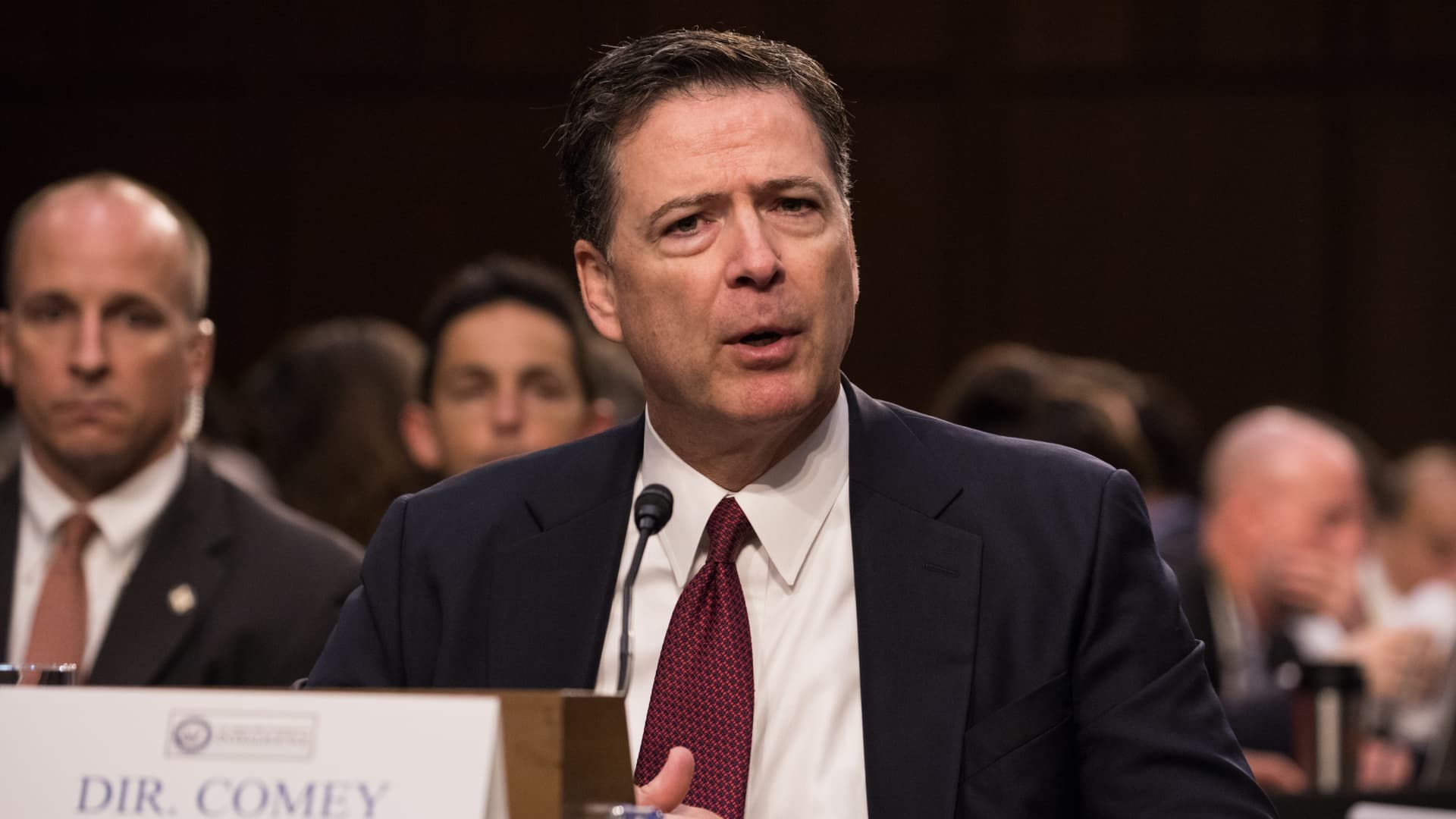
File photo: On Thursday, June 8, 2017, former FBI Director James Comey testifies before the Senate Intelligence Committee in the Hart Senate Building on Capitol Hill.
Cherise May | Null Photo | Getty Images
A federal judge on Monday suspended another judge’s order requiring FBI Director James Comey, who was accused of lying to Congress in 2020 congressional testimony, to provide the Justice Department with all grand jury materials related to his criminal indictment.
Judge Michael Nachmanoff said he would decide whether to allow the order to go into effect after considering the Justice Department’s dissent and arguments in favor of Comey’s lawyers.
Nakhanov gave the Justice Department until Wednesday to file an objection in the U.S. District Court for the Eastern District of Virginia. Mr. Comey’s lawyers have until Friday to respond.
The judge’s action came hours after Judge William Fitzpatrick issued an order indicating that charges against Comey could soon be dismissed due to possible “misconduct” by prosecutors. The charges were made at the behest of President Donald Trump.
“We recognize that the government’s actions in this case, whether intentional, reckless, or negligent, raise questions of genuine misconduct,” Fitzpatrick said in a written opinion.
He said Interim U.S. Attorney Lindsay Harrigan’s request to present the case to a grand jury and indict Comey may have violated court orders and Comey’s Fourth Amendment rights.
“There are reasonable grounds to ask whether the government’s actions were intentional or showed reckless disregard for the law,” Fitzpatrick wrote.
“The facts set forth herein and the court’s detailed findings establish that “there may be grounds for dismissing the indictment because of issues that arose before the grand jury.”
Mr. Fitzpatrick acknowledged that ordering the Justice Department to release all documents and audio recordings of the grand jury that indicted Mr. Comey was an “unusual remedy.”
“However, given the factual challenges raised by the defense to the government’s conduct and the prospect that government misconduct may have tainted the grand jury process, disclosure of grand jury materials under these unique circumstances is necessary to fully protect the rights of the defendants,” Fitzpatrick wrote.
The judge noted that an FBI agent who was the only witness to testify before the grand jury was informed by another agent shortly before testifying that evidence obtained in the Comey investigation may have included material protected by attorney-client privilege.
Fitzpatrick also said he identified two statements Harrigan made to the grand jury that “on their face appear to be fundamental misstatements of law that could undermine the integrity of the grand jury process.”
One of the statements, which the judge called a “fundamental and highly prejudicial misstatement of law,” suggested to the grand jury that Mr. Comey did not have a Fifth Amendment right not to testify at trial.
CNBC has reached out to Harrigan’s office for comment.
Comey was indicted on September 25 in federal court in Alexandria, Virginia, on charges of false statements and obstruction in connection with his testimony before the Senate Judiciary Committee in September 2020.
In his testimony, Comey denied authorizing another person at the FBI as an anonymous source for news reports about the investigation into 2016 Democratic presidential candidate Hillary Clinton and her emails.
Mr. Comey has denied wrongdoing, but the charges come just days after Mr. Trump urged Attorney General Pam Bondi to prosecute the former FBI director, a longtime enemy of the president.
Harrigan was handpicked by President Trump to head the Eastern District of Virginia after his predecessor hesitated to indict Comey.
Mr. Comey’s trial is currently scheduled for January 5th.
