

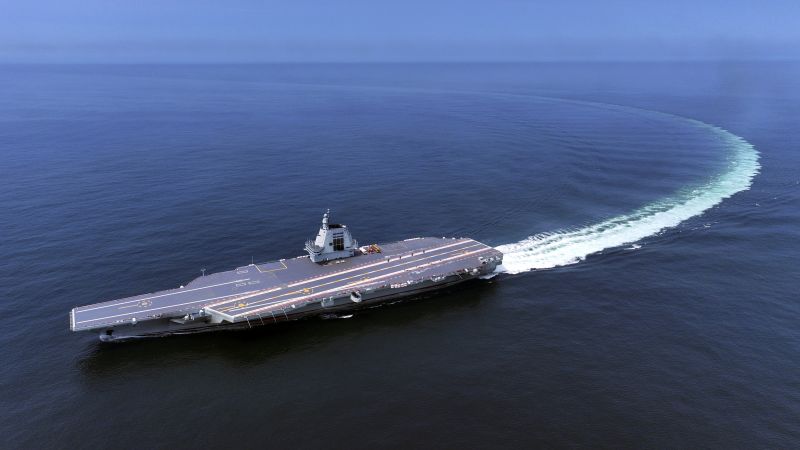
The formal commissioning of China’s newest and most capable aircraft carrier is a significant step forward for Beijing as it seeks to catch up with the United States in naval supremacy.
Chinese leader Xi Jinping presided over a commissioning ceremony at the military port in Sanya, Hainan Island, earlier this week, Chinese state broadcaster CCTV reported on Friday.
According to Chinese state media, Fujian is China’s third and most advanced aircraft carrier, equipped with electromagnetic catapults that can launch three types of aircraft.
A new technology known as EMALS allows planes to take off with heavier weapons and fuel, allowing them to attack enemy targets further away.
The only other aircraft carrier in the world equipped with the EMALS system is the U.S. Navy’s newest aircraft carrier, the USS Gerald R. Ford, which was certified for flight deck operations using the EMALS system in spring 2022.
But despite these advances, two former U.S. aircraft carrier officers told CNN last month that Fujian’s air operations may still be only about 60% of what they were on a U.S. Navy carrier 50 years ago.
The U.S. Navy’s 10 legacy aircraft carriers, the Nimitz class, rely on steam-powered catapults to launch their aircraft. However, unlike the US aircraft carriers, China does not have nuclear-powered aircraft carriers.
Nuclear power allows U.S. aircraft carriers to remain at sea as long as their crews have food. The Fujian is powered by conventional fuel, so it must either come into port or be picked up by a tanker at sea to refuel.
China, under President Xi Jinping’s leadership, is launching high-tech warships at a breakneck pace and building the world’s largest navy, putting pressure on the United States and its Pacific allies to keep up.
In terms of sheer number of ships, the Beijing Navy is currently larger than the Washington Navy, and Chinese shipyards can churn out new ships at a much higher rate. However, the United States maintains a significant technological advantage and can field far more aircraft carriers.
Nevertheless, Fujian’s formal commissioning is a milestone for the Chinese Navy. With a displacement of 80,000 tons, it is the closest aircraft carrier to the U.S. Navy’s 97,000-ton Nimitz-class aircraft carriers.
And China is currently building another aircraft carrier, known as the Type 004, which is expected to not only employ EMALS technology but, unlike the Fujian, also be nuclear-powered, similar to the USS Ford.
Fujian’s flight deck is the first in China to eliminate the ski-jump-style ramp used by existing small aircraft carriers, Liaoning and Shandong, to fly aircraft under their own power.
Following the launch test, Chinese state media and military expert Zhang Junsha praised the ship as evidence of China’s emergence as a major aircraft carrier power.
However, concerns about the air operation emerged after a Chinese military blogger commented on a state-run CCTV video about the Chinese military that featured Fujian province.
“Since both catapults are located near the center front of the landing area, a J-15 or J-35 (two Chinese carrier-based fighter jets) would overturn the catapults during landing, temporarily rendering them unusable for launch operations, which would affect the fighter’s takeoff efficiency,” the blogger said in the military review blog Haishixianfeng.
The comments were picked up by South Korea’s Chosun Ilbo newspaper, and CNN asked two former U.S. naval officers to review the report and video.
Karl Schuster is a former U.S. Navy captain who served on two U.S. aircraft carriers and is a retired lieutenant commander. Former U.S. Naval Aviator Keith Stewart also commented on Fujian’s deck layout.
Schuster noted that the landing area is angled at only 6 degrees off-center, smaller than a Nimitz-class U.S. carrier, limiting the space between the landing strip and the catapult.
In addition, its long landing area is too close to the bow, further restricting the aircraft’s movement, he suggested.
Schuster and Stewart noted that the Fujian’s front catapult appears to be longer than the Nimitz’s, meaning the aircraft is at risk of hitting the flight deck as it moves between the elevator and the hangar deck.
The only way to alleviate this is to slow down flight deck operations, they said.
