

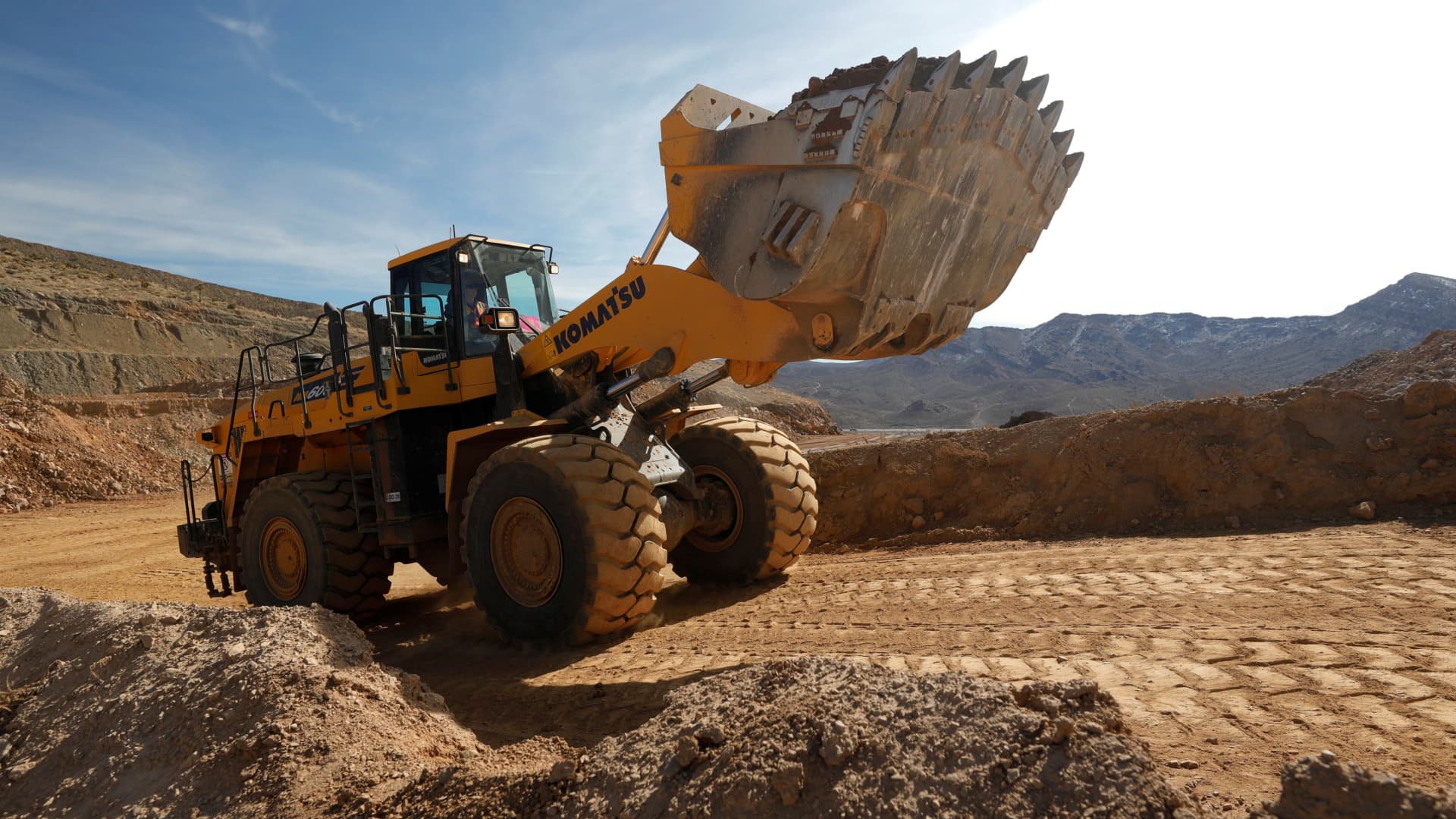
A wheel loader transports ore to a crusher at the MP Materials Rare Earth Mine in Mountain Pass, California, USA, January 30, 2020.
Steve Marcus | Reuters
The emergence of critical minerals as a new arena of geopolitical competition coincides with a dizzying rise in U.S.-listed rare earth mining stocks.
Despite the rally in recent weeks, Critical Metals stock is up 241% in the past three months, while NioCorp Developments, Energy Fuels and Idaho Strategic Resources are all up well over 100% over the same period.
The impressive gains have been even more remarkable since the beginning of the year. Energy Fuels’ stock has quadrupled in the first 10 months of this year, and NioCorp Developments’ stock has nearly quintupled.
Rare earths have emerged as an important bargaining chip in the ongoing geopolitical competition between the world’s two largest economies, the United States and China.
Tony Sage, CEO of Critical Metals, which owns one of the world’s largest rare earth deposits in southern Greenland, said the gathering of U.S.-listed rare earth mining companies was evidence of a major market boom.
“When I say it this way, what I mean is that there were four great booms: the gold boom in the 19th century, the oil boom in the 20th century, the technology boom in the early 21st century, and now the rare earth boom,” Sage told CNBC by phone.
“But the rare earth boom is the future. It will power all of the above.”
We are moving from a philosophy of “filling the gap” through imports to a philosophy of “mining the gap” domestically or regionally.
Audan Martinsen
Head of Supply Chain Research at Rystad Energy
Rare earths refer to the 17 elements on the periodic table that have atomic structures that give them special magnetic properties. These materials are essential components for a wide range of modern technologies, from everyday electronics such as smartphones to electric vehicles and military equipment.
China, which has a near-monopoly on rare earths, recently threatened to expand restrictions on rare earth exports to further strengthen its supply chain advantage. However, following a face-to-face meeting between US President Donald Trump and Chinese leader Xi Jinping in South Korea on Thursday, Beijing agreed to delay the October 9 export ban by one year.
U.S.-listed rare earth stocks rose on the news, but analysts remain skeptical that the apparent trade truce will provide long-term relief.
On October 30, 2025, U.S. President Donald Trump shakes hands with Chinese President Xi Jinping during a bilateral meeting at Gimhae International Airport on the sidelines of the Asia-Pacific Economic Cooperation (APEC) Summit in Busan, South Korea.
Evelyn HochsteinReuter
“As with any boom, there were a lot of oil companies that didn’t find oil, a lot of gold companies that didn’t find gold, and I’m sure there are a lot of rare earth companies that don’t make it, because when there’s a boom, there’s hype. And when there’s hype, there’s too much investment,” said Critical Metals’ Sage.
“It’s not going straight up. It’s a jagged line, but with the right projects in the right places and the right partners, the trend will be in the right direction,” he added.
“A much bigger and longer supercycle”
Kevin Das, senior technical consultant at Australia-based rare earth exploration company New Frontier Minerals, agreed with Mr Sage’s explanation of the boom in the rare earth market, although he acknowledged the possibility of a fall in share prices.
“People are talking about what a bigger supercycle is, an uptrend, and some of the evidence for that is that commodity prices have been low and there’s been a lack of investment for some time. And now with the advent of AI… we’re going to see a bigger and longer supercycle,” Das told CNBC by phone.
Das pointed out similarities between the Biden administration’s support for clean energy projects, which coincided with the rise in lithium-related stocks, and the Trump administration’s support for rare earths.

Critical Metals stock price over the past three months.
“In the last nine or 10 months since President Trump took office, we’ve been talking about annexing Greenland and talking about reaching a deal with Ukraine on rare earths, but the real clincher was the stock deal with MP Materials,” Das said.
“So I think the next two to three years of runway will be very fruitful,” he added.
But not everyone is so bullish about the outlook for rare earth stocks.
Ordan Martinsen, head of supply chain research at Rystad Energy, said the recent surge in stock prices reflected a combination of geopolitical tensions, strategic policy support and speculative momentum.
“Rare earths have clearly moved to the center of global industrial strategy and are essential for defense, EVs, and clean energy, but this looks more like the early stages of a structural shift than a mature ‘fourth boom,'” Martinsen told CNBC via email.
Neodymium is on display at the Inner Mongolia Baotou Steel Rare Earth High-Tech Co., Ltd. factory in Baotou, Inner Mongolia, China, on Wednesday, May 5, 2010.
Bloomberg | Bloomberg | Getty Images
“We are moving from a philosophy of ‘filling the gap’ through imports to a philosophy of ‘unearthing the gap’ domestically or regionally,” he continued. “This will be a long, expensive and difficult journey due to the complexity of obtaining adequate and cost-effective resources and full control over elemental diversity.”
Transition to clean energy
Garnaut Wagner, a climate economist at Columbia University, said there are two clear factors at play as global competition to secure supplies of critical minerals intensifies: structural and political.
“Structurally, the transition to clean energy is happening, and it’s accelerating, regardless of any political attempts to stop or derail things. And certainly, it depends on a lot of critical minerals, whose prices are bound to rise,” Wagner told CNBC via email.
China, for example, supplies many of these minerals at low cost, Wagner said, noting that the Asian giant’s mineral dominance is no coincidence.
“Beijing has been investing heavily in green industrial policy for years, focusing on fully integrated supply chains. That’s where politics comes in,” Wagner said.
“Some attempts to move supply chains onshore are strongly justified by national security and other reasons, and they will drive up prices and stock prices for U.S. mining companies. Of course, some of what we’re seeing is just current politics, crazy trade wars, etc.,” he added.
