

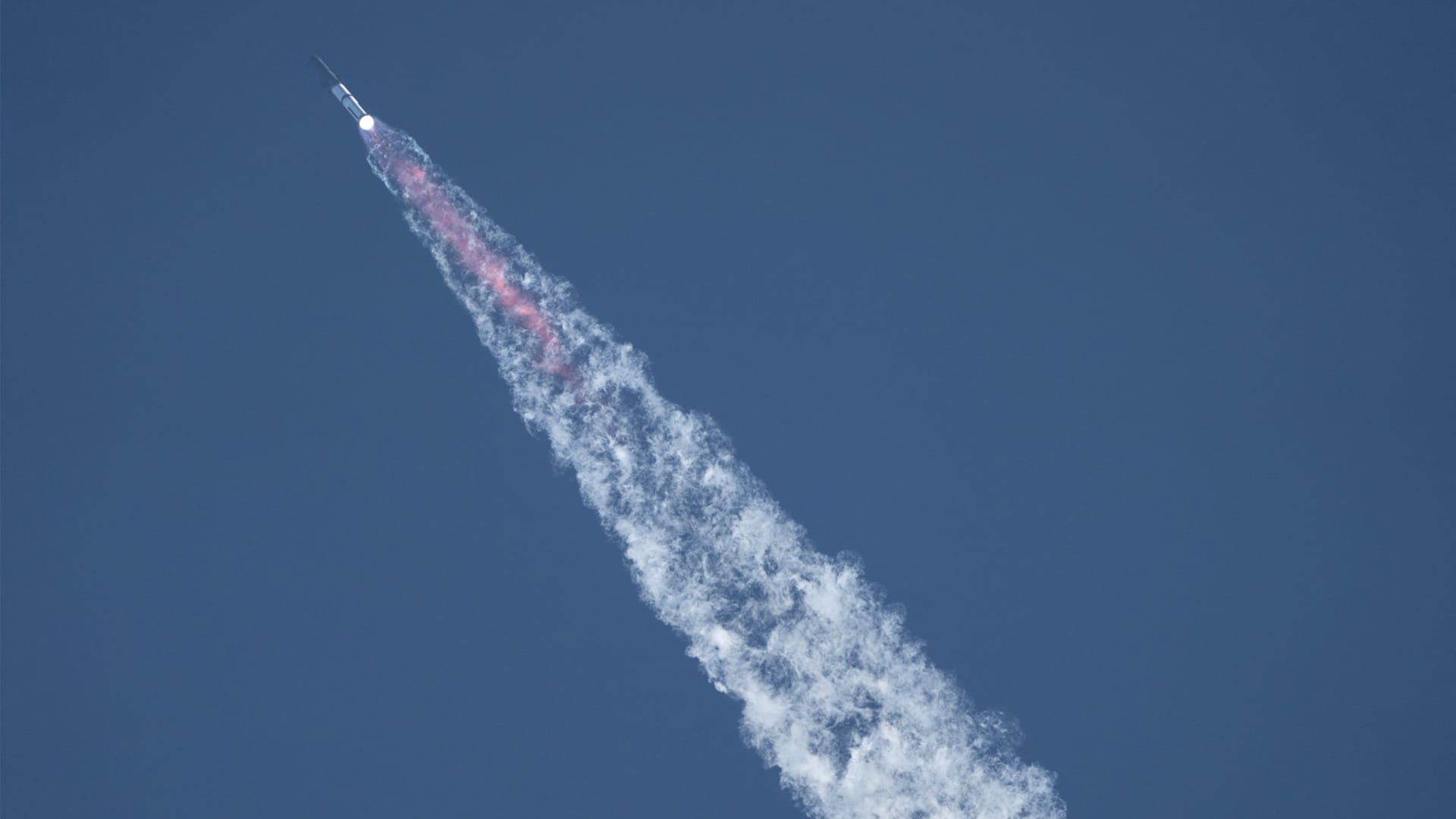
SpaceX’s Starship Rocket 38 lifts off during its 11th test flight, seen from South Padre Island, Texas, on October 13, 2025.
Gabriel V. Cardenas | AFP | Getty Images
SpaceX announced it has proposed a “simplified mission” to NASA to return astronauts to the moon, following criticism from Acting Space Administration Administrator Sean Duffy over the delay.
“We are sharing and formally evaluating simplified mission architectures and operational concepts that we believe will result in a faster return to the moon while improving crew safety,” Elon Musk’s aerospace and defense contractor said in a company blog post published Thursday.
Earlier this month, Duffy said in an interview on CNBC’s Squawk Box that SpaceX is behind schedule in building the lunar landing system for NASA’s Artemis III mission, and that the agency will reinstate landing contracts for that mission to competitors such as Jeff Bezos’ rocket maker Blue Origin.
In an email to CNBC, a NASA spokesperson said the agency “has received and is evaluating plans from both SpaceX and Blue Origin to accelerate HLS production.”
“In response to the closure, the agency will be issuing an RFI requesting proposals from the broader aerospace industry,” the spokesperson said. “Given the urgency of hostile threats to lunar peace and transparency, a panel of NASA subject matter experts is being convened to evaluate each proposal and determine the best path to winning the second space race.”
NASA previously said SpaceX and Blue Origin had until Oct. 29 to propose new ways to accelerate the project.
Musk initially responded to Duffy by posting on Duffy’s social network X: “Sean Dummy is trying to kill NASA!” “There’s no way the person in charge of the US space program has a double-digit IQ,” Musk wrote in another post.
SpaceX’s giant Starship has so far conducted 11 unmanned test flights. Although the last two flights are considered successful, the company has not been able to demonstrate all of the in-orbit refueling capabilities it needs before embarking on its Artemis III manned lunar mission.
Blue Origin is developing the lunar lander for NASA and has received about $835 million from the agency since the contract began in 2023. The company plans to launch a smaller version of the lander known as Blue Moon Mark 1.
Meanwhile, China aims to land astronauts on the moon by the end of this decade.
In September, during an all-hands meeting with NASA staff, Duffy told staff he was angry that some attendees at a Senate hearing had “shadowed” the space agency by questioning whether the U.S. would be able to return astronauts to the moon before China did.
In addition to the moon mission, China announced this week that it will send a new crew to the Tiangong space station, an orbiting laboratory. China built the space station after being excluded from access to the International Space Station due to U.S. national security concerns.
SpaceX will receive rewards when it achieves various milestones under the NASA contract for the Human Landing System Integrated Lander (HLS).
NASA has already paid SpaceX about $2.7 billion for “design, development, manufacturing, testing, launch, demonstration, and engineering support” for HLS, according to USA Spending, which tracks federal contracts. The agency is obligated to pay SpaceX about $300 million more for the milestones it achieves, and Musk’s company stands to get a total of $4.5 billion (or an additional $1.5 billion) from the HLS contract if it hits all the milestones.
SpaceX said in a blog post today that it has “self-financed” more than 90% of the program, meaning it has already spent more than $30 billion.
As CNBC previously reported, some NASA employees are being asked to work for the space agency without pay during the federal government shutdown if their work supports the Artemis mission.
SpaceX and Blue Origin did not immediately respond to CNBC’s requests for comment.
