

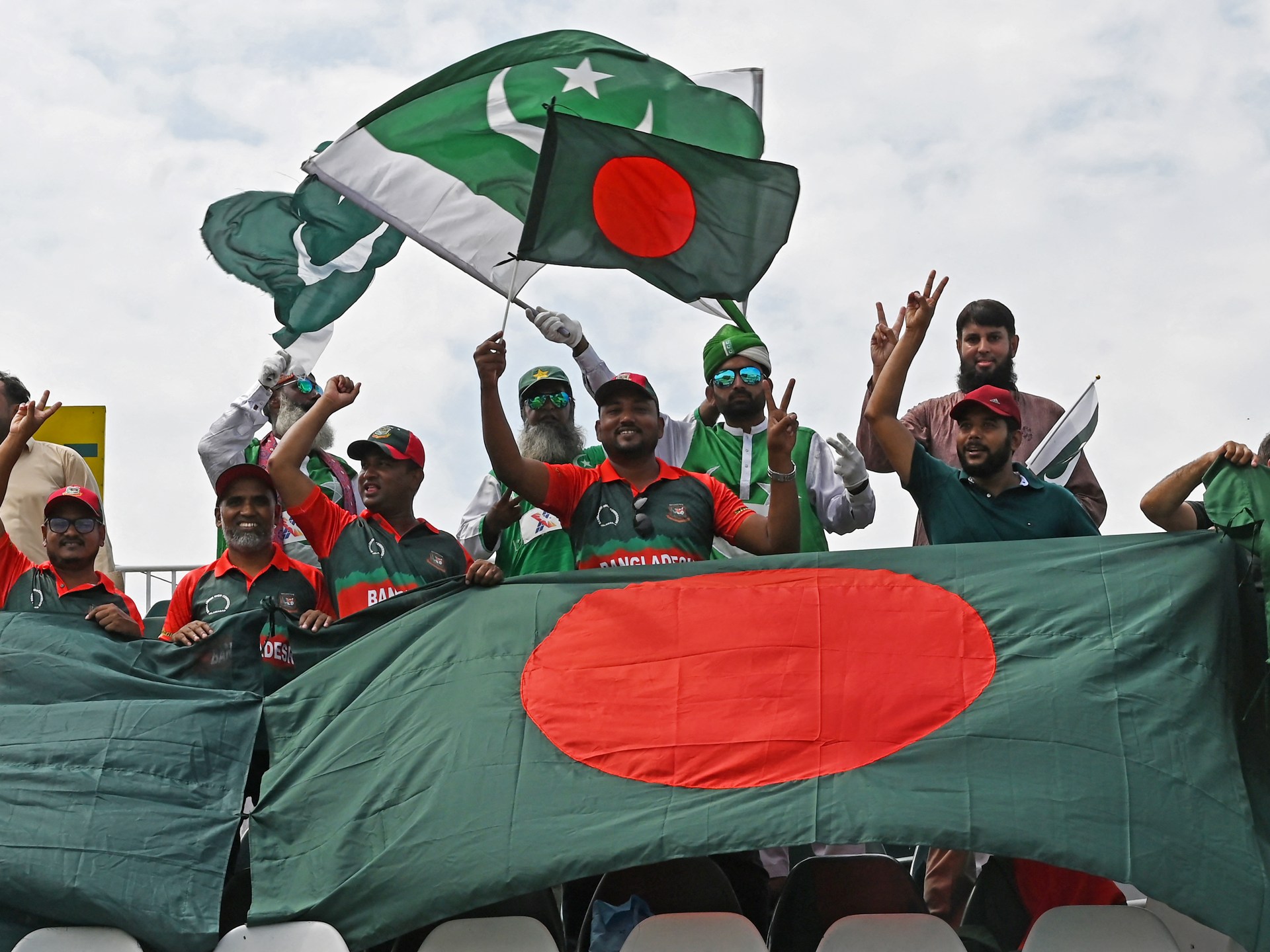
ISLAMABAD, Pakistan – Pakistan’s participation in the T20 World Cup is in doubt after Bangladesh were expelled from the tournament by the International Cricket Council (ICC).
Bangladesh, which will compete in the next world championships in June 2024, was expelled from the tournament on Saturday after weeks of deadlock with the ICC over a request to move the venue from India to Sri Lanka. The ICC awarded Bangladesh’s spot to the next highest T20 team, Scotland.
Recommended stories
list of 4 itemsend of list
The ICC has been accused of practicing “double standards” in the unprecedented move of expelling a full member state over a logistics impasse.
The Pakistan Cricket Board (PCB) immediately backed Bangladesh, saying it would not take a “final decision” on the team’s participation until next week.
PCB Chairman Mohsin Naqvi met Pakistan Prime Minister Shehbaz Sharif on Monday to discuss the issue, but did not say whether Pakistan would travel to the tournament, which begins on February 7.
Naqvi, who is also Pakistan’s interior minister, said in a post on X: “We have agreed that the final decision will be taken on Friday or next Monday.”
Due to rocky relations between New Delhi and Islamabad, all of Pakistan’s World Cup matches are scheduled in Sri Lanka.
What is the Bangladesh vs India T20 World Cup controversy all about?
The controversy involving the three South Asian countries began three weeks ago when the Bangladesh Cricket Board (BCB) requested that all the team’s matches scheduled in India be held in Sri Lanka. They cited concerns for the safety and security of players.
This follows the sudden removal of Bangladeshi fast bowler Mustafizur Rahman from Indian Premier League (IPL) franchise Kolkata Knight Riders on instructions from the Board of Control for Cricket in India (BCCI).
The BCCI cited “development in all aspects” as the reason. That may refer to the deterioration in relations between Dhaka and New Delhi since August 2024, when Bangladeshi Prime Minister Sheikh Hasina was ousted from power and went into exile in India, where she remains.
Bangladesh maintained that even if one of their players is unsafe in India, they cannot jeopardize the safety of the entire team and support staff.
But the ICC, currently headed by Jay Shah, son of India’s Home Minister Amit Shah and a close ally of Prime Minister Narendra Modi, rejected the relocation request. The governing body said there was no “credible” or “verifiable” threat against the Bangladesh national team.
Further back-and-forth between the BCB and the ICC, with neither side moving from their original positions, saw Bangladesh expelled from the tournament and replaced by Scotland.
Why is the ICC accused of “hypocrisy”?
In late 2024, the ICC brokered a three-year agreement between India and Pakistan that allows both countries to play matches at neutral venues when their neighbors host international tournaments.
The decision was taken after India refused to travel to Pakistan for the ICC Champions Trophy, citing security concerns raised by the Indian government. India played all their matches including the final in Dubai, United Arab Emirates.
Pakistan will play a match in Sri Lanka in the 2025 ICC Women’s World Cup, which will be co-hosted by India and Sri Lanka, and will play a similar match in the 2026 ICC Men’s T20 World Cup.
BCB President Aminul Islam pointed to the agreement and accused the ICC of “hypocrisy” for rejecting a similar request from Bangladesh.
With the BCB and ICC deadlocked, the PCB decided to join the dispute in support of Bangladesh’s request for a neutral venue.
At the ICC board meeting last week to discuss the issue, Pakistan was the only full member state to support Bangladesh’s position. Other board members supported the idea of having Bangladesh play instead if they refused to play in India.
Why was Pakistan involved in this incident?
Although the dispute is related to sports, the underlying tensions are deeply political, with the three countries sharing decades-long severed relations.
After the partition of British India in 1947, India emerged as an independent state while Muslim-majority Pakistan was established with its eastern and western wings separated by more than 2,000 km.
Less than 25 years later, the eastern wing separated after a bloody war and became Bangladesh. The Indian military played a crucial role in supporting Sheikh Mujibur Rahman, the founder of Bangladesh and Hasina’s father.
Fast forward to 2024, and the once-close India-Bangladesh relationship has been torn apart by Hasina’s ouster, while Bangladesh-Pakistan relations, previously near rock bottom, have rapidly improved.
So, at a time when Bangladesh was locked in negotiations with the ICC, Pakistan’s head of cricket, Naqvi, publicly criticized the governing body.
“We cannot have double standards,” Naqvi said on Saturday.
“You can’t say that one country (India) should do whatever it wants and another country should do exactly the opposite. That’s why we took this stand and made it clear that Bangladesh has been treated unfairly against them. They should be in the World Cup. They are a major stakeholder in cricket.”
How will Pakistan react and what can it do next?
Within days of the BCCI’s decision to exclude Mustafizur from the IPL, the PCB reacted by offering Bangladesh’s star bowler an option to register for the Pakistan Super League, the country’s premier franchise T20 tournament.
Despite reports in the Pakistani media that the PCB may withdraw from the T20 World Cup, Naqvi has not hinted at the possibility.
There is also speculation that Pakistan may withdraw from the match against India in Colombo on February 15 as a symbolic act of support for Bangladesh.
A final decision is expected on Friday or Monday, with continued uncertainty potentially disrupting Pakistan’s preparations for the tournament. They are scheduled to play against the Netherlands in the tournament’s opening match on February 7th.
Former ICC and PCB president Ethan Mani has warned the PCB not to withdraw from the World Cup.
“This brings politics into the game. I have always maintained that the two should be strictly separated,” he told Al Jazeera.
What will happen if Pakistan withdraws from the T20 World Cup?
The rivalry between Pakistan and India in the political arena has long spilled over onto the cricket field, which has increasingly become a proxy battleground, especially since then. Tensions escalated sharply after a four-day military clash between the two neighbors in May.
Relations were further strained after India refused to travel to Pakistan for the Champions Trophy, which they won unbeaten in the United Arab Emirates.
When the two teams met again at the Asia Cup in September, Indian players refused to shake hands with Pakistani players. After India won the tense final, the Indian team also refused to accept the trophy from Naqvi, who is also the president of the Asian Cricket Council.
Ali Khan, a professor at the Lahore University of Management Sciences and author of “Pakistan Cricket: Nation, Identity, Politics,” said Pakistan’s support for Bangladesh was a “definitely principled position to take.”
“If both India and Pakistan can handle similar situations, why can’t another full ICC member state (Bangladesh) be accepted? It is also important for Pakistan to defend the way the ICC is currently operating,” he told Al Jazeera.
But Mr Khan warned that threatening a boycott was going too far.
“Then it veers into a performative, petty point-scoring exercise. Pakistan should continue to forcefully highlight inequities within the ICC at every meeting, persuade others to speak out, and shame others. This requires strong diplomacy, not chest-puffing.”
Meanwhile, veteran Indian cricket writer Sharda Ugra said Pakistan’s intervention appeared to be aimed at building alliances.
“The cricket community will obviously be disappointed if Pakistan withdraws from the tournament,” she said.
Ugra believes Naqvi’s move is aimed at “embarrassing and putting the ICC and BCCI at a disadvantage, especially since Naqvi is also Pakistan’s interior minister.”
“But if Pakistan withdraws, it could have huge consequences.”
What impact will this controversy have on cricket?
Mr Khan argued that the ICC had taken principled positions in the past, including on the reunification of apartheid-era South Africa, but that the balance was shifting.
“Sadly, India’s huge economic influence in cricket has greatly upset the balance of the cricketing world and has simply become a mouthpiece for the Indian government, and other member states are also responsible for this by cowardly accepting India’s diktat,” he said.
Ugra also criticized the England and Wales Cricket Board and Cricket Australia for their respective silence on the issue.
“Bangladesh is part of the ICC community, a full member, and these two boards should have played their part to make it more fair,” she said. “They all seem to be subservient to the BCCI and behaving as if they have no power.”
