


Enrollment in the Affordable Care Act marketplace has declined by millions this year, and the Trump administration and health policy experts are at odds over the cause.
The number of people enrolled in health insurance plans purchased through the ACA marketplaces fell by about 3 million, or about 13%, to 19.2 million in February 2026, down from 22.1 million at the end of 2025, according to data released last week by the Department of Health and Human Services.
This is the first decline in ACA enrollment since the first Trump administration and the largest decline since the ACA Marketplace was established in 2014.
The data reveals for the first time how many enrollees have “benefited” from reducing their monthly premium costs since enhanced ACA premium subsidies expired at the end of 2025. The data reveals whether those who signed up were also able to make their monthly payments.
Health policy experts said the decline is a clear sign that the expiration of federal subsidies for ACA premiums has made insurance too expensive for many Americans, and many households are opting out of insurance.
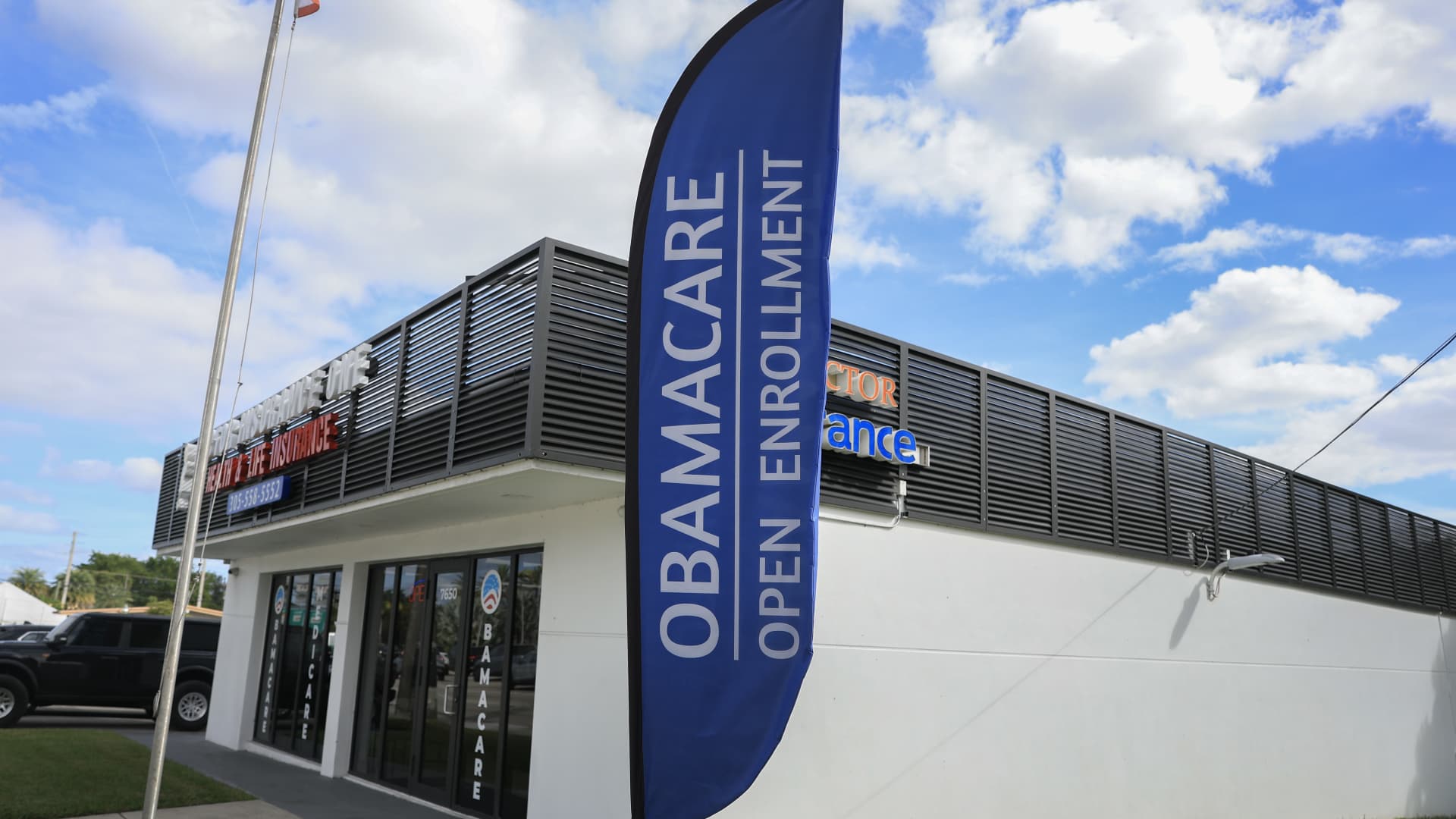
An Obamacare sign stands in front of an insurance agency in Miami on November 12, 2025.
Joe Radle | Getty Images
The Trump administration portrayed the decline in a positive light, with HHS pointing to efforts to crack down on fraud as a major factor in the recent decline.
HHS said in a recent data release that its efforts have partially eliminated the large increase in fraudulent admissions that occurred under the Biden administration. Among other things, the agency noted that the Centers for Medicare and Medicaid Services canceled coverage without the consent of 250,000 people enrolled in ACA plans.
Policy experts said there was little evidence to support the idea that fraud enforcement was the main factor.
If anything, the fraud argument provides political cover for the administration and Republicans in a midterm election year, when affordability is “a top concern for Americans,” said Jonathan Oberlander, a professor of health politics and policy at the University of North Carolina at Chapel Hill.
The expansion of ACA premium subsidies was the main reason for the government shutdown in the fall. Democrats pushed to extend the subsidies beyond 2025, but Republicans ultimately allowed them to expire.
Republicans also made a number of administrative tweaks to ACA markets in their so-called “Big and Beautiful Bill,” which is estimated to further reduce enrollment.
“Under President Trump, Republicans are committed to health care affordability across the board,” a Centers for Medicare and Medicaid Services spokesperson said in an emailed statement. “Furthermore, CMS will continue to root out waste, fraud, and abuse wherever we discover it to protect Americans’ tax dollars,” the spokesperson said.
The scope of ACA fraud may have been exaggerated

HHS said it estimates “inappropriate, fictitious, and fraudulent admissions” will reach 5.6 million in 2025.
It said in the data release that “program health initiatives” undertaken by the Trump administration, including eliminating certain special enrollment periods and canceling insurance policies deemed fraudulent, had resulted in millions of fewer people enrolling.
“The Trump administration has utilized a number of tools to ensure that federal funding goes to only those who are eligible,” according to a June 26 report from the Department of Health’s Office of the Assistant Secretary for Planning and Evaluation.
Health policy experts do not dispute that there was some measurable fraud within the system. Indeed, the Government Accountability Office, a nonpartisan federal watchdog that audits government spending and efficiency, outlined the risks of fraud associated with ACA subsidies in a December report requested by congressional Republicans.
But experts dispute that cause, as some of the problematic activity can be explained by legal or non-criminal factors.
HHS said it estimates that more than 1 million current ACA enrollees do not have Social Security numbers, classifying them as “inappropriate” or “fictitious” enrollments. But experts said this was not clear evidence of wrongdoing.
As an example, many immigrants who are legally in the U.S. on regular visas that qualify them for the ACA don’t necessarily have Social Security numbers, said Michael Gasmano, a health policy professor at Lehigh University.
He said illegal immigrants were already barred from enrolling in ACA plans.
House Speaker Mike Johnson (R-Louisiana) discusses rising health insurance premiums as House Minority Leader Steve Scalise (R-Minn.) and House Minority Leader Tom Emmer (R-Minn.) look on during a news conference at the Capitol in Washington, Dec. 10, 2025.
Heather Deal | Getty Images
More broadly, there could also be issues with Social Security number data matching in ACA Marketplace registrations. So the lack of an SSN could be a data issue, not fraud, Oberlander said.
Matthew Fiedler, a senior fellow at the Brookings Institution think tank who studies health economics and policy, said SSN shortages can occur when brokers try to sign up “fake” registrants (which constitutes fraud), but they can also occur when brokers are simply “sloppy” and don’t try to collect all of the registrant’s information.
“Indeed, it is very likely that the reason the government did not end these registrations all together is because they believe this group contains a large number of legitimate registrations,” Fiedler wrote in an email.
Oberlander gave an even more frank assessment, suggesting the firings were politically motivated. “The decline in enrollment is in no way due to fraud,” he said. “(Republicans) are exaggerating the scope of the fraud problem to obscure the progress they have made in reducing health insurance coverage.”
Access to “free” health plans
November 1, 2025, healthcare.gov website on a laptop located in Norfolk, Virginia.
Stephanie Reynolds | Bloomberg | Getty Images
The premium subsidy enhancements Congress tentatively enacted in 2021 allow low-income households between 100% and 150% of the federal poverty line to access certain ACA health plans without paying monthly premiums.
HHS said in a recent report that many enrollees misrepresent their income to access these “free” ACA health plans.
But Cynthia Cox, ACA program director at KFF, a nonpartisan health policy research group, said the alleged misstatement may not have been intentional.
If you sign up for ACA coverage, you’ll need to estimate your income for the next year. These estimates determine eligibility for premium subsidies, but Cox said some people, especially those with unstable incomes, may make incorrect assumptions.
Either way, you will have to adjust that income on your tax return and repay the excess subsidy.
Obamacare sign at an insurance agency in Miami, November 12, 2025.
Joe Radle | Getty Images
HHS said the “free” plans also provided financial incentives for “unscrupulous” brokers to unknowingly enroll people in ACA coverage in order to receive commissions. Since they were not required to pay premiums, these people did not know they had coverage.
HHS said CMS identified 250,000 people who enrolled without their consent and terminated their coverage.
Why ACA premium subsidies are likely to be a driver
Health policy experts say the most likely factor in the decline in enrollment is the sharp rise in ACA premiums following the expiration of enhanced subsidies at the end of 2025.
Last year, KFF estimated that due to the subsidy expiration, enrollees’ premiums increased by an average of 114%, from $888 in 2025 to $1,904 in 2026. Some enrollees could potentially pay more than $20,000 a year in additional premiums in 2026, KFF said.
“It is basic economics that the more expensive something is, the less likely people are to buy it,” Fiedler of the Brookings Institution wrote in an email.
Senate Minority Leader Chuck Schumer (D.Y.) speaks at a press conference with other members of the Senate Democratic leadership after a policy luncheon at the Capitol on October 15, 2025.
Anadolu | Getty Images
“There is also abundant empirical evidence that when premiums rise, significantly fewer people purchase insurance (especially among the low-income populations served by marketplaces),” he wrote. “So it would be a big surprise if doubling enrollees’ premiums didn’t significantly reduce enrollment.”
Additionally, inflation in the U.S. economy remains high, Gusmano said.
As a result, household income, which takes into account living costs, has decreased, making it difficult to pay medical insurance premiums, he said.
The decrease in the number of registrants is in no way due to fraud.
Jonathan Oberlander
Professor of Health Politics and Policy at the University of North Carolina at Chapel Hill
Policy changes to the ACA markets emphasized by the Trump administration “had most of their effects by the end of 2025,” Fiedler said, meaning that the large drop in enrollment seen in early 2026 cannot be easily explained by fraud regulations alone.
Enrollment is likely to continue declining through 2026 and will continue to decline for years to come, experts say.
A KFF poll released in March found that about 17% of reinstated ACA enrollees said they were not confident they would be able to pay their monthly health insurance premiums for the entirety of 2026.
The Congressional Budget Office estimated in February that total enrollment in ACA marketplace health plans will fall to 12.5 million people by 2028, nearly half of last year’s enrollment. This would still be about 1 million more students than enrollment in 2021, when the enhanced subsidies went into effect.
The percentage of the U.S. population without health insurance is expected to grow from 7.6% in 2025 to 10.4% by the end of 2010, according to the CBO.
“Enrollments in the market are down significantly, and we’re only in the first few months (of 2026),” said Oberlander of the University of North Carolina. “This is just the beginning.”
