

bogota, colombia —
Election authorities in South America may need to take the soccer calendar into account when setting the next voting date.
That seems to be a lesson from Colombia, where excitement about playing in the World Cup for the first time since 2018 spilled over into politics ahead of the June 21 presidential run-off.
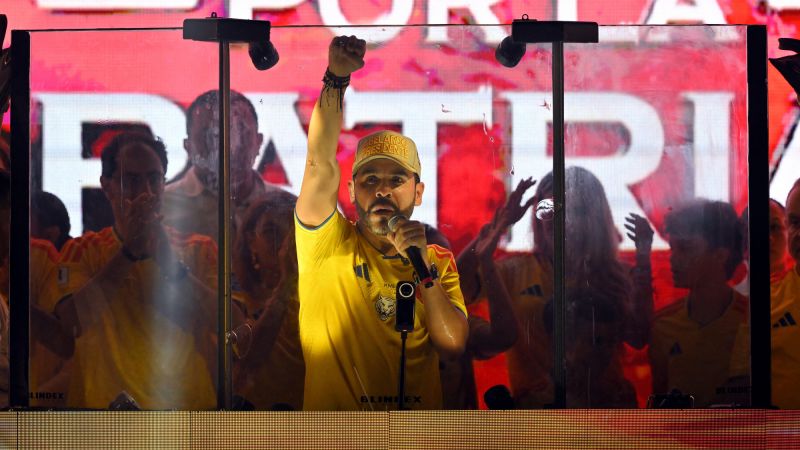
On Wednesday, a local judge in Colombia’s capital, Bogota, even ruled against right-wing election favorite Abelardo de la Espriela from wearing the national team’s bright yellow jersey.
In recent weeks, de la Espriela and his supporters have worn the jersey at political rallies and on social media. Mr. de la Espriela, a conservative nationalist who brought MAGA-like rhetoric into Colombian politics, considers the soccer uniform to be a symbol of the country, like the flag and the military, a symbol of his political aspirations.
Ahead of the first round of voting on May 31, Mr. de la Espriera asked voters to wear jerseys at polling stations, circumventing election rules that prohibit candidates from campaigning on election day.
His critics, including his left-wing rival Ivan Cepeda, have criticized de la Espriela, saying sports equipment should belong to all Colombians and deploring the politicization of sports equipment. On Thursday, Colombian judge Aura Forero went a step further, ruling that his use of the jersey was “inappropriate” and formally banning it from being worn in political contexts.

Mr. de la Espriela’s use of the soccer uniform for political expediency “logically undermines the right to equal use by other presidential candidates and their supporters, since the improper use of the uniform is skewed in favor of Mr. de la Espriera’s candidacy and his political party,” the ruling said.
Inappropriate or not, Latin American politicians love soccer jerseys, or camisetas. In a region where soccer is a religion, it’s no surprise that politicians use sport to win people’s hearts.
Former Brazilian President Jair Bolsonaro frequently wore the unmistakable green and yellow Brazil jersey, turning it into a powerful symbol of his own brand of right-wing politics. Long before Bolsonaro, his nemesis and current president, Luiz Inacio Lula da Silva, was finding parallel routes for Brazilian soccer fans to smile and pose for photos with soccer stars like Ronaldo Fenomeno.

Nothing says “man of the people” like the jersey of his beloved team. This makes the jersey an obvious choice for political elites who want to appear approachable. Italy’s Silvio Berlusconi, the father of modern right-wing populism, built part of his political career on the success of AC Milan, which he owned from 1986 to 2017 and is considered by some to be one of the greatest club teams of all time, with an overwhelmingly successful run in the late 80s and early 90s.
In Venezuela, the only country in South America to never qualify for the Men’s World Cup, both former president Nicolas Maduro and the dozens of opposition leaders who challenged his rule have both worn Vino Tinto jerseys.
This week, amidst the uproar, an old video of Colombian politicians from all walks of life wearing national team jerseys resurfaced on social media. Cepeda’s campaign chief María José Pizarro wore the jersey during the March 8 parliamentary elections, and Colombian President Gustavo Petro also wore it at the national team’s farewell party the day after Judge Forero’s ruling was announced. It is unclear whether the president’s choice of attire constitutes a crime or whether he is not guilty because he is not participating in a political event.

With the start of the World Cup and Colombia’s election day approaching, de la Espriela said he would ignore the ban as an attack on personal freedoms. Some supporters are holding a “flag day” on Saturday, calling on all supporters of the right-wing presidential candidate to wear jerseys (something Bolsonaro has done for years to rally his fans).
Given that 10 million Colombians voted for Mr. de la Espriela in the first round of last week’s elections, and given that the run-off vote will be held on June 21 between Colombia’s World Cup matches against Uzbekistan and Congo, it will be difficult for police to fine everyone who wears a camiseta in public.
