

Nuestra Covertura in Spanish
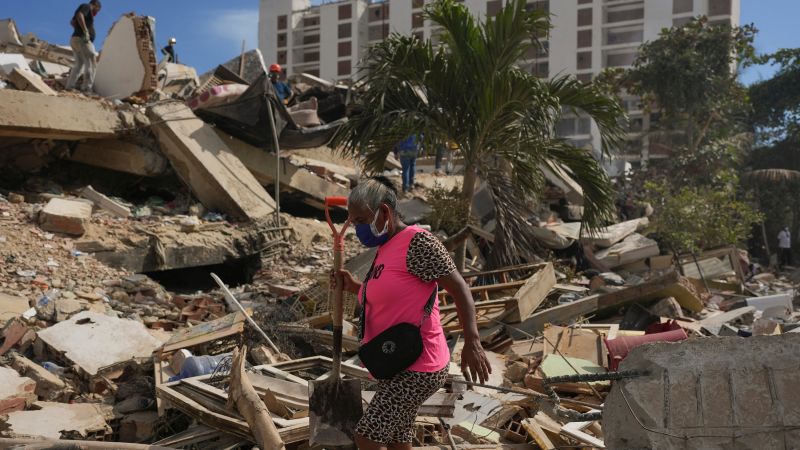
Yesterday, as Venezuelans in La Guaira continued to scavenge through the rubble of collapsed buildings, a government excavator stood motionless next to piles of concrete and bent rebar.
It’s been nearly a week since two major earthquakes destroyed much of this coastal city, and there’s a lot of work to be done. Heavy machinery is an essential tool in the aftermath, but when CNN asked the excavator operator why it wasn’t working, he said he didn’t have enough gasoline to put it in the machine.
Venezuela, a country with the world’s largest reported oil reserves, has been hit by the worst earthquake in more than 100 years, leaving many of its citizens forced to manually dig friends and family out of the rubble due to fuel shortages. Their despair comes as Venezuela’s government faces mounting criticism over its handling of the crisis.

“People are furious,” said Carmen Beatriz Fernández, a political analyst and director of the consulting firm DataStrategia. “What we see is this tragedy is a reflection of another tragedy where you dedicated the capacity of the state only to repression and propaganda. You dismantled the capacity of the state to provide basic needs.”
Opposition leader María Colina Machado said the crisis motivated her to return to Venezuela from U.S. exile, telling Fox News that she and Venezuelans “need to come together.”
Meanwhile, the government has defended its earthquake response despite “initial confusion”, with top lawmaker Jorge Rodriguez touting new efforts to “allocate volunteers according to established priorities”. Interior Minister Diosdado Cabello told Venezuelans early on to trust the government.
“We are asking the public, in the midst of this situation, to be able to organize within their communes, to be able to organize within all buildings. We need to know who is missing, where they have been, so that we can carry out rescue operations more precisely,” Cabello said last Thursday.


In La Guaira, one of the worst-hit areas in the country, the humid air is filled with the smell of putrefaction and additional resources are desperately needed. CNN witnessed people using picks, shovels and their bare hands to demolish the collapsed high-rise apartment building.
“We spent a lot of time finding new tools to use for specific tasks, like cutting steel,” Hassel Mendoza told CNN. The engineer flew in from Tampa and has been trying to find his mother, sister, brother-in-law and nephew sleeping on the ground in the ruins of a nine-story apartment building since arriving two nights ago.
Mendoza said the search would have been extremely difficult without the proper tools. Civil defense teams from neighboring Aragua state did not have any of the equipment needed to quickly destroy the debris, Mendoza said. There are no drills or sensors. Water donations from governments and others helped, but they were not enough.
The official death toll continues to rise, albeit slowly. On Tuesday, National Assembly Speaker Jorge Ramírez, the acting president’s brother, announced at least 1,943 people had died, an increase of about 200 from the previous day.
However, the number of casualties is believed to be much higher. The U.S. Geological Survey estimates that tens of thousands of people are likely to die. Gianluca Rampolla, the UN’s resident humanitarian coordinator in Venezuela, said on Monday that the Venezuelan government and the UN were procuring 10,000 body bags in anticipation of the rising death toll.
When CNN passed by a makeshift morgue in La Guaira’s port, rows of coffins were piled high on the pier.
Like many people camping outside their families’ homes in Venezuela, Mendoza refuses to believe they are gone until the last possible moment. “There is a glimmer of hope that the family is alive,” she said. “We won’t know until the body is found.”
Her faith is not without precedent. Miraculous rescues are being caught on camera across Venezuela, well beyond the three-day “golden window” to find survivors. Jack Thorpe, an American volunteer with Resource Rescue International, told CNN he witnessed trapped people going into “survival mode” and trying to stay alive as they waited for rescue.
“We’re looking for lives, but we’re looking for dead as well,” Thorpe said of the team that headed to Venezuela from North Carolina on Monday. “I think at some point they’ll tell us it’s a full-scale recovery effort. We know we’re still finding people alive in these buildings, so we’re not going to give up just yet.”

Davis Ramos hasn’t cried since her daughters died in last Wednesday’s earthquake. He doesn’t know the use for it. Crying has not brought him back to digging through the rubble of his wife’s parents’ apartment, where he and others have spent days digging and searching for bodies.
“I can’t even imagine crying,” Ramos said. “Even if I feel like my heart is breaking right now, I can’t think of crying because tears won’t move a stone. What I need is strength and will.”
Ramos’ two daughters, Darling Antonella, 7, and Dulce Maria, 2, were staying with their grandparents and great-grandparents, who also died in the earthquake.
He was working at the city’s large port when the earthquake occurred. He rushed to the building within 30 minutes of the first earthquake. He’s been digging ever since.
“We’re just asking for the strength to get to where they are and to give them some rest,” Ramos said. He has been amazed by the help from around the country and abroad. “From the first afternoon, we saw patrols, firefighters, rescue teams, international aid, people from other states who came here with their bare hands and personal belongings.”
Ramos added that the state government brought a generator to assist in the search on the first day. Initially, heavy equipment brought in by others was able to excavate the site, but once rescuers determined there were no signs of life inside the apartment building, the equipment was moved elsewhere.
Ramos and other volunteers scoured the apartment, finding personal belongings such as her mother-in-law’s phone, sewing table and her daughter’s bed, but there was no sign of the children, at least not yet. Ramos suspects they fled to the other side of the force, which he was unable to reach.
“We have made peace with this issue,” he said. “We just want the strength to reach them and give them the rest they deserve. That’s all we want.”
Isa Soares and Madalena Araujo reported from La Guaira, Venezuela. Gonzalo Zegarra contributed to this report.
