

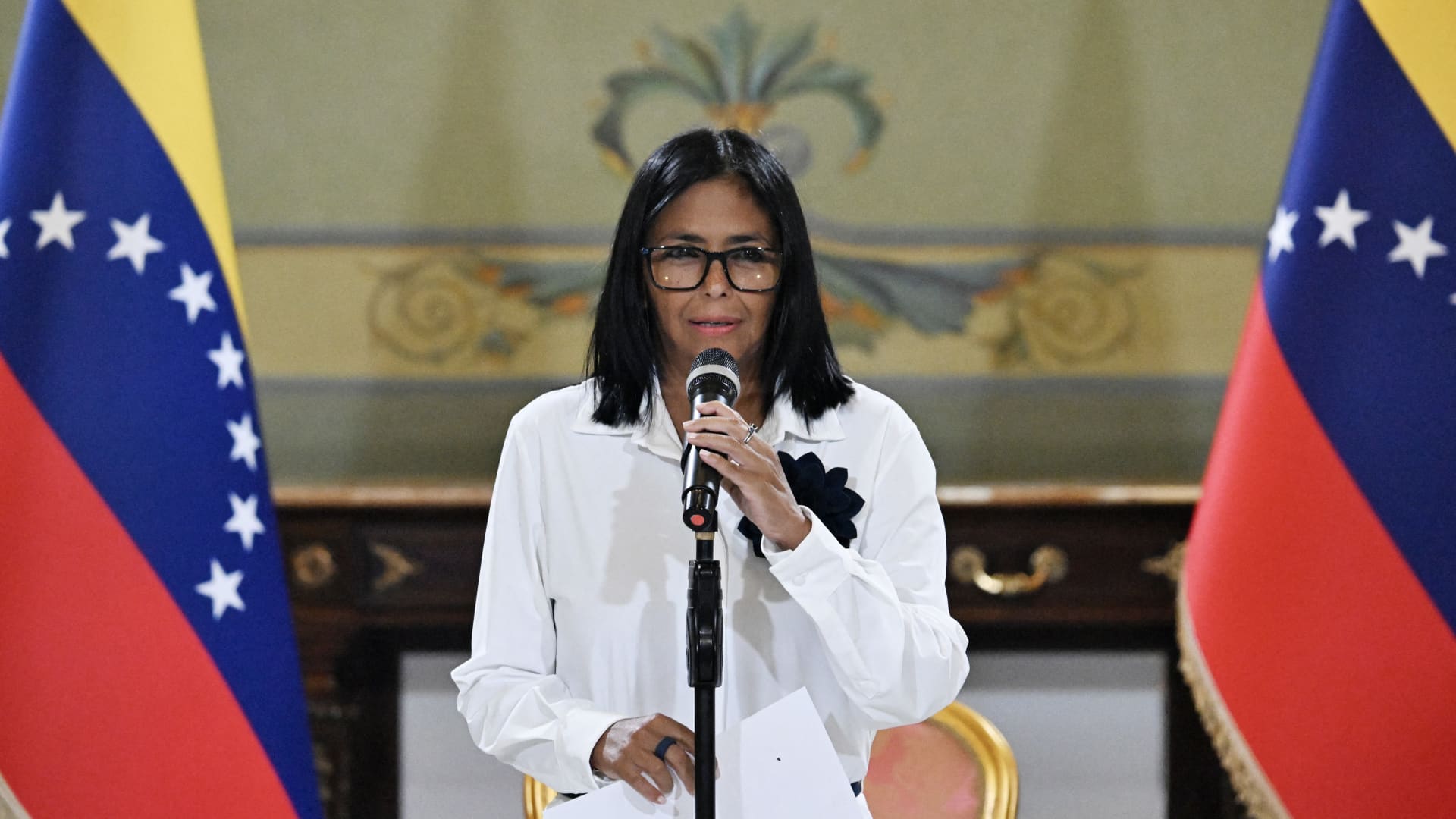
Venezuela’s Interim President Delcy Rodríguez speaks at a press conference after the signing ceremony of the agreement between Chevron Venezuela and the national government held at the Miraflores Palace in Caracas on April 13, 2026. On April 13, Venezuela’s interim President Delcy Rodríguez praised the oil sector’s progress in terms of foreign investment as part of a deal to increase oil production with US giant Chevron. (Photo by Juan BARRETO/AFP via Getty Images)
Juan Barretto | AFP | Getty Images
Venezuela’s government announced Wednesday that it has begun a “comprehensive and orderly process” to restructure massive government debt and state oil company debt.
Venezuela’s Economy and Finance Ministry said in a statement that its aim was to “bring the economy to the service of the Venezuelan people and free the country from the burden of accumulated debt.”
“Venezuela has demonstrated solvency and full compliance with all international obligations for many years. This ability and willingness to meet its financial commitments has been hampered since 2017 as a result of financial sanctions,” the government said.
“For too long, this country has been deprived of normal access to financing, leaving its economy without the ability to invest in health care, electricity, water, education, infrastructure, restoring productivity and the well-being of its people.”
Officials say the restructuring process aims to ensure significant debt relief, with the funds used for the benefit of the country and its people.
“Venezuela will sustainably fulfill its commitments, do so under the conditions that the Venezuelan people deserve, and build a solid path to restore well-being, justice and social equality,” the statement said.
In 2017, during his first presidential term, President Donald Trump imposed financial sanctions on Venezuela aimed at restricting the Maduro regime’s access to capital.
In January, the US military captured Venezuelan President Nicolas Maduro in an unprecedented military operation. He was taken to the United States and charged with his wife, Cilia Flores, on charges including drug-terrorism conspiracy.
Both Maduro and Flores deny wrongdoing.
Ousted Venezuelan President Nicolas Maduro attends a hearing in a narco-terrorism case accusing Venezuelan officials of running a cartel that flooded the United States with cocaine, on March 26, 2026, at the Daniel Patrick Moynihan US Courthouse in New York City, USA. This courtroom sketch was taken on March 26, 2026.
Jane Rosenberg Reuter
Foreign sanctions have severely affected Venezuela’s economy over the past decade, pushing the country into default and mounting public sector debt.
Venezuela’s total debt defaults amount to at least $150 billion, or more than 200% of its gross domestic product, according to independent financial think sanction OMFIF. The country suspended public debt payments in 2017 as it suffered from hyperinflation.
However, under interim President Delcy Rodriguez, relations appear to have dissolved. In April, the Trump administration lifted sanctions against the Rodriguez administration. President Trump said earlier this year that Venezuela would ship sanctioned oil to the United States, with the proceeds controlled by the White House and sold at market prices.
He also said U.S. oil giants would invest billions of dollars to revive Venezuela’s oil industry.
Venezuela, a founding member of OPEC, has the world’s largest proven oil reserves at 303 billion barrels, or 17% of global reserves, according to the U.S. Energy Information Administration.
On Tuesday, President Trump posted a map of Venezuela on Truth Social, showing the country as the “51st state” of the United States.
Last month, the IMF and World Bank resumed dealings with Venezuela, paving the way for the agency’s first full assessment of the country’s economy in nearly 20 years. Such a move could ultimately allow billions of dollars to be raised through frozen special drawing rights.
In 2019, these groups suspended business with Venezuela over government recognition issues. The results of previous elections in which Mr. Maduro was declared the winner have been disputed, and protests have erupted in the capital, Caracas.
Investor appetite for Venezuelan bonds has soared since President Maduro’s deposition by the United States in January, with the value of Venezuelan bonds soaring on the heels of an extraordinary U.S. military operation in the country.
The price of the country’s benchmark 10-year sovereign bond has nearly doubled since January, and rose further after news of the debt restructuring plan was announced on Wednesday. The value of bonds issued by state oil company PDVSA has also soared this year and soared again during trading on Wednesday.
Venezuela announced Wednesday that it plans to present its macroeconomic framework and public debt sustainability analysis to the international financial community next month.
