

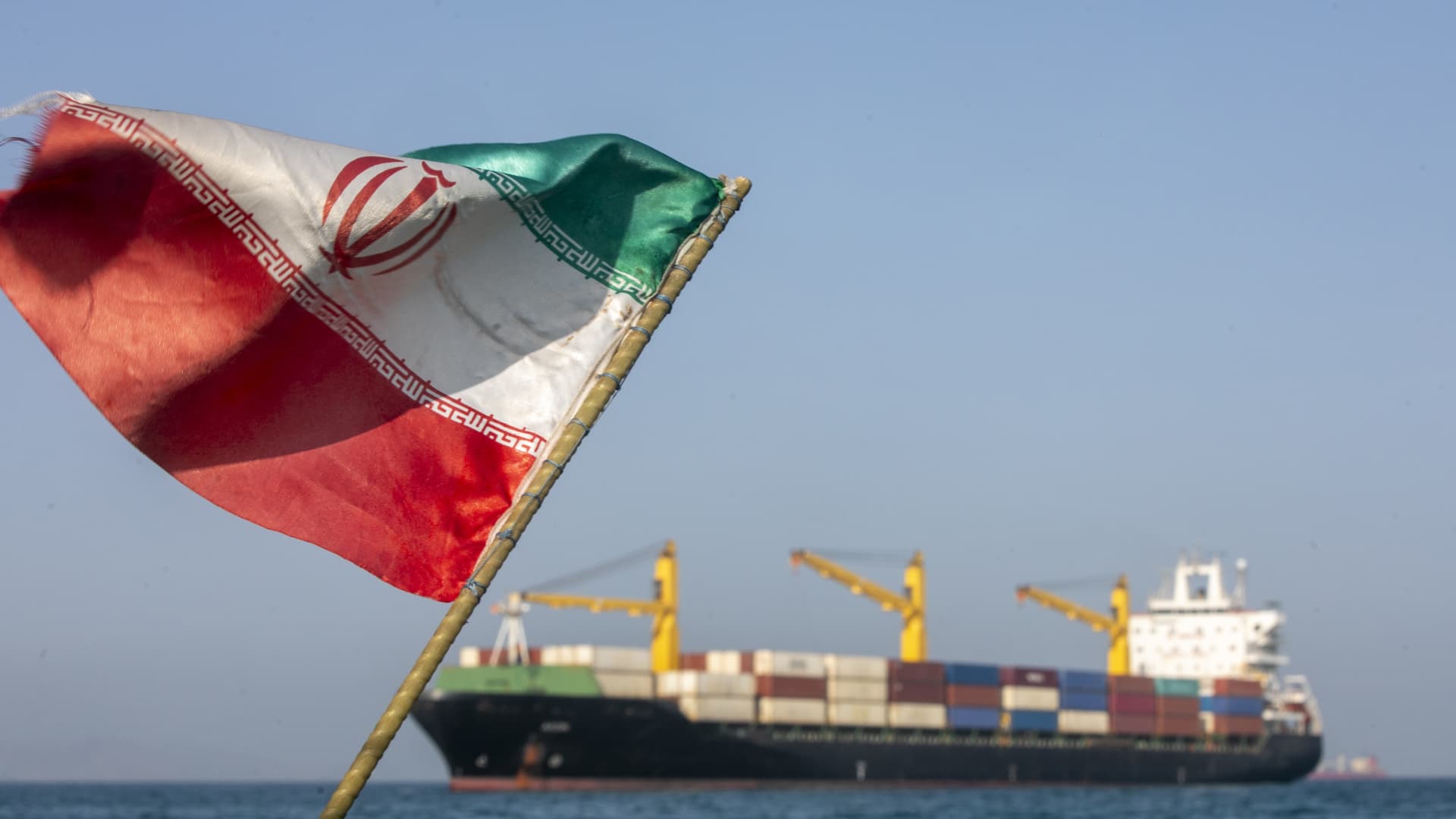
A ship anchors and an Iranian flag waving in the wind in the Strait of Hormuz near Larak Island, Iran, on May 16, 2026.
Majid Saidi | Getty Images News | Getty Images
The U.S. military carried out a “self-defense” strike in southern Iran early Tuesday, with U.S. Central Command saying the military action was “to protect U.S. forces from Iranian military threats.”
CENTCOM spokesman Tim Hawkins said targets include missile launch sites and Iranian vessels attempting to plant mines.
“U.S. Central Command continues to exercise restraint and protect our nation’s forces throughout the ceasefire,” Hawkins added.
The move comes after US President Donald Trump said in the US on Monday that negotiations with Iran were “progressing well.” But he warned that “it’s either a big deal for everyone or no deal at all,” threatening to bring things “back to the front and firing, but bigger and stronger than ever.”
According to Reuters, US Secretary of State Marco Rubio, who is visiting India, said the Strait of Hormuz must be opened “in any case”, referring to US actions against Iran. He added that a deal with Iran could take several days. On Monday, Fox News quoted a senior US official as saying the deal with Iran was “95% done.”
This is not the first example of military action since a ceasefire was agreed between Washington and Tehran on April 8. Later that month, U.S. Marines seized the Iranian cargo ship Tuska, and in May the two sides exchanged gunfire in the Strait of Hormuz, with each side claiming the other had launched an attack.
In a separate Truth Social post, the US president said Iran’s enriched uranium stockpile would be “immediately handed over to the United States and repatriated for destruction” or destroyed within Iran or “at another acceptable location.”
President Trump also urged Arab countries to sign the Abraham Accords, which normalizes relations with Israel. But Pakistan flatly rejected the proposal, with sources telling Reuters that the two issues were “unrelated and cannot be linked.”
Oil prices were mixed on Tuesday morning, with west texas intermediate Futures fell about 5% to $91.87 per barrel, while international benchmarks brent It rose 2.14% to $98.2.
Chen Lanhee, a partner at advisory firm Brunswick, told CNBC’s “Squawk Box Asia” that the majority of Americans want the war to end.
“It doesn’t matter what Iran has or doesn’t have. It doesn’t matter what the contours of the deal are. They just want to end the war and lower the price of gasoline and gas,” Chen said.
