

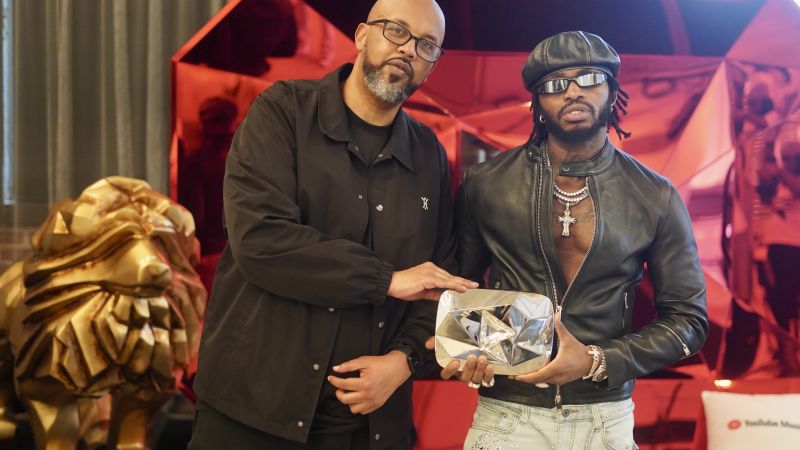
When people say that African music is having a “global moment,” they are often referring to only a small part of the continent.
“Nigeria and South Africa are the most dominant,” said Tuma Basa, YouTube’s former director of black music and culture. He recently announced his retirement after eight years with the company.
Afrobeats and amapiano (South African electronic dance music) are elevating African music around the world, but despite its rich diversity in more than 50 countries, the continent’s global presence remains concentrated in a small number of countries.
For Basa, the reasons are cultural and structural.
“First of all, they all speak English, and that still makes a difference in terms of the international reception of music,” Basa said, referring to Nigeria, South Africa and Ghana.
Diaspora communities also play a major role in exporting African sounds internationally.

“The strong diaspora from Nigeria and Ghana is key to the popularity of this music,” Basa said.
“South Africa doesn’t have a huge diaspora, but their dance spread like wildfire through social media.”
Events held in Lagos and Accra, such as ‘Death December’ and Ghana’s ‘Year of Return’ initiative, attract African American and Black British visitors, further increasing exposure. These visitors often take their music back to the United States and the United Kingdom, widening its international reach.
Still, Basa believes large parts of Africa remain overlooked, noting that many regions and genres receive little attention in the global music industry.
“Yes, some regions are left out of the global discussion,” he said. “But that will change as technology continues to level the playing field.”
Basa emphasized that tools for music production and distribution are becoming increasingly accessible. Cheaper production technology, social media, and global streaming platforms are reducing the traditional gatekeeping that once restricted artists from emerging markets. Still, he stressed that technology alone is not enough. Supporting artists around the world requires local infrastructure, licensing systems, and decision-makers in Africa.
Basa knows firsthand what it means to travel between worlds.
Born in the Democratic Republic of Congo to Rwandan parents, raised partly in Zimbabwe and educated in the United States, he describes himself as a “perpetual foreigner.”

These 10 African artists have received over 500 million views on YouTube in the past year
“It couldn’t help but empathize with me,” Basa said. “It forced me to develop intercultural skills.”
That perspective later shaped his work at MTV, Spotify, and YouTube, where he became one of the most influential curators of black music globally.
At Spotify, Basa helped build RapCaviar into one of the streaming world’s most influential hip-hop playlists, helping shape the careers of major artists and promoting the sounds of Africa and the diaspora to a broader audience.
Despite the industry’s obsession with algorithms, Basa says there are no real shortcuts to sustained success.
“Growth hacks definitely exist,” he says. “Abusing the system will backfire.”
Rather, he believes that consistency and collaboration are the most effective tools for artists looking to gain momentum.
“When artists collaborate, they tap into other artists’ audiences,” Basa explained.
“Consistency builds a relationship with your audience. They know you’ll always be there.”
Algorithms are just one part of the discovery ecosystem. Basa said human curation, licensing deals and commercial partnerships influence what viewers hear on streaming platforms. Playlist editors, label executives, curators, advertisers, and media gatekeepers decide which songs and artists get priority.
Brand campaigns, playlisting, label investments, touring support, and synchronization deals when music is licensed to television, film, or commercials all influence which artists receive international recognition.
As a result of these factors, global exposure is often driven as much by business strategy as organic discovery. Concert infrastructure, touring networks and royalty collection systems remain underdeveloped in many markets, a challenge Bassa likens to “fixing the plumbing” behind the scenes.
Without stronger systems, African artists risk creating cultural values that other artists more effectively benefit from. Building infrastructure is essential to achieving sustainable profits.
Although streaming services don’t publicly encourage direct pay-to-play arrangements, industry influence still flows through marketing budgets, label relationships, and playlist pitches, helping certain artists gain more exposure than others.
But Basa said “human curation is still very important.”
He argues that local knowledge is important because many of Africa’s sounds and movements are often misunderstood or completely ignored by decision-makers outside the continent. Without African-based curators and executives in important rooms, the entire region can become globally invisible.
Still, algorithms are reshaping the way listeners discover music, and not necessarily the way they expand exposure.

“A lot of it is so personalized that you’re singing along to a choir,” Basa said, describing a recommendation system that repeats what listeners already like.
At the same time, younger audiences are increasingly blurring the lines between old and new music, influencing musical discovery in novel ways.
“Songs that were considered ‘old’ back then are now treated like modern records in many young people’s personal playlists,” Basa said.
Basa suggested that while algorithms can help resurface older music to younger listeners, social platforms like TikTok, user-generated playlists and internet communities are also facilitating rediscovery in ways traditional radio never could.
Basa argues that despite the global accessibility of streaming, Africa’s main challenge is infrastructure, not talent.
He points out how technology has dramatically changed the music business. In the MTV era, artists needed expensive cameras, editing equipment, and industry connections just to distribute their videos internationally. Today, artists can shoot videos with a simple digital camera, edit them on a laptop, and upload them directly to YouTube.
“Music and music visuals are now borderless,” Basa said.
But visibility alone doesn’t give ownership. This is an important distinction as the music industry continues to evolve. Artists need global exposure as well as rights and access.
“If music is not available on a platform, can it really be discovered?” Basa said.
In many African markets, incomplete publishing data, weak rights enforcement, and distribution gaps continue to prevent music from being distributed on major global platforms.
The economics of streaming also reveal global disparities.
“The difference in payment amount is not necessarily due to the nationality of the artist,” Basa explained. “It’s because of where the audience is.”
Streams generated in wealthy advertising markets typically generate more revenue than in developing countries because subscription prices and advertising rates are higher.
Genres like kizomba, an Angolan style of music and partner dancing known for its romantic rhythms, and morna, a Cape Verdean soulful genre often compared to blues and fado, remain largely absent from the world’s mainstream conversation. So are South Africa’s new “3-step” electronic dance movement and Rwanda’s KinyaTrap scene, which blends hip-hop with local storytelling and street culture.
Fragmentation is not only musical, but also cultural.
“Linguistically, I don’t think musical movements coming from Francophonie or Lusophone countries are part of the same movement as Afrobeat or Amapiano,” Basa says.
For Basa, unity is more than a symbol, it is a practical strategy needed to advance African music globally.
“When it comes to movement, collaboration is the infrastructure,” he said. “If only all artists had the same idea.”
Basa also looks at how generative artificial intelligence could reshape music globally.
“Gen AI has risks,” he says. “There will be unintended negative side effects.”
Still, he believes the technology is already too embedded in the industry to be reversed.
“The train has left the station,” Basa said. “It is already being used in different capacities and at different levels of discretion.”
He noted that artists were using AI-assisted translation, background vocals, and songwriting support, but the extent to which generative AI was involved in this process was often not fully disclosed.
Basa also believes that AI could help African artists overcome language barriers and expand internationally.
“I can be an artist in Korea, and I can make my own songs in Korean, and I can use my voice, words, melodies, and rhythms to make Swahili versions, Mandarin Chinese versions, Arabic versions, Portuguese versions,” he said. “Nothing changes except the language.”
At the same time, he believes there will still be a place in the industry for artists who reject AI altogether.
For Basa, the debate ultimately comes down to audiences, artists and the industry deciding where to draw the ethical line.
Global attention to African music may be brighter than ever. But Basa believes the next stage will depend not just on talent, but on the ability of African artists and industries to build sustainable infrastructure, take control of their own narrative and expand beyond the genres the world already knows.
Because, he says, Africa’s story is still much bigger than the playlists currently dominating the charts.
