

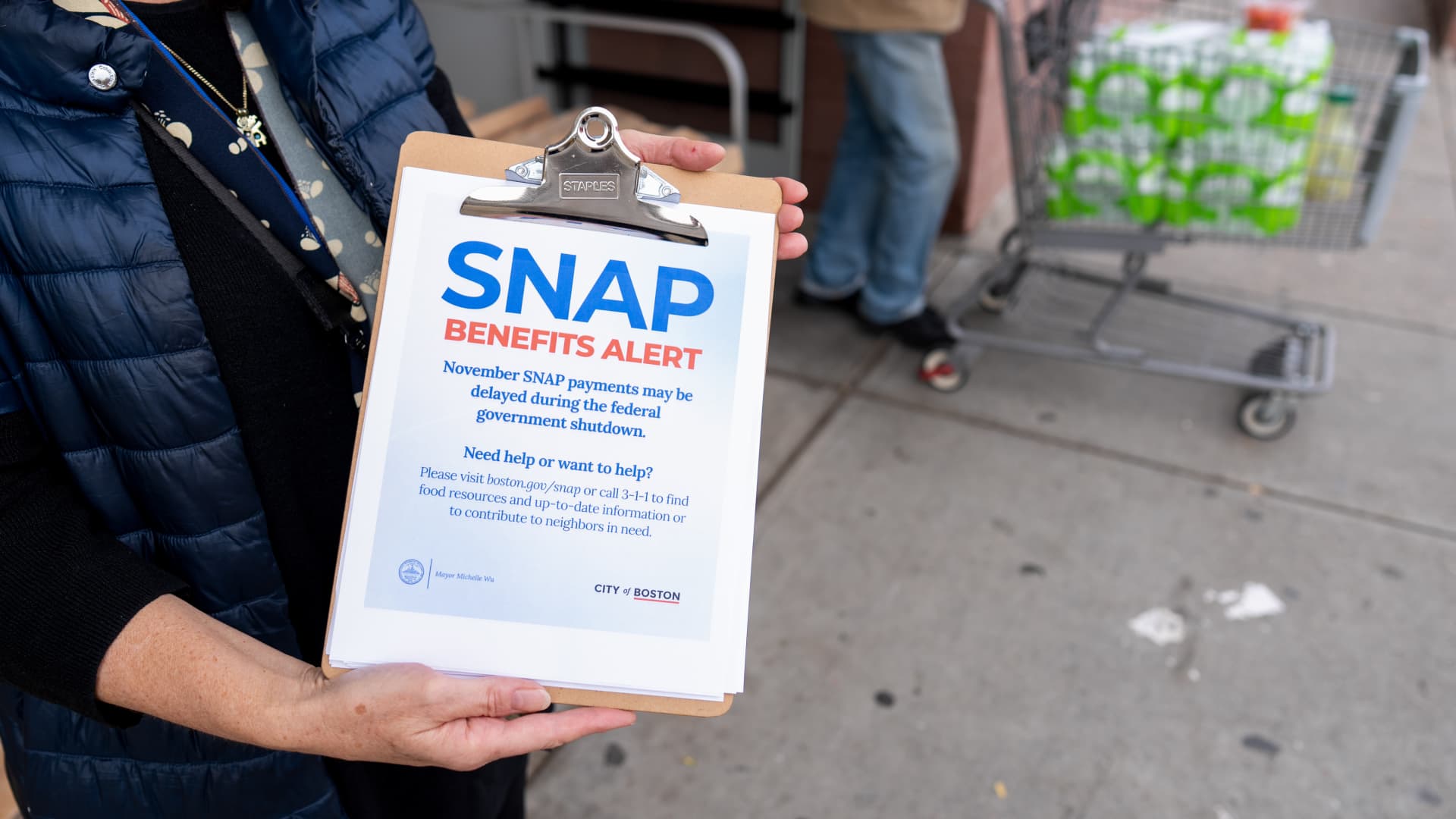
Volunteers display information about the Supplemental Nutrition Assistance Program (SNAP) at a grocery store on Monday, November 3, 2025 in Dorchester, Massachusetts, USA.
Mel Musto | Bloomberg | Getty Images
In a memo late Saturday evening, the U.S. Department of Agriculture threatened financial penalties to states that issued full monthly SNAP benefits in November if they did not “cancel” food stamp payments.
The late-night directive from the Trump administration adds to the confusion over the anti-hunger program, which serves more than 42 million Americans.
The memo, signed by Patrick Penn, USDA assistant secretary for food, nutrition and consumer services, warned states that the government had not fully settled November’s SNAP benefit payments.
“To the extent that states submitted complete SNAP payment files for November 2025, this was unauthorized,” the memo states.
State program administrators were instead directed to partially distribute 65% of that month’s SNAP benefits, according to the memo.
The memo also says states must “immediately rescind actions taken to issue full SNAP benefits in November 2025.” Failure to comply could result in the Department of Agriculture revoking federal contributions to administrative costs or making states financially responsible for “overissuance resulting from noncompliance.”
It is unclear how USDA expects states to recover fraudulent SNAP payments.
Sen. Amy Klobuchar (D-Minnesota) slammed the Trump administration’s move.
“Cruelty is what matters. It’s their choice whether to do this or not,” Klobuchar wrote in a post on social media site X.
The USDA and the White House did not immediately respond to CNBC’s requests for comment.
The memo was first reported by the New York Times.
This comes as some states scramble to comply with the court’s ruling Thursday, when a federal judge in Rhode Island ordered the Trump administration to pay out November’s full SNAP benefits on Friday. A judge has rejected the administration’s plan to partially fund the food stamp program amid the U.S. government shutdown.
The USDA then told states it would begin disbursing full SNAP benefits to comply with that order, even though the ruling faced an appeal from the Trump administration.
The Associated Press reported late Friday that more than six states “confirmed on Friday that some SNAP recipients had already received their November payments.”
The administration asked the U.S. Court of Appeals for the First Circuit for an emergency injunction to block the order to pay full food stamp benefits pending the outcome of its appeal. A three-judge panel of the Court of Appeals rejected the request on Friday.
But within hours, Supreme Court Justice Ketanji Brown Jackson temporarily suspended the order. Mr. Jackson directed the First Circuit to promptly rule on the government’s motion to impose an indefinite stay on the lower court’s order mandating full benefits.
The Trump administration previously said it would not use emergency funds that included $4.65 billion to fund the Supplemental Nutrition Assistance Program in November.
U.S. District Court Judge Jack McConnell of Rhode Island on Oct. 31 ordered the administration to use the funds to pay at least partial benefits and to consider other options for providing full benefits.
Days later, the administration announced it would pay 65% of the benefits, but denied using so-called Section 32 funds to make up the difference.
The total cost of full SNAP benefits for the same month would be approximately $8 billion.
The program, like other federal programs, currently has no allocated funding because Congress failed to pass a spending bill. This failure led to the U.S. government shutdown on October 1st.
Past administrations have continued to pay SNAP benefits during previous government shutdowns.
