

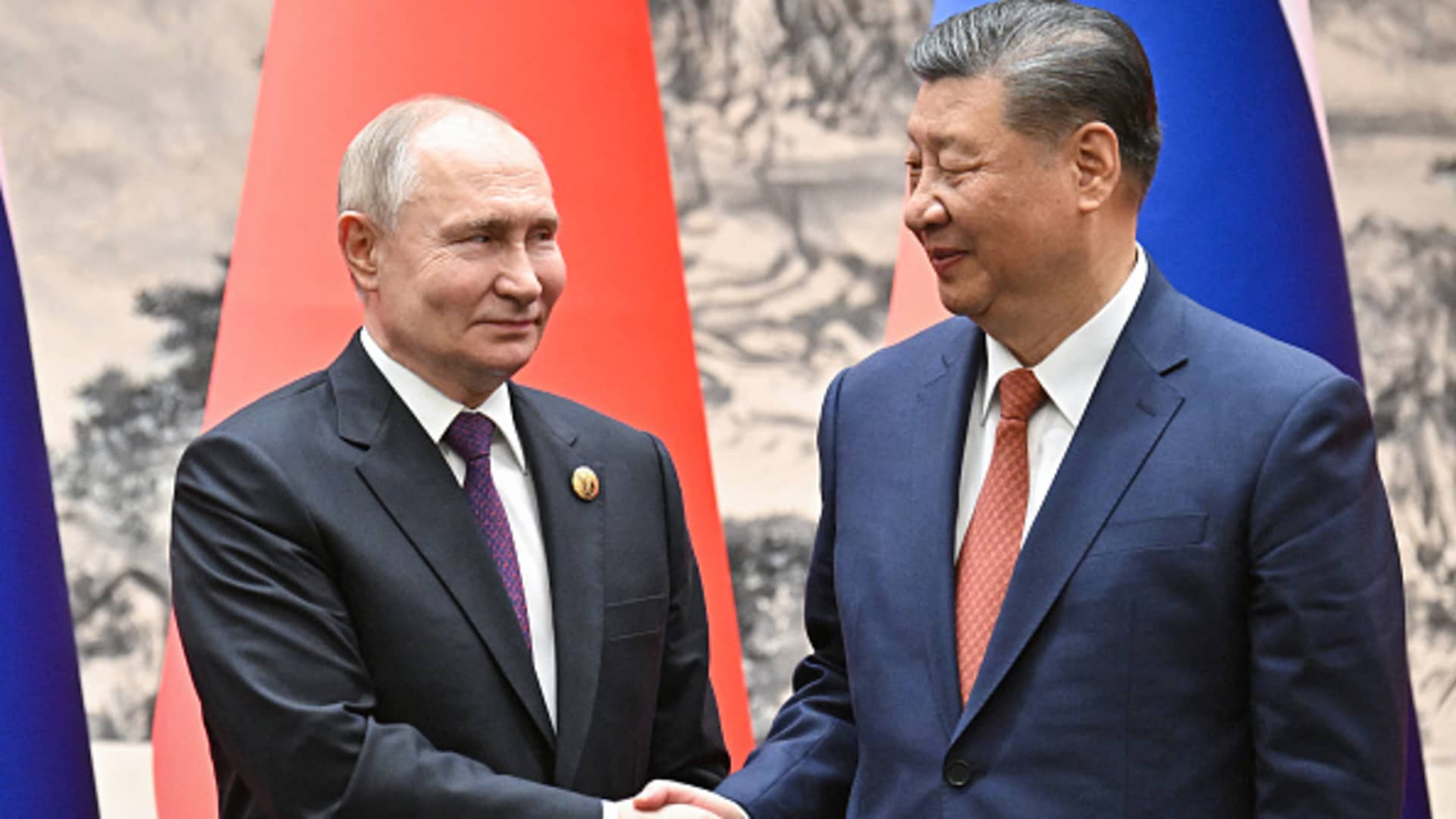
This pool photo distributed by Russian state news agency Sputnik shows Russian President Vladimir Putin and Chinese President Xi Jinping shaking hands during a signing ceremony after meeting in Beijing on May 16, 2024.
Sergei Bobilev | AFP | Getty Images
Hello, my name is Leonie Kidd and I’m from London. Welcome to today’s Daily Open Newsletter.
The so-called “strategic triangle” of Russia, China, and the United States will face one of its most important tests today.
The meeting between Russian President Vladimir Putin and Chinese President Xi Jinping in Beijing will be an important indicator of the current state of relations between the two countries. But it will also test relations with the United States after President Donald Trump ended his visit to China on a positive note.
This is a lot of geopolitical news for markets to digest, with investors walking a fine line between stocks that are generally resilient and some bond markets that are showing signs of distress.
What you need to know today
Russian President Vladimir Putin is in Beijing for a two-day summit with Chinese President Xi Jinping, the second meeting between the two leaders in the past year.
Dennis Wilder, a former U.S. intelligence official and Georgetown University professor, said Putin will seek reassurance that improving China-U.S. relations will not change the “strategic triangle” that keeps China and Russia closer together than either country.
However, the Financial Times reported this morning that Xi told President Trump last week that he may “regret” Putin’s invasion of Ukraine, according to a source cited by the FT with knowledge of the U.S. assessment of last week’s meeting.
It has become a top priority for President Putin during his stay in Beijing after the Russian leader last week suggested he was close to a “serious” gas and oil deal with China.
Meanwhile, President Trump called off plans to launch a new attack on Iran after Middle Eastern countries asked him to “delay.”
Qatar, Saudi Arabia and the United Arab Emirates (UAE) urged the White House to reconsider its actions, while President Trump said he had asked for a “short period of two or three days” to postpone the impending attack on Iran because he believes several countries are very close to a deal.
Oil prices softened on the news, but across stock markets Asia-Pacific stocks were mixed, with pre-market indicators pointing to a volatile open across Europe and the US.
In Paris, G7 finance ministers and central bank governors continue to take a cautious attitude. French Finance Minister Laurent Lescure told CNBC that while Europe’s economy is showing resilience, there are still major supply shocks. Valdis Dombrovskis, the European Commission’s head of economic affairs, also warned that the Iran war was causing a “stagflation shock”.
In corporate news, standard chartered The bank has outlined plans to cut more than 15% of its corporate headcount to meet its profitability targets by 2030. He said automation and the adoption of AI will help reduce roles across the back office.
— Leonie Kidd
And finally…
Musk slams Altman verdict as ‘technical’, vows to appeal
A federal jury in Oakland, California, said Monday that Elon Musk took too long to sue OpenAI and its CEO Sam Altman for allegedly violating an agreement to operate the artificial intelligence venture strictly as a charitable nonprofit.
The advisory jury’s verdict, which came after less than two hours of deliberation, was immediately adopted by District Court Judge Yvonne Gonzalez Rogers.
The court did not address whether Musk’s “charitable trust violation” claims were meritorious, instead finding that they fell outside the three-year statute of limitations.
Musk and his lawyers said they would appeal the ruling to the U.S. Court of Appeals for the 9th Circuit. The end of the trial marked a defeat for Mr. Musk in an early battle between the two tech billionaires who were once close friends.
In a post on his social network X, Musk called the decision a “calendar technicality.”
— Jeffrey Kopp, Laura Kolodny
