

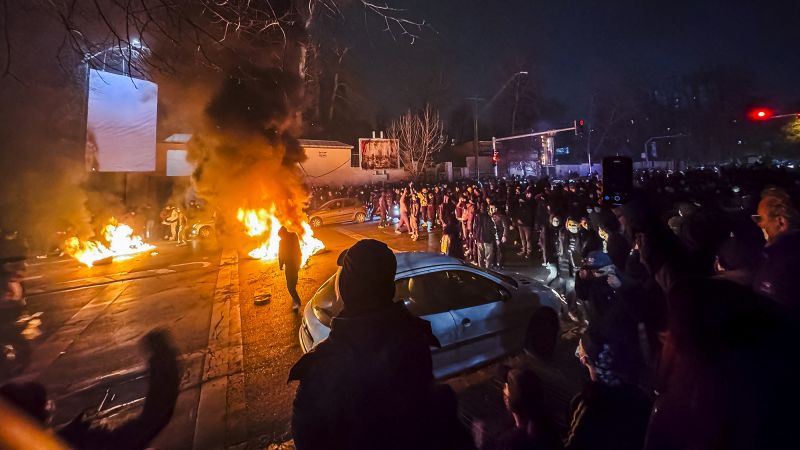
After finishing her morning errands in Tehran on Thursday, January 8, Mariam changed clothes and went home for coffee with a friend. By evening, she was among the crowds protesting the country’s dire economic situation. What happens over the next two days could be pivotal in Iranian history.
Those heading to the protests expected violence, but what happened that night was beyond their imagination. It was the 12th day of nationwide unrest, but at least initially the mood at the demonstrations was upbeat and determined.
“It was a beautiful Thursday night,” Mariam recalled, as her friends and family filled the streets in Iran over the weekend to protest for better living conditions and an end to the repressive regime.
“It felt dystopian and eerily weird,” said the 30-year-old artist. “In the morning, life was normal, but by night everyone was out protesting.” CNN is using pseudonyms for her and the other protesters quoted in this story for their safety.
On Shariati Street, Iran’s capital’s main north-south artery, Hasan, 33, headed to a roundabout where his friends had gathered to join the protest. “There was a sense that we were going to make a change, that maybe a revolution was actually going to happen,” he said. The bloodshed that followed quickly dashed that hope.
It was on that night that Reza Pahlavi, the son of the deposed Iranian shah and based in the United States, called on Iranians to take to the streets from 8 p.m. Many of those who took part in the protests spoke out in support of him.
Iran was plunged into darkness as protesters rallied in more than 100 cities across the country after nightfall.
At 8 p.m., authorities shut down internet access, cut off international phone calls, and imposed an unprecedented communications blackout for 92 million people. Security forces conducted a crackdown in the darkness.
What unfolded over the next 48 hours proved to be the deadliest attack by the Iranian state against its own people since the founding of the Islamic Republic some 47 years ago.
As the power outage gradually lifted, CNN pieced together the weekend’s events through first-hand accounts from protesters who have since left the country and videos of the carnage shared by activist groups.
Witnesses, human rights activists and medical experts told CNN that Iranian security forces unleashed widespread violence over the weekend of January 8 and 9, turning streets across the country into battlefield-like conditions and raising the possibility of coordinated armed attacks.
By the end of the weekend, thousands of people had died, with the regime later acknowledging the shocking death toll. In the aftermath, hospitals struggled to treat the injured, women’s cries could be heard coming from graveyards overwhelmed by the dead, and morgues were filled with bags containing unidentified bodies.
Other videos show blood-soaked streets, demonstrators lying motionless with apparent gunshot wounds, green laser dazzlers designed to confuse crowds, semi-automatic gunfire and screams.
Kiarish, a demonstrator from another city near Tehran, told CNN how he left his family home to join thousands of people in a large but peaceful protest. Security forces opened fire, resulting in a fatal situation.
“I had heard about the shootings, but… it was completely different,” Kiaris said, recalling past protests he had attended.
In Tehran, Mr. Hasan returned to the streets on Friday despite the bloodshed he witnessed the day before.
“In fact, there was no escape from the violence,” he says.
Nazanin, a 38-year-old woman who took part in a protest on Tehran’s Ashrafi Esfahani Boulevard the following night, said the Basij, an ideologically driven volunteer militia often deployed to police protests and enforce social control, used handguns, shotguns and so-called pellet bombs, which release pellets upon impact.
Drones emitting green, red and blue lights flew overhead, while laser sights attached to rifles were aimed at protesters. Some protesters were shot in the face, she told CNN.
It added that protesters set fires in the streets in an attempt to stop the spread of tear gas and erect a barrier against security forces.
By Friday evening, gruesome footage shot in Tehran had surfaced online. In one video, a demonstrator sits on a sidewalk, using a belt as a makeshift tourniquet to stop bleeding from a leg wound, while others retreat as clashes are illuminated by laser lights sweeping through the crowd.
Chaos erupted in dozens of cities across Iran. Demonstrators set fire to vehicles and buildings and pelted stones as they battled security forces and loyalist militias. The government claimed the protests were infiltrated by “insurgents” acting on behalf of Israel and the United States, both of which launched unprecedented military attacks against Iran just seven months ago.
In the days leading up to the Jan. 8 riot, US President Donald Trump repeatedly warned that the United States would be “hit very hard” if Iranian authorities violently suppressed the demonstrations, and said the United States was “locked and loaded.” Over the weekend, he called on Iranians to “keep protesting” and promised that “help is on the way.”

For Hassan, too, the unrest felt different, reflecting both the brutality of an increasingly paranoid regime and a new level of public anger and desire for confrontation. “There was a whole different energy,” he said. “People are so angry that they just want to take to the streets.”
In the days that followed, casualty numbers became clear, and it became clear that the death toll was significantly higher than in previous protests. According to the U.S.-based Human Rights Activists News Agency (HRANA), by some estimates more than 5,000 people were killed in the riots, the highest death toll in any major protest movement Iran has experienced.
Supreme Leader Ayatollah Khamenei acknowledged the heavy sacrifices, saying thousands had been killed and blaming “those associated with Israel and the United States” for the massacre. Iran’s National Security Council announced on Wednesday that 3,117 people had been killed in the protests, of which 2,427 allegedly “innocents” were killed by “terrorists” aiming to stir up unrest.
Authorities also accused them of targeting banks, mosques, medical centers and gas stations, with footage of burned buildings shown on state television. Without providing evidence, they accused the protesters of committing “ISIS-like atrocities,” including “burning people alive, beheading them, and stabbing them.”
Activists said authorities were trying to send a message to protesters by using such force.
“The way the authorities launched the crackdown seems as if it was planned and coordinated,” Mahmoud Amiry Moghaddam, director general of the Norway-based Iranian Human Rights Group, told CNN, adding that witnesses in various locations had testified that they saw authorities use live ammunition and military-style weapons “with the aim of killing as many people as possible.”
A doctor who treated some of the injured told CNN that the types of injuries changed over the weekend, between January 8 and 9, as authorities began to increase the use of deadly force.
“It was as if he had been ordered to use live ammunition now,” the doctor said.
That Thursday night, images were released showing Iranian military vehicles equipped with machine guns driving on the streets of the capital. CNN has confirmed that the location is in Sadeghye Square, just 2.5 miles (4 kilometers) south of the busiest part of Ashrafi Esfahani Boulevard.
Other videos circulating showed armed men shouting support for Khamenei while riding in trucks loaded with machine guns.
Despite the power outage and very little information coming out of Iran, Amiri Moghaddam said what has emerged still shows a “genocide” that is “worse than we could imagine”.
By Saturday, January 10, Tehran’s Behesht-e-Zahra cemetery, the country’s largest, was crowded with families looking to bury their loved ones, Kiarish and Mariam said. Kiaris, who was searching for Nasim, a family friend who he heard had been shot in the neck on Thursday night, said hundreds of bodies were stored in two warehouses at the cemetery. He described seeing bodies stacked in layers in black zippered body bags.
This scene was repeated elsewhere. In Qarizak, south of Tehran, video showed a large crowd gathered around dozens of body bags placed on a sidewalk near a morgue.
During its first decade in power in the 1980s, the Islamic Republic executed thousands of people in a sweeping crackdown on opposition. According to Amiri Moghaddam, this wave of violence traumatized an entire generation.
“It took years for them to get back on their feet,” he said.
Amily Moghaddam said the current administration’s goal appears to be to once again “traumatize generations.”
credit:
OSINT reporters: Oliver Sherwood, Avery Schmitz, Farida Elsebei
OSINT Supervising Editor: Gianluca Mezzofiore
Reporter: Kareem El Damanhoury
