

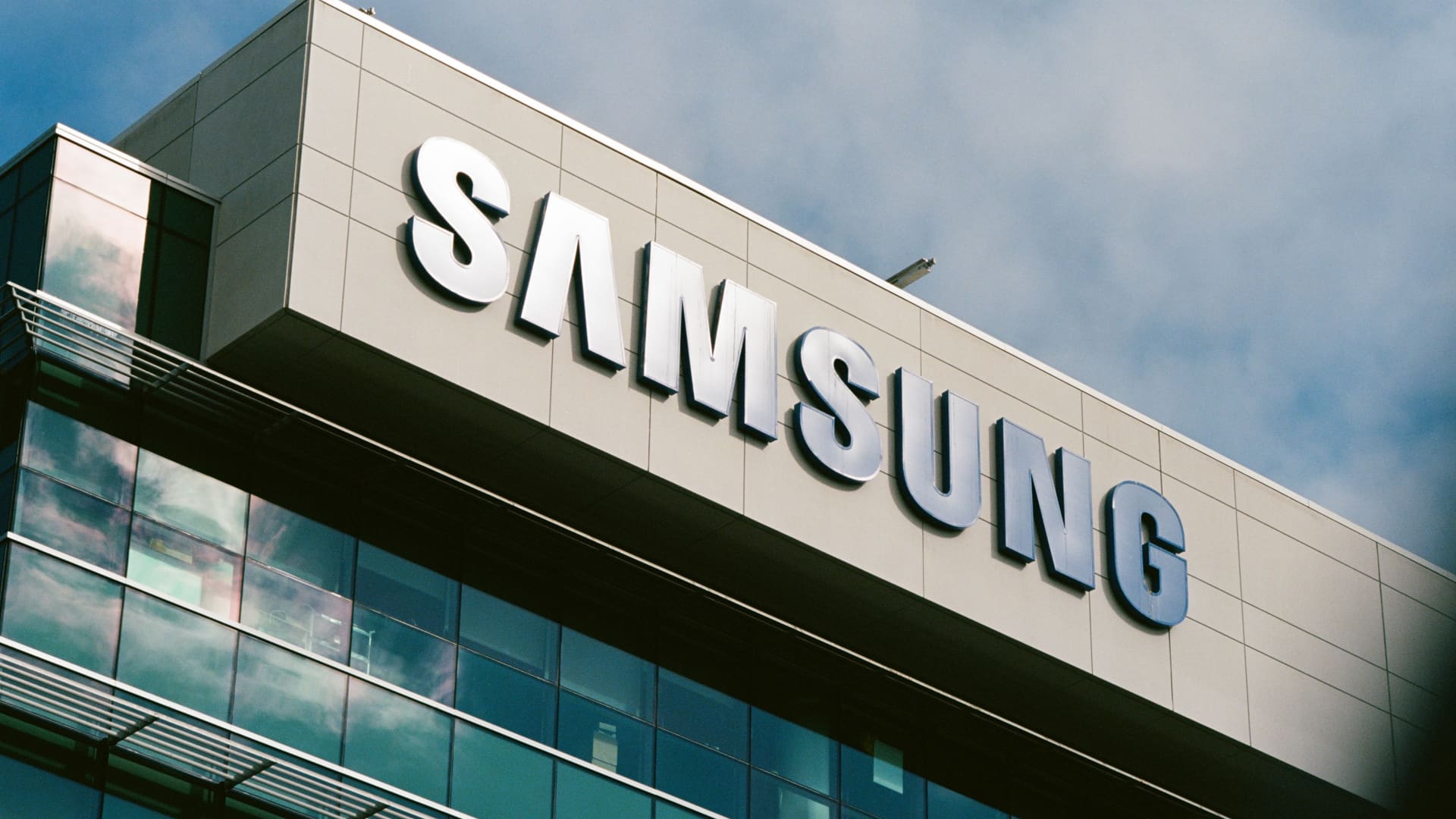
A close-up of the Samsung logo at a research building in Silicon Valley, Mountain View, California, October 28, 2018.
Smith Collection/Gado | Archive Photos | Getty Images
Samsung Electronics on Thursday reported that its first-quarter operating profit rose more than eight times, setting a new record and beating analysts’ expectations for explosive growth in its chip business.
Below is a comparison of Samsung’s first quarter results with LSEG SmartEstimate, which emphasizes more consistently accurate analyst forecasts.
Revenue: 133.9 trillion Korean won ($89.96 billion) vs. 132.69 trillion won Expected operating profit: 57.2 trillion won vs. 55.28 trillion won expected
The South Korean tech giant’s quarterly profit rose more than 750% year-on-year, setting a new record. The company also posted record revenue, up nearly 70% year over year.
This profit was in line with Samsung’s own forecast of 57.2 trillion won and exceeded the full-year 2025 profit of 43.6 trillion won.
The revenue extends the momentum from the final quarter of last year, when Samsung surpassed the record 17.6 trillion won set in the third quarter of 2018.
Samsung’s record profits were driven by a strong chip business. In addition to its smartphone business and semiconductor foundry services, the company is also a major manufacturer of memory chips.
The company’s chip division has emerged as a big beneficiary of the global AI data center boom, which has limited supply and soared prices for memory chips used in data centers and electronic devices such as smartphones, PCs and game consoles.
The strong quarter also came as Samsung continues to expand its high-bandwidth memory (HBM) business, a key component of AI data center chips.
Samsung said in its earnings report that it expects demand for server memory to remain strong in the second half of the year as hyperscalers continue to support AI deployment and demand for agent AI accelerates.
“We expect the next quarter to be better than the first quarter, thanks to a strong economy driven by rising memory prices, and we expect 2026 to be Samsung’s best year yet,” said Jeongku Choi, research analyst at Counterpoint Research.
“Memory is firmly establishing itself as a determining factor in the success or failure of AI infrastructure,” Choi added.
Samsung’s stock price rose about 1% in South Korea after the announcement of its financial results, but it pared that increase in afternoon trading and closed 2.43% lower. The company’s stock price has increased about 90% since the beginning of the year.
chip strength
Samsung’s chip business, also known as the DS (Device Solutions) division, includes memory chips, semiconductor design, and foundry business units.
The segment’s operating profit in the first quarter was 53.7 trillion Korean won, compared to just about 1 trillion Korean won in the same period last year. These gains accounted for more than 90% of the company’s total revenue for the quarter.
Counterpoint Research’s Choi pointed out that Samsung’s operating profit margin in the first quarter exceeded 70%, exceeding the operating profit margin of other semiconductor giants. Nvidia and TSMC The latest quarter is no different, as prices continue to rise due to memory shortages.
Samsung executives said during an earnings call Thursday that the company’s available memory supply is still expected to be significantly lower than customer demand.
“Our demand sufficiency ratio is currently at a record low and, unlike in previous years, customers concerned about supply shortages are actually bringing forward demand to 2027,” he said, adding that the supply-demand gap is expected to widen further in 2027.
high bandwidth memory
Although Samsung’s sales of high-bandwidth memory helped boost its profit margins, it also faces stiff competition in the HBM space after ceding an early lead to rival SK Hynix.
Samsung is racing to catch up with SK Hynix in the lucrative technology, announcing in February that it had mass-produced the world’s first HBM4 memory chips and shipped them to an anonymous customer.
HBM4 is the sixth generation of HBM technology and the most advanced version to date. It is expected to be the primary AI memory chip used in Nvidia’s next-generation Vera Rubin architecture, designed for powerful AI workloads in data centers.
SK Hynix first announced in March of last year that it was sending samples of HBM4 to customers, and announced in September that it was ready for mass production of HBM4. However, the company has not yet announced commercial shipments of HBM4.
“Samsung has made improvements with HBM4, and the gap with SK Hynix has narrowed compared to the previous generation HBM,” said Ray Wang, an analyst at Semi-Analysis who leads the company’s memory coverage from Seoul.
“Yet, we continue to see SK Hynix taking the lead in the HBM competition with its peers,” he added.
SK Hynix continued to lead HBM with a 57% revenue market share in the final quarter of last year, according to data from Counterpoint Research.
Headwind?
Samsung’s chip business is expected to continue to benefit from rising memory prices, but this trend could negatively impact other business segments.
Rising prices for memory chips, which are widely used in home appliances, are expected to put pressure on Samsung’s smartphone and home appliance businesses.
Meanwhile, the company said in an earnings call Thursday that it will continue to monitor the Middle East conflict, which poses risks to Samsung’s raw materials and energy supply chain.
