

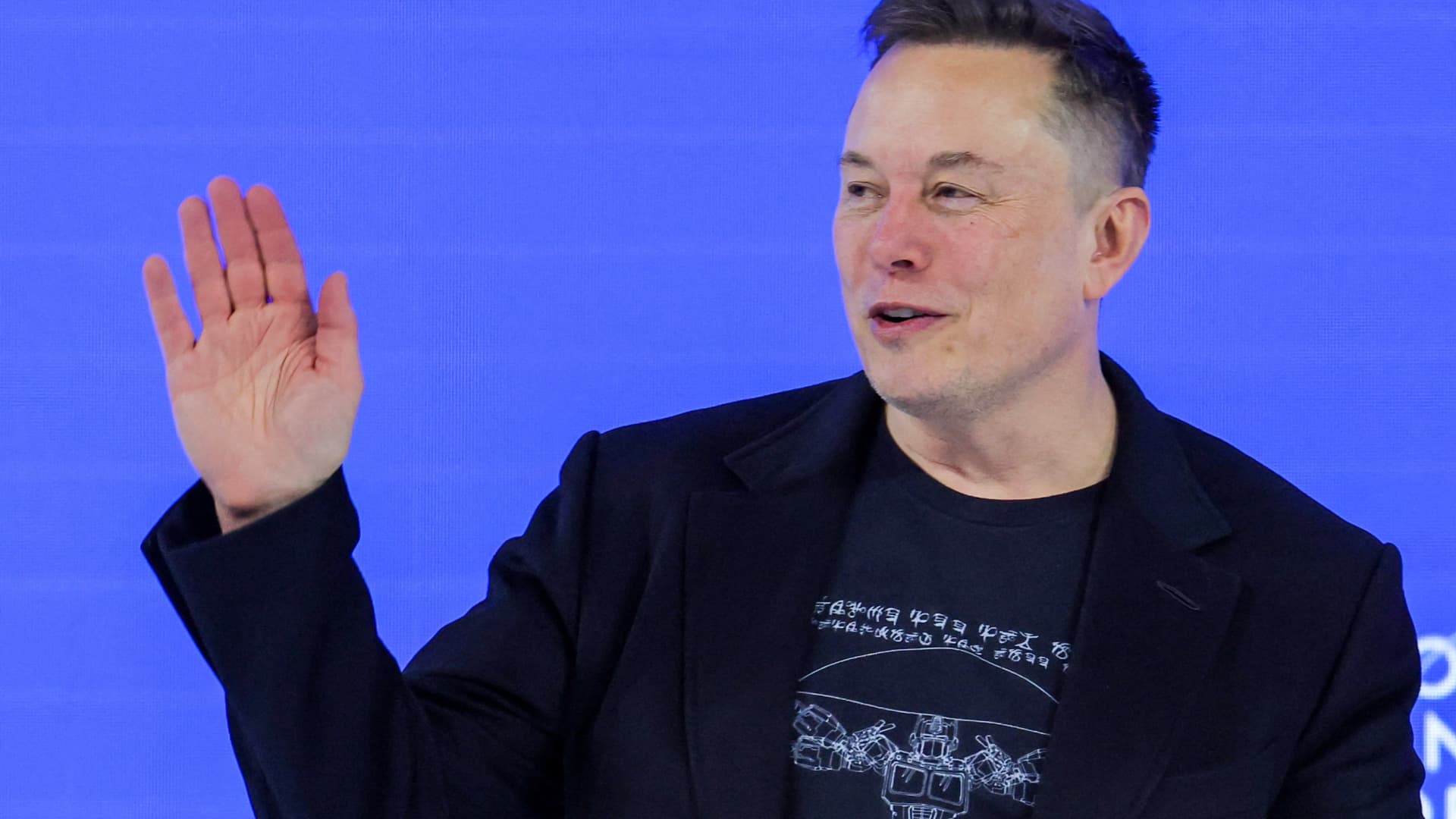
Elon Musk waves to the crowd at the 56th World Economic Forum (WEF) Annual Meeting in Davos, Switzerland, January 22, 2026.
Dennis Bariboos | Reuters
tesla reported first-quarter results Wednesday that beat analysts’ expectations, even though sales were lower than expected.
The stock initially rose about 4% in after-hours trading, but gave up its gains after the company announced in its earnings conference that spending this year would be $5 billion more than previously expected.
Here’s how the company performed compared to the expectations of analysts surveyed by LSEG:
Earnings per share: 41 cents adjusted, 37 cents expected; Revenue: $22.39 billion, $22.64 billion expected.
Tesla stock has underperformed all of its megacap peers so far this year, down 14% as of Wednesday’s close. The company’s core automobile business continues to struggle with competitors around the world such as China’s BYD and Xiaomi.
Tesla’s revenue for the quarter rose 16% from $19.3 billion a year earlier, according to its earnings report. Automotive sales also increased 16% to $16.2 billion from $14 billion in the same period last year. Tesla confirmed in its financial results that it plans “more affordable trims” for its Model Y SUV and Model 3 sedan.
The past year has been a challenge as Tesla’s aging electric vehicle lineup has been challenged by rivals offering high-tech but lower-priced models. Tesla also faces continued consumer backlash over CEO Elon Musk’s collaboration with the Trump administration, his inflammatory political rhetoric and support for far-right politicians.
Tesla reported earlier this month that it delivered 358,023 vehicles in the first quarter, down from the previous quarter and up about 6% from a year ago. Tesla has recorded annual sales declines for the past two years, and the year-ago decline was partially due to “several weeks of lost production” as the company upgraded its Model Y factory line.
Net income increased to $477 million, or 13 cents per share, from $409 million, or 12 cents per share, in the year-ago period.
Excluding environmental regulatory credit sales, Tesla’s auto gross margin was 19.2%, higher than any quarter last year. The company said higher average selling prices and “lower average cost per vehicle due to lower material costs” contributed to margins.
What the company described in its shareholder materials as “one-time benefits” related to tariffs and car warranties also boosted profits. In February, the Supreme Court struck down most of President Donald Trump’s far-reaching tariff policies, and companies are now seeking refunds from the federal government. Chief Financial Officer Vaibhav Taneja said in an earnings call that the company has not benefited from the Supreme Court’s ruling.
Capital spending for the quarter was $2.49 billion, an increase of 67% from $1.49 billion in the same period last year. Capital spending this year will be more than $25 billion, higher than last quarter’s forecast of $20 billion for 2026, Taneja said on the conference call. This is up from $8.6 billion in 2025.
In its energy division, which sells solar power equipment and various battery energy storage systems, Tesla reported revenue of $2.41 billion in the quarter, down 12% from $2.73 billion a year earlier.
Musk is trying to change the landscape around his company by focusing on self-driving technology and humanoid robots. Tesla is testing a small number of self-driving cars on its ride-hailing service in Texas, but it still relies on EV sales for most of its revenue and has not yet sold any robotaxi-enabled vehicles.
Tesla announced in January that it would end production of the Model S and Model X and use its Fremont, California, factory to make the Optimus humanoid robot. The company announced Wednesday that “preparations for our first large-scale Optimus factory will begin soon in the second quarter,” with plans for a “first generation line” that will produce 1 million robots a year.
Musk has a history of setting ambitious goals for developing futuristic products and failing to meet them.
Musk said in an earnings call that older Tesla models equipped with Hardware 3 computers will not be able to use the company’s upcoming “unsupervised” FSD system. FSD systems are intended to allow cars to be driven unmanned or safely used without active human supervision.
The company said it would set up “discounted trade-ins” for cars with older hardware and allow customers to upgrade their cars’ computers and cameras to enable use of future self-driving systems.
Tesla will be the first of the $1 trillion tech companies to report results for the quarter. alphabet, Amazon, Meta and microsoft A report is expected next Wednesday, and the following day. apple.
This is breaking news. Please check back for the latest information.
WATCH: Tesla can only trade on hope for the future for so long, says Cramer
