

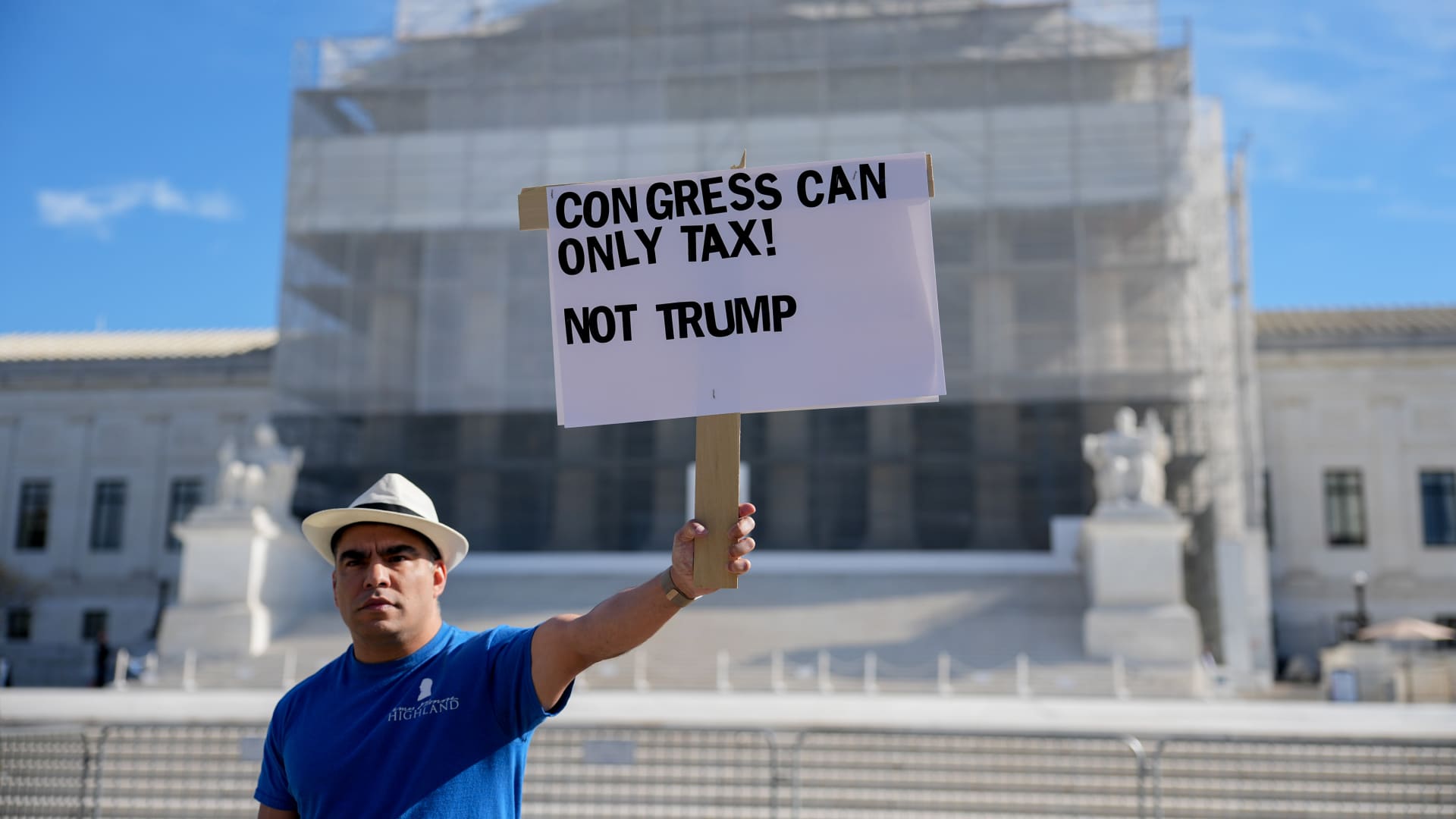
Wednesday’s Supreme Court tariff hearing marks the biggest legal and policy challenge for President Donald Trump’s administration, with potential economic fallout to follow. The market impact is complex. The U.S. Supreme Court heard arguments on whether the White House could flexibly exercise tariff authority under the International Emergency Economic Powers Act, which allows the president to regulate international commerce but does not specifically authorize tariffs. The impact is likely to be felt for months, as there is little expectation that the judge will rush to a decision. But speculation is already rife. Will the court completely overturn the tariff and force the government to issue rebates to importers who had to pay the tariff? Would that keep the levy in place and expand the executive branch’s authority over trade issues? Or will they find a compromise that keeps some tariffs in place and waives others, perhaps punitive tariffs targeting countries identified as fentanyl producers? Wall Street is bracing for fallout, with far-reaching effects expected, the extent of which is unknown. Judges questioned the legality of the tariffs during a hearing Wednesday. The legal developments pushed up stock prices and sold bonds, pushing up U.S. Treasury yields. “The court’s decision could have far-reaching implications for economic activity, inflation, Fed policy, interest rates and the dollar,” Bank of America economist Stephen Juneau said in a note. “Full or partial elimination of tariffs would have both positive and negative effects on growth in the short term.” At the same time, Trump administration officials argued that even if they lose in the Supreme Court, there are other legal provisions regarding tariffs that would apply. In that case, there will likely be winners and losers depending on how Trump moves forward. AI analytics firm Reflexivity said if President Trump loses, imported consumer goods, small businesses, construction and tech companies will be the winners, while domestic manufacturing will lag. If the president wins, Reflexivity believes protected industries such as steel and aluminum will win, as well as non-durable goods manufacturers. What happens next? Polymarket traders put the probability of tariffs in place at just 26%, raising further questions. The most important of these is whether the court will take the next step and force the government to refund the duties already paid. The United States collected approximately $195 billion in tariffs during fiscal year 2025, more than double the previous year’s total. Analysts have suggested the total amount returned could be close to $100 billion, or a percentage of total tariff collections from the Trump tariffs. “While we don’t see much legal argument for this approach, the general consensus is that SCOTUS can do whatever it wants and may want to avoid costly and chaotic refund procedures,” Wolfe Research wrote. “After all, SCOTUS rulings rarely cost taxpayers $100 billion.”The legal battle comes at a troubling time for investors, amid growing concerns about artificial intelligence-based market valuations. According to FactSet, the S&P 500’s forward P/E ratio is about 23 times, well above the average over the past five and 10 years. While a messy legal battle over tariffs would be unwelcome, the reality is that lifting them would provide both positive and negative impetus to economic growth. If rebates are ordered, they would further increase debt and deficit pressures at a time when the White House is pushing for a gradual decline in deficits through 2025. As a result, interest rates could rise as investors demand higher yields from holding U.S. Treasuries and the Federal Reserve becomes reluctant to cut rates further. “Uncertainty and abnormality are the two big keywords for 2025,” said Mitchell Goldberg, Head of Client First Strategy. “If the Supreme Court rules against the administration, I don’t think that’s the end of the road for tariff policy. It’s just another hurdle.”
