

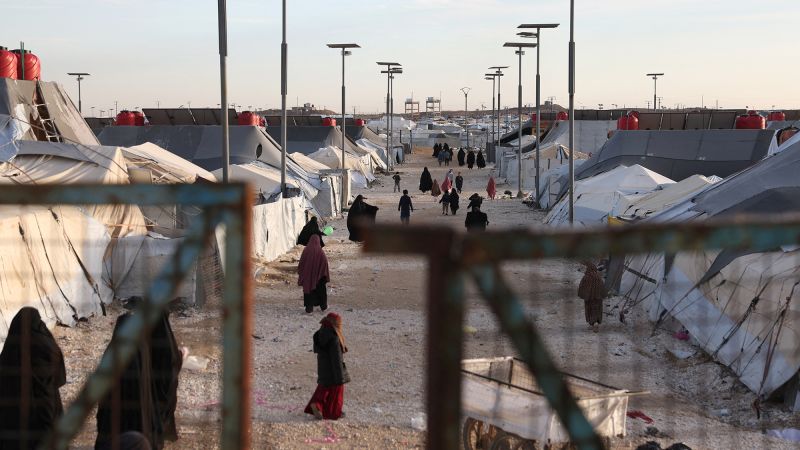
Syrian TV reported that there was a “mass flight” from Syria’s al-Hol camp housing ISIS-affiliated families last month after Kurdish forces withdrew, with reports saying thousands may have fled.
Interior Ministry spokesperson Noureddine Baba was quoted as saying that the Syrian Democratic Forces (SDF) withdrew from the camp without coordination with the Syrian government or the US-led coalition against ISIS.
In January, the SDF said it had withdrawn from al-Hol camp, citing “international apathy” toward ISIS and “the international community’s failure to meet its responsibility to address this serious problem.”
Baba said Syrian authorities had “identified more than 100 breaches in the perimeter wall of the camp that facilitated smuggling activities,” adding that the number of escapees needed to be verified.
An internal memo sent to European Union member states raised security concerns that thousands of people, the majority of the camp dwellers, may have escaped, Reuters reported and an EU official confirmed to CNN.
The memo said the situation of third-country nationals evacuated from Al-Hol camp “remains unclear.”
The Wall Street Journal reported, citing US intelligence, that between 15,000 and 20,000 people, including ISIS affiliates, are now on the run in the country after escaping from al-Hol camp. CNN has not verified this number.

According to the United Nations, more than 30,000 people are detained in Al-Hol camp.
Questions arose over the fate of thousands of Islamic State prisoners and their families in northeastern Syria last month after government forces seized control of part of the territory long held by Kurdish forces that guarded the prison.
At the time, detainees had previously escaped from al-Shadadi prison, which the SDF said held “thousands” of ISIS prisoners.
The SDF was a partner of the United States in Syria, but the U.S. withdrawal from the country in 2019 pushed the Kurdish group into a corner, especially after the fall of Bashar al-Assad’s regime in late 2024 and the rise of Syrian President Ahmad al-Sharah. The US-led coalition fighting ISIS in Syria has long relied on the SDF to guard ISIS prisons.
The SDF had accused the coalition of failing to intervene to stop the advance of government and allied forces.
ISIS emerged from the remnants of Al Qaeda in Iraq. At its peak, it ruled over a third of Syria, with Raqqa as its capital. In 2017, the SDF declared the “total liberation” of Raqqa and worked with the US-led coalition to retake the territory from ISIS.
The group was largely defeated in 2019, but some elements still operate covertly in Syria and Iraq. When Assad’s regime collapsed, several Middle Eastern countries and their Western allies warned that ISIS could take advantage of the chaos to stage a counterattack.
In November, Sharaa joined the US-led anti-ISIS coalition, and his forces continue to hunt for members of the group.
Pressure is mounting on Australia, the United States, Britain and other countries to repatriate thousands of citizens, mostly women and children, who have been held in Syrian concentration camps since the caliphate collapsed more than five years ago.
CNN previously reported that more than half of Al-Hol camp’s population are children, with the majority under the age of 12.
Last week, Australian Prime Minister Anthony Albanese said Australia would not repatriate its citizens with ties to Islamic State members. The comments follow reports that 34 Australian women and children were turned away by Syrian authorities after leaving the al-Rooj camp, where ISIS fighters and their families are being held.
Many governments are reluctant to repatriate their citizens, citing national security concerns or domestic opposition. Al Roy camp also houses London schoolgirl Shamima Begum, who fled at the age of 15 to join ISIS in 2015 and was subsequently stripped of her British citizenship.
