

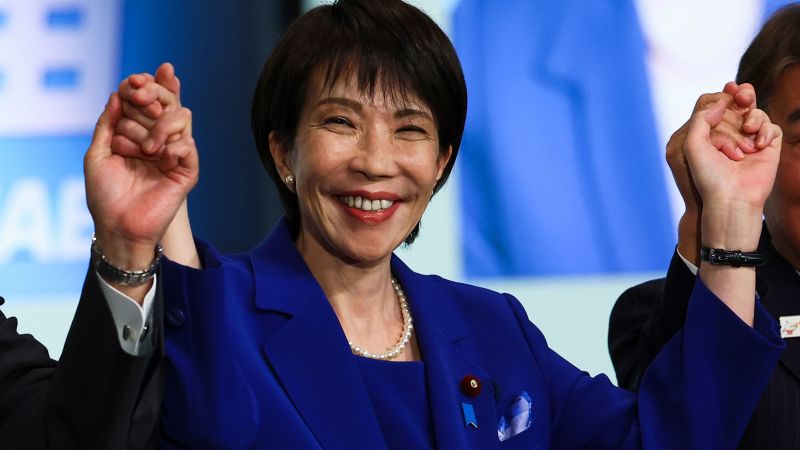
A staunch conservative politician with a penchant for heavy metal is set to make history on Tuesday as Japan’s first female prime minister.
Sanae Takaichi’s appointment to the position is a landmark moment for Japan, just days before US President Donald Trump’s visit to Asia. Historically, it is a country with deep-rooted patriarchy and strong gender norms, with politics and the workplace still dominated by older men.
On Monday night, Takaichi’s ruling party, the Liberal Democratic Party (LDP), which is conservative despite its name, formally aligned itself with the opposition party Nippon Ishin no Kai, all but paving the way for Takaichi to become prime minister.
She now needs to secure two more votes in the lower house when Japan’s parliament votes on a new prime minister on Tuesday afternoon.
Prime Minister Shigeru Ishiba announced his resignation, triggering a leadership election, and Takaichi was elected as Liberal Democratic Party president in early October.
Her election as leader over a more moderate candidate signals a shift to the right in the scandal-hit Liberal Democratic Party. It is trying to win back voters who have switched to new far-right parties after suffering crushing defeats in the past two parliamentary elections.
They chose a colorful character to take the helm. Photos of Takaichi from her younger days have been widely circulated on social media, particularly of her love of motorcycles (including the Kawasaki Z400GP she rode before becoming a member of parliament in 1993) and her passion for playing heavy metal drums (which she still indulges in at home when she’s stressed).
But she is also a die-hard conservative, which has alarmed more centrist party members. For example, she supports amending Japan’s pacifist constitution and frequently visits the controversial war shrine that lists the names of people convicted of war crimes during World War II. He also opposes the expansion of the movement to allow married couples to have separate surnames.
Some of these positions, such as her hawkish views on China, could complicate Japan’s regional relations. And in Japan, some are concerned about her economic proposals for big spending and tax cuts as the country struggles with soaring inflation and the cost of living.
If she is elected prime minister on Tuesday, tackling high prices will be one of her first tasks. For example, the price of rice, Japan’s staple food, has nearly doubled since last year.
Additionally, Japan faces the ever-present problems of a declining birthrate, a declining labor force, and a growing elderly population. Public opposition to mass immigration is growing. Then there’s the Trump administration and its whiplash of tariffs that shook Asian economies earlier this year.
Additionally, the Liberal Democratic Party faces its biggest crisis in decades, having been stripped of its majority in parliament under the Ishiba administration due to a political slush fund scandal, and faces the immense task of regaining public trust.
Normally, just being elected as leader of the ruling party was enough to secure the position of prime minister. However, Takaichi’s path to power was complicated. Already having to find new ways to secure a majority, Komeito, the LDP’s coalition partner for 26 years, abruptly severed its alliance with the party when the LDP won the leadership election.
Her party’s new political alliance, Nippon Ishin, shares some of her conservative values, such as tougher immigration controls, and has pledged to reduce the number of MPs by 10% as part of the coalition agreement. However, the Japan Restoration has other aspirations, such as making Osaka, its local power base, Japan’s second capital.
Takaichi’s party hopes she will be the answer to her recent unpopularity. But with a revolving door of prime ministers that have cycled through four leaders over the past five years, Japan’s so-called “Iron Lady” will need to deliver results quickly to remain in power.
